Python coding platforms make it easier to learn programming without spending hours configuring software or searching for disconnected tutorials. The best platforms let you write Python code, practice concepts, receive feedback, build projects, and gradually move from beginner exercises to real-world development.
But there isn’t one perfect platform for everyone. A complete beginner may need guided lessons and instant feedback, while an aspiring developer may care more about projects, algorithms, Git, and portfolio building.
This guide compares some of the best Python coding platforms in 2026 so you can choose one based on your goals, experience, and budget.
What Is a Python Coding Platform?

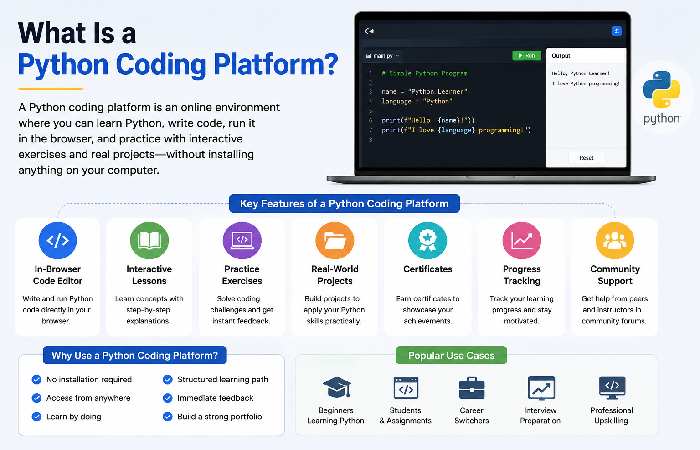
A Python coding platform is a place to learn or practice Python. They are mostly a type of website that provide an interactive practice or learning experience such as: you can write and run the python codes directly on the browser. The features include;Interactive Python exercises, Quizzes and assessments, Real-world projects, AI-assisted explanations or feedback. It is important that in this style of learning programs, real-coding is carried out so much that is the thing a beginners must be learning.
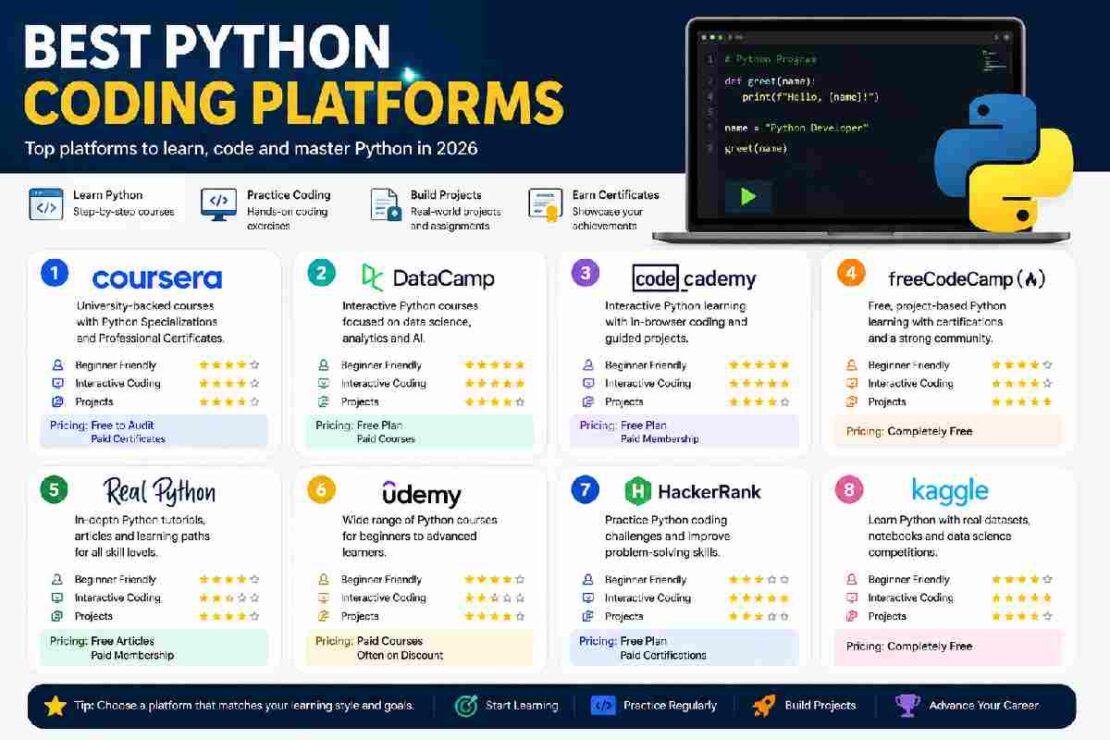
Best Python Coding Platforms at a Glance
| Platform | Best For | Beginner Friendly | Hands-On Practice | Projects | Cost |
|---|---|---|---|---|---|
| Codecademy | Guided interactive learning | ★★★★★ | ★★★★★ | ★★★★☆ | Free + paid |
| DataCamp | Interactive learning & data | ★★★★★ | ★★★★★ | ★★★★☆ | Free start + paid |
| freeCodeCamp | Free structured learning | ★★★★☆ | ★★★★☆ | ★★★★★ | Free |
| Coursera | Structured courses & certificates | ★★★★☆ | ★★★★☆ | ★★★★☆ | Free trial + paid |
| Real Python | In-depth Python learning | ★★★★☆ | ★★★★☆ | ★★★★☆ | Free + membership |
| HackerRank | Coding practice | ★★★★☆ | ★★★★★ | ★★★☆☆ | Free + paid |
| LeetCode | Algorithms & interviews | ★★★☆☆ | ★★★★★ | ★★☆☆☆ | Free + paid |
| Kaggle | Data science practice | ★★★★☆ | ★★★★★ | ★★★★★ | Free |
Editorial comparison based on platform features and learning use cases available in 2026; pricing and plans can change.
1. Codecademy – Best for Guided Interactive Learning
Codecademy is one of the most viable options when starting out your Python journey and want to code in a browser. Instead of separating instructional lessons from hands-on, you will code through a concept, and then, practice immediately. Which might be helpful if you really are from ground zero and need some guidance to organize scattered YouTube lessons and documentation.
Best for: Beginners who have zero experience and need step by step guidance.
Why it is special: Interactivecoding exercisesStructuredlearning path. Explanations easy enough for a beginner to understandCode- it, and practice it. You can keep a check of your progress. Why learn It: Perhaps the biggest upside to Codecademy is that the program guides you from one lesson to another in a seamless fashion.
No need to pick another topic every now and then.
2. DataCamp – Best for Interactive Python and Data Skills
DataCamp has also gotten extremely robust for those looking to link Python up with data science, AI, and data-related skills. The site connects Python classes with snippets of theory with lots of practice in the browser itself. DataCamp’s 2026 compares courses based on affordability, depth of practice, instructor excellence, and learner’s result.
There’s an Introduction to Python for those who want the most basic knowledge including variables, data types, list manipulation, packages, and of course basic NumPy concepts.
Best for: Beginners, aspiring data scientists, and analysts.
Why choose it:
- Interactive exercises
- Python learning paths
- Data-focused courses
- Short lessons
- Practice without local setup
DataCamp is especially attractive if your long-term goal is Python for data analysis or machine learning rather than general software development.
3. freeCodeCamp – Best Free Python Learning Option
However, if you’re the most Budget conscious, it should be pretty high on your list too. It’s learning model that puts a lot emphasis on actually coding or build. That distinguishes itself from some of platforms that primarily teach through recorded video or quick quizzes. What freecodecamp best suited for Best for learners seeking an affordable self guided program 7 why pick this resource It offers a wide array of of useful free learning resources It focuses on the benefits of learning by actually coding or practicing on projects it boasts and impressive learning community Offers tons of real – world coding practice Expands your portfolio What You Sacrifice when You use a free program is that if you’d like to have a guiding hand with you from the start of any learning journey, and it make the decision a little of tougher.
4. Coursera – Best for Structured Courses and Certificates
Coursera will be beneficial if you wish to take formal courses from universities and tech companies.
It’s course catalog for Python offers: courses from beginners level and a certificate of professionality from different institution and tech companies like IBM, Google, Microsoft, University of Michigan among others. As an example, ‘Python for Everybody’ which comes from University of Michigan is cited as beginner specialization course, and ‘Crash Course on Python’ as it comes from Google also is listed as beginning course.
Good for: Students and Professionals looking for certified courses structure.
Why choose it:
- University-backed courses
- Professional certificates
- Beginner-friendly options
- Career-oriented programs
- Courses covering Python, data, AI, and development
Coursera is a better fit when credentials and structured coursework matter as much as coding practice.
5. Real Python – Best for Deep Python Knowledge
Real Python is particularly useful once you want to move beyond basic syntax.
Its content covers Python concepts, tools, libraries, development environments, and practical programming topics. Its code-editor course, for example, includes lessons on choosing an environment, running code, debugging, and optimizing a development setup.
Best for: Learners who want detailed Python explanations and practical reference material.
Why choose it:
- In-depth tutorials
- Practical Python examples
- Expert-oriented explanations
- Courses and written resources
- Useful reference material
It works particularly well as a companion resource when you’re building projects and encounter a Python concept you don’t fully understand.
6. HackerRank – Best for Coding Practice
Rather than course-based, HackerRank is primarily practice-based. You are provided with coding problems that you are required to solve in an online editor, with instant feedback automatically graded for you. The HackerRank Python problems are concerned with strings, collections, regex, along with other topics.
Recommended for: Programmers with a preliminary background on the basic Python, who want more practice. Once a student finishes a beginner course, HackerRank may prove to be the place to translate abstract notions into computational competencies.
7. LeetCode – Best for Python Interview Preparation
LeetCode is best for learners past the total beginner stage. LeetCode’s Python curriculum involves data structures, algorithms, strings, trees, dynamic programming, and other software interview topics. Best For: Learners who are moving on from beginner and are getting ready for software engineering jobs. Avoid: Beginners who have never coded in Python before-If you’re still shaky on understanding loops, functions, lists, and dictionaries, you will probably find the problem sets on LeetCode way more intimidating than they actually have to be.
8. Kaggle – Best for Python Data Science Practice
Kaggle is a good option if you plan to use the learning to solve actual data and real world problems through python code:
The Kaggle learning is especialy usefull to who aim for data science and machine learning application. Presenting as an extra 2026 comparisons is showing free micro-courses and notebooks in relation of Kaggle usage.
Perfect for: Individuals seeking data analysis, machine learning and A.I understanding.
The advantage is clear. Instead of working alone on exercises of coding, there is possibility to learn using python code on data, usingnotebooks.
Which Python Coding Platform Should Beginners Choose?
Your choice should depend on what you want to achieve.
Choose Codecademy if:
You want a guided, interactive introduction and prefer learning one concept at a time.
Choose DataCamp if:
You want interactive Python lessons and expect to move into data analysis, AI, or data science.
Choose freeCodeCamp if:
You want to learn without paying and are comfortable being more independent.
Choose Coursera if:
You want structured courses, recognized organizations, and certificates.
Choose Real Python if:
You want detailed explanations and practical Python knowledge.
Choose HackerRank or LeetCode if:
You already understand Python fundamentals and want to strengthen problem-solving or prepare for technical interviews.
Choose Kaggle if:
Your goal is Python for data science and machine learning.
A Simple Way to Compare Python Platforms
Think of your learning journey as four stages:
Learn → Practice → Build → Apply
A good beginner might start with an interactive platform such as Codecademy or DataCamp, reinforce the fundamentals through free practice resources, then move to projects and finally use platforms such as HackerRank, LeetCode, or Kaggle for specialized practice.
This approach is more effective than trying to complete five different Python courses at the same time.
How to Choose the Best Python Coding Platform
Before creating an account, ask these five questions:
1. Can I write code while learning?
Look for an actual coding environment, not just videos.
2. Does it match my level?
A beginner should not start with an advanced interview platform.
3. Does it teach what I actually need?
Python for web development is different from Python for data science.
4. Can I build projects?
Projects turn lessons into skills and give you material for a portfolio.
5. Is the pricing sustainable?
A platform is only useful if you can continue using it long enough to make progress.
Common Problems Beginners Face
“I understand Python tutorials, but I can’t write code.”
Spend less time watching and more time solving small exercises. Try writing a solution before looking at the answer.
“Coding challenges are too difficult.”
Move back to beginner exercises. Practice variables, conditions, loops, functions, lists, dictionaries, and simple problem-solving before attempting advanced algorithm questions.
“I keep switching between platforms.”
Pick one primary platform for your learning path and use other websites only as supporting resources.
“I don’t know what to build.”
Start small. A calculator, number guessing game, expense tracker, quiz application, or simple file organizer can teach more than another beginner course.
FAQ
What are Python coding platforms?
Python coding platforms are Websites oronline learning spaceswhere you can learn and rehearse Python using instructional lessons, exercises, problem-solving challenges, development work, as well as interactive environments.
The Finest Python coding system for new clients is?
For learners that like a led, intuitive method to understanding, Codecademy as well as DataCamp are excellent alternatives.
For those that like discovering in a free, project-centric style, freeCodeCamp is another excellent selection.
Can I learn Python online without Python installation?
Yes. A great deal of online Python coding websites supply the capability to code and execute Python in the internet browser, so you do not need to mount anything on your local system to begin learning.
Which is the very best Python platform to rehearse coding?
For practicing problem-solving, HackerRank or LeetCode are prominent options. To practice data-oriented Python, Kaggle is a wonderful resource to investigate.
Are there free Python coding platforms?
Yes.freeCodeCampas well asKagglea are both 100% totally free to make use of for learning Python as well as working on initiatives. A lot of coding-practice websites will certainly likewise give a ton of free difficulties. Some paid systems will certainly have free lessons, trials or a limited cost-free account choice.
How much time does it take to discover Python?
This varies, but typically, discovering Python typically takes regarding 2 to 3 months with consistent study and also technique to come to be fluent in the language as well as comfortable coding genuine applications.
Final Thoughts
Don’t get swayed by the size of the course catalog. The best Python learning platforms are the ones where you actively code consistently and that align with your specific goal. Interactive platforms like Codecademy and DataCamp make the initial steps less daunting for beginners.
While freeCodeCamp is the clear winner if you need a free path forward, Coursera’s robust selection of courses and certifications fit well too.
After getting the basics down, you may want to consider more job-ready tools like HackerRank, LeetCode, Real Python, and Kaggle for interviewing or data-driven work. Bottom Line: All you need to do is pick one and go!
.