
Last Updated: September 16, 2026
Searching for a neural network tutorial? You’re likely wondering how a computer is able to learn from data without having to do any heavy mathematics. Artificial neural networks may seem a little intimidating at first, but in essence they are nothing more than a collection of artificial neurons that are connected to each other and modify themselves based on what they find.
After you have seen how the individual building blocks operate, you can leverage frameworks such as PyTorch and Tensor Flow to create your own!
What Is a Neural Network?
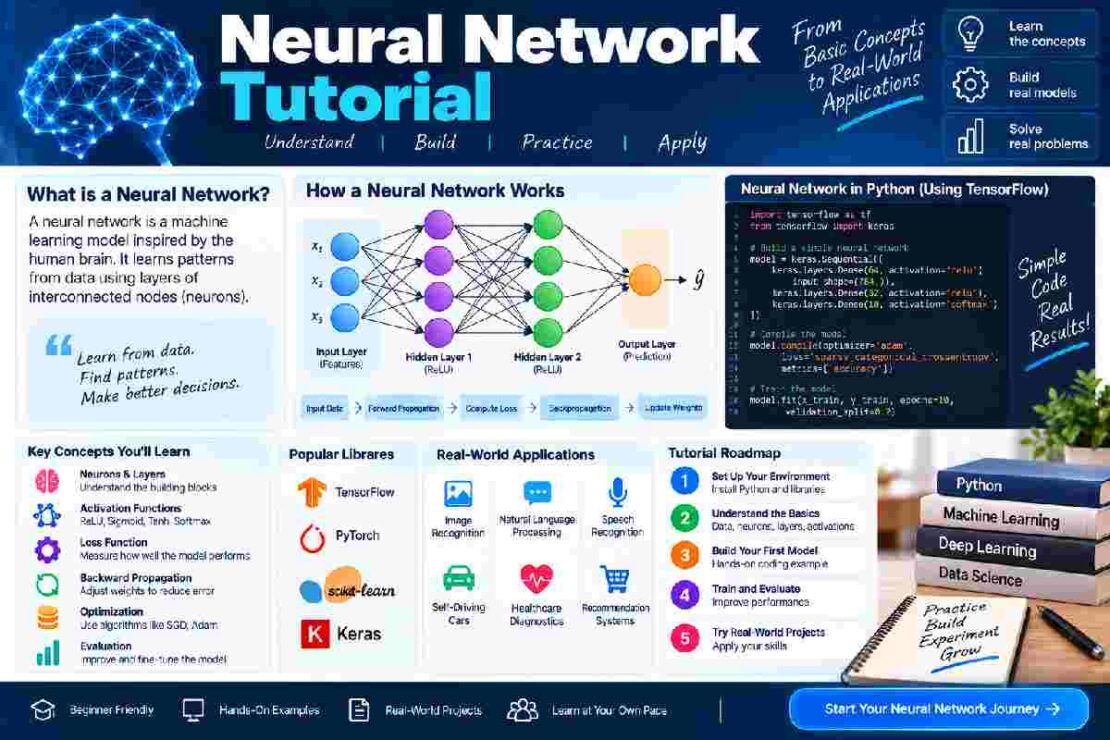
A neural network is a machine-learning model consisting of multiple layers of interconnected neurons loosely inspired by the way biological neurons work. A simple neural network typically consists of:
Input layer (receives the data)
Hidden layers (processes and combines it)
Output layer (returns the prediction)
The network learns by adjusting the weights of the connections.
If you’re training a number recognition model, for example, a neural network will learn patterns of pixels that distinguish a 3 from an 8.
How a Neural Network Learns
The learning process can be explained step-by-step:
Data is fed through the network, a process called forward propagation.
A prediction is generated and compared with the expected result using a loss function.
The connection weights are updated to improve the prediction, a step called backpropagation.
The process begins again:
Input prediction loss backpropagation weight update
The weights are updated repeatedly during training, causing the model to extract patterns from the data.
Important Concepts in Neural Networks
If you’re working through a neural network tutorial for beginners, focus first on these concepts.
Activation Functions
Activation functions control how information flows through an individual neuron. The rectified linear unit (ReLU) activation function is popular for hidden layers because it is simple and effective in many neural network designs.
Loss Functions
A loss function measures how close the model’s output is to the actual answer. The training process tries to reduce this loss.
Optimizers
An optimizer makes updates to the model’s weights during training. SGD and Adam are common optimizers.
Training and Testing Data
Models should not just memorize the training data. Separating your data into training and testing sets helps you see whether it generalizes well to new examples.
Where Should a Beginner Use PyTorch?
Where Should They Use Tensor Flow / Keras? Where Should They Use NumPy? Where Should They Use Google Colab?
Common Beginner Problems
One common mistake is focusing only on getting a high accuracy score. A model can perform well on training data while struggling with new data.
Another mistake is changing several settings at once. If you adjust the learning rate, architecture, dataset, and optimizer simultaneously, it becomes difficult to understand what actually improved the model.
Start with small experiments and change one thing at a time.
Final Thoughts
After you’ve got a new neural network broken down into pieces, you should be able to comprehend how it works. Bringing to the front, implementation details such as those, those degrees, and loss, training and optimizing ideas before you get to high-level framework will let you view that can help you know how it will be adapted by you to suit your needs. Neural network tutorials which will start by undertaking a project such as classifying MNIST pictures should show you the paths out of raw information through the degrees and backpropagation. With practice that is regular you’ll graduate coming from a basic tutorial about neural network to constructing out simple deep learning data files for photos, text as well as other data files that are real-world.