
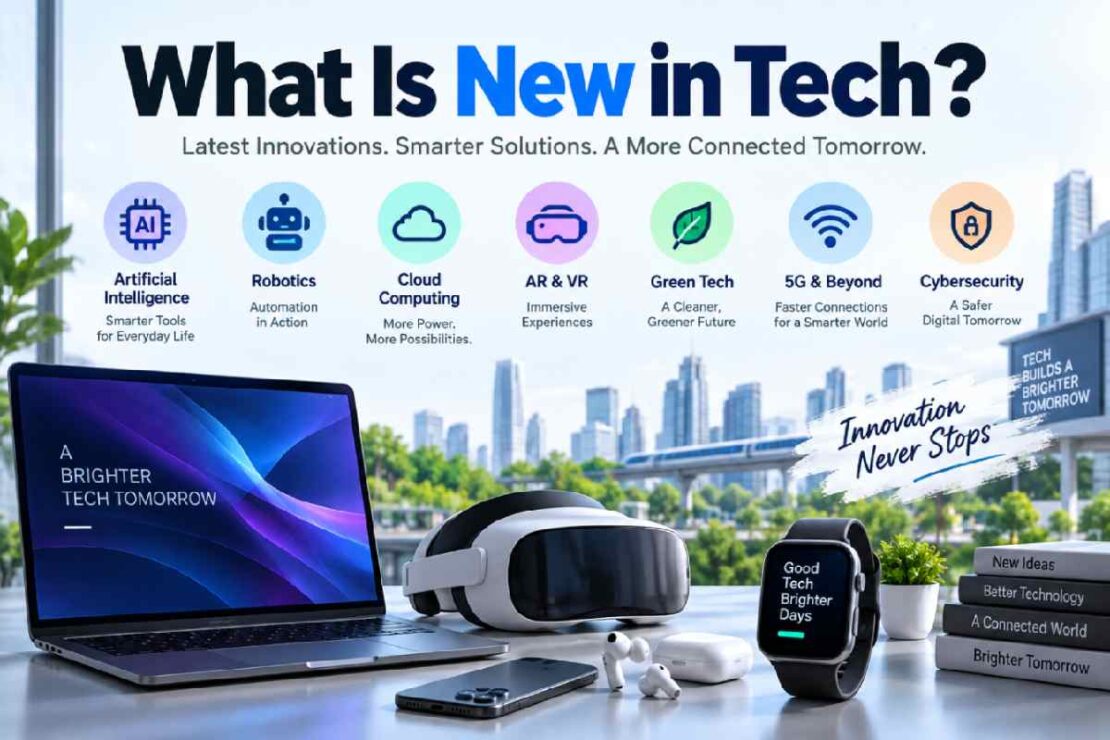
The tech world is progressing at an unprecedented rate and it can be hard to tell what is really new and what’s simply a relaunch of an existing concept. So, what are the latest in tech that 2026 has to offer? There’s much more than new iPhones, laptops, and new apps.
AI systems are doing more; robotics is looking less like a future aspiration and more like a daily utility; cybersecurity is becoming just that: cybersecurity by AI; and companies are pouring investments into infrastructure that caters to contemporary AI tasks.
Other emerging technology areas are as follows. Further Technologies Edging.
What Is the New in Tech Meaning? What Are the Biggest Technology Trends 2026? What Are Some Examples?
What Are the Benefits?
What Are the Limits? What Is It All About and What Do I Need to Know?
What Does New in Tech Mean?
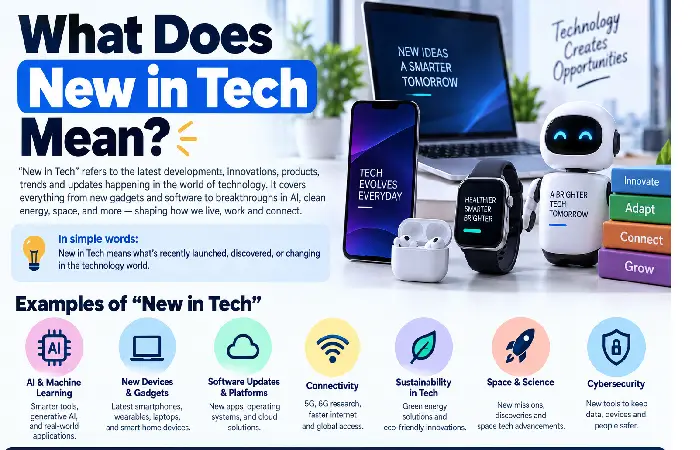
New in tech can mean many things.
It may refer to new, emerging or inventive technology or it may refer to an existing major technology innovation.
Take these examples of artificial intelligence. Conventional artificial intelligence is not new, but the use cases of generative AI, multimodal AI, and AI agents are some of the newer use cases.
The phrase new in tech can refer to several different things.
It can describe a technology that has recently been invented, a major improvement to an existing technology, or an emerging technology that is beginning to gain practical adoption.
For example, artificial intelligence is not a new invention. However, the capabilities of modern generative AI, multimodal AI, and AI agents represent significant developments in how AI can be used.
New Technology vs Emerging Technology
These terms are often used interchangeably, but there is a difference.
| Type | Meaning | Example |
|---|---|---|
| New technology | Recently introduced or significantly improved | New AI-powered software |
| Emerging technology | Still developing and gaining adoption | Quantum computing |
| Mature technology with new capabilities | Existing technology undergoing major change | AI-focused cloud infrastructure |
A technology does not have to be invented this year to be considered new in tech. A major improvement in capability, accessibility, cost, or adoption can make an established technology newly important.
Why Is Technology Changing So Fast in 2026?
Several factors are accelerating technological development.
Artificial Intelligence Is Becoming a General-Purpose Technology
ChatGPT’s impact A billion dollar brand for all? We’ll wait. All of this may be only the beginning of a much longer term.
Computing Infrastructure Is Evolving
Modern AI workloads require a lot of compute, memory, networking, storage and energy. This is leading to the need for dedicated infrastructure.
Companies Are Transitioning From AI Proofs of Concept to Real Use Cases
Firms also now want to deploy AI to solve real business issues, as opposed to trialing AI demos.
Hardware and Software Are Converging
Physical technologies are being assembled from robotics, sensors, AI models, connected devices, and automation.
Security Is Becoming More Important
As more systems become connected and AI-enabled, privacy, cybersecurity, identity, governance, and digital trust are becoming essential parts of technology development.
What Are the Biggest New Technology Trends in 2026?
Major technology areas to look for in 2026 Following are some of the key technology areas to watch for in 2026 as consumers, developers, businesses and researchers continue their journey to fulfill the promises of technologies.
1. Agentic AI
Agentic AI is one of the most promising breakthroughs happening now.
Normal AI tools would give an output or result for a prompt or a request. AI agents will extend this by ability to plan for a task, use tools, retrieve information and act for the specific goal.
For example, agents may instead get a hint on how to resolve a customer issue, rather than having a virtual assistant provide a complete solution. Agents could do things like probe an issue, look up data, submit a support case and escalate when needed.
Where Is Agentic AI Used?
Common applications include:
- Customer support
- Software development
- Research
- IT operations
- Sales
- Marketing
- Data analysis
- Document processing
- Business automation
What Are the Benefits of Agentic AI?
Agentic AI supports companies in automating routine tasks, eliminating labor-intensive processes, and linking a series of activities into a single flow.
But autonomous systems may also make wrong decisions. Permissions, observation, testing, and human control are still relevant.
2. Multimodal Generative AI
Generative AI is moving beyond text.
Modern AI systems can work with combinations of text, images, audio, video, documents, and code.
This is known as multimodal AI.
Examples of Multimodal AI
Multimodal systems can be used for:
- Image analysis
- Voice assistants
- Video understanding
- Document analysis
- AI coding
- Creative work
- Accessibility
- Customer service
The importance of multimodal AI comes from the fact that real-world information exists in many formats rather than text alone.
3. Multiagent AI Systems
Instead of asking one AI system to handle an entire workflow, organizations can use multiple specialized agents.
For example:
Research agent → Analysis agent → Writing agent → Verification agent
Each agent can focus on a particular task.
Why Are Multiagent Systems Important?
They can divide complex workflows into smaller jobs and allow specialized AI systems to cooperate.
This approach is particularly relevant to business automation, research, software development, and data processing.
4. Domain-Specific AI Models
Another vital development has been the proliferation of AI models targeting specific sectors or specific tasks.
Rather than relying solely on Generic-AI organizations can utilise task-specific models for:
Finance
Healthcare
Legal services
Manufacturing
Cybersecurity
Customer support
Scientific research
Why Use a Specialized AI Model?
A suitable model for the purpose might enhance performance, while possibly minimizing superfluous processing and enhancing control over business requirements.
The correct model is based on the use case, not on how big the model is.
5. AI-Native Software Development
AI is changing how developers build software.
Developers can use AI tools to assist with:
- Writing code
- Explaining code
- Debugging
- Testing
- Documentation
- Refactoring
- Prototyping
- Understanding unfamiliar code
Does AI Replace Software Developers?
Software development is a mixture of art, science, and creation. Even if AI is used to speed up some of the development work, human developers are necessary.
Devs has to have an understanding of architecture, security, testing, requriments, performance & business logic.
The bottom line is that the most tangible shift is developers now more and more can merge conventional engineering expertise with the enhancement of AI.
6. AI Infrastructure and Specialized Computing
The growth of AI is creating demand for powerful computing infrastructure.
This includes:
- GPUs
- AI accelerators
- CPUs
- High-speed networking
- Storage
- Cloud platforms
- Data centers
- Advanced cooling systems
Why Does AI Infrastructure Matter?
AI applications depend on infrastructure that can process large amounts of data efficiently.
As AI workloads increase, companies need to consider computing performance, energy consumption, networking, storage, and cost.
7. AI-Powered Cybersecurity
Artificial intelligence is changing cybersecurity.
Security teams can apply AI to review millions of events, detect patterns that don’t look right, prioritize alerts, and aid in root cause analysis.
Meanwhile, an attacker can also use AI.
How Can AI Help Cybersecurity?
AI can assist with:
Threat detection
Fraud detection
Anomaly detection
Security monitoring
Incident investigation
Alert prioritization
What Are the Risks?
•AI may be used to further increase the sophistication of phishing, social engineering, automated attacks and others.
This is where enterprises will need a security strategy that is robust enough to handle both AI-based defence, as well as the AI-enabled
.
8. Robotics and Physical AI
AI is increasingly moving from digital environments into the physical world.
Robotics combines artificial intelligence with hardware, sensors, software, and mechanical systems.
Applications include:
- Manufacturing
- Warehouses
- Agriculture
- Logistics
- Healthcare
- Autonomous systems
- Humanoid robotics
What Is Physical AI?
Physical AI refers broadly to intelligent systems that can perceive and interact with the physical environment.
Unlike a chatbot that only produces information on a screen, a physical AI system can potentially use sensors and hardware to respond to real-world conditions.
9. Edge Computing
Edge computing involves pushing some of the processing farther away from the device or data source.
For instance, instead of transmitting all the camera frame data to a data center, the edge system can analyze the data on-site and transmit only the outputs that matter.
Benefits of Edge Computing
Edge computing can provide:
- Lower latency
- Faster responses
- Reduced bandwidth usage
- Local processing
- Better support for IoT systems
- Real-time automation
Edge computing is particularly useful where fast response times are important.
10. Quantum Computing
Quantum computing uses principles of quantum mechanics to process information differently from conventional computers.
Potential applications include:
- Scientific research
- Drug discovery
- Materials science
- Optimization
- Cryptography
Is Quantum Computing Ready for Everyone?
No.
Quantum computing remains an emerging technology. It has significant research and commercial potential, but it is not a replacement for ordinary computers for everyday activities.
11. Spatial Computing
Spatial computing combines digital information with physical environments.
It can include:
- Augmented reality
- Virtual reality
- Mixed reality
- 3D interfaces
- Spatial mapping
Where Can Spatial Computing Be Used?
Potential applications include:
- Education
- Training
- Gaming
- Product design
- Healthcare
- Engineering
- Industrial maintenance
- Remote collaboration
12. Sustainable Technology and Green Computing
Technology is also becoming more focused on energy efficiency.
AI data centers and other computing infrastructure can require substantial amounts of electricity, increasing the importance of efficient technology.
Green technology includes:
- Energy-efficient processors
- Renewable energy
- Efficient data centers
- Advanced cooling
- Battery technology
- Smart grids
- Energy management
The goal is not simply to make technology more powerful but also to make it more efficient.
How Is New Technology Changing Everyday Life?
You don’t even have to work in tech for this to hit home.
Smartphones
Today, AI is applying to our smartphone photography, translation, voice features, search, text results, personalization, and photo editing.
Search
Search is evolving to be more conversational and increasingly includes AI context, in addition to list format results.
Work
AI can assist teams in sharing knowledge from meetings, creating reports and documents, analyzing data and automating repetitive tasks.
Shopping
Enhancement in Product recommendations, Visual search, Customer service, Personalization and Inventory management.
Banking
Banks employ technology for: Fraud detection Digital payments Risk analysis Customer support and customer service Personalization of user experience.
Healthcare
AI and high-performance computing are also in the mix for drug discovery, patient communication, research, and imaging.
What Are the Benefits of New Technology?
There are a few advantages people and organisations can receive from new technology.
Increased Productivity
Automation can reduce monotonous work, freeing up human hours to spend on more complex work.
Faster Decision-Making
They may have limited knowledge.
Improved Accessibility
You can enable people to do the work through voice interfaces, translation, assistive technology, AI, and more.
New Products and Services
Innovative technology has the ability to develop new products, business, and service is.
Better Connectivity
Cloud computing, cell phone networks, and smart gadgets allow people and organizations to work from anywhere.
What Are the Risks of New Technology?
Technology also creates challenges.
Privacy
Connected devices and online services can collect large amounts of personal and organizational data.
Cybersecurity
More connected systems can create additional opportunities for cyberattacks.
AI Accuracy
AI-generated information can sometimes be incorrect or misleading, making verification important.
Job Disruption
Automation can change the tasks people perform and the skills employers need.
Digital Inequality
Not everyone has equal access to devices, high-speed internet, technology training, or advanced digital services.
Overdependence on Automation
Organizations should avoid relying completely on automated systems without appropriate human oversight.
How Is New Technology Affecting Jobs?
Technology can both create and change jobs.
The World Economic Forum’s Future of Jobs research points out that AI & information-processing technologies, robotics, networks, and cybersecurity are some of the important forces impacting the jobs market.
Other mention is made of the increase in the use of IT skills such as those related to AI and big data, networks and cybersecurity, and digital literacy.
Technology Skills Worth Learning
Beginners and professionals can consider developing skills in:
- Artificial intelligence
- Data analysis
- Cloud computing
- Cybersecurity
- Programming
- Automation
- Database technologies
- Critical thinking
- Problem-solving
- Communication
The specific skills that matter most depend on the person’s career and industry.
How Should Beginners Learn New Technology?
You do not need to learn every technology trend.
A better approach is to build strong fundamentals first.
Start With AI Fundamentals
Learn basic concepts such as:
- Machine learning
- Generative AI
- Large language models
- AI agents
- Prompting
- AI limitations
Learn Cloud Computing Basics
Understand:
- Cloud computing
- Storage
- Databases
- APIs
- Virtual machines
- Serverless computing
Learn Cybersecurity Basics
Start with:
- Strong passwords
- Multifactor authentication
- Phishing
- Malware
- Encryption
- Privacy
- Network security
Build Data Skills
Learn:
- Spreadsheets
- SQL
- Data visualization
- Basic statistics
- Data quality
Choose a Specialization
After learning the basics, you can explore:
- AI and machine learning
- Cybersecurity
- Cloud computing
- Software development
- Data engineering
- Robotics
- UX design
- Technology management
How Can You Decide Whether a New Technology Is Worth Learning?
Not every technology trend deserves your time.
Does It Solve a Real Problem?
Look for technologies that address genuine business or consumer needs.
Is Adoption Growing?
Look beyond social media hype and examine real-world use.
Can You Build Something With It?
Hands-on projects can help you determine whether a technology is useful.
Is the Skill Transferable?
Fundamental skills such as programming, data analysis, cloud computing, cybersecurity, and problem-solving can remain useful even as individual tools change.
Is There Good Documentation?
Reliable documentation and an active learning community can make a technology much easier to understand.
How Should Businesses Evaluate New Technology?
Businesses should not adopt technology simply because it is popular.
They should consider several questions.
| Question | Why It Matters |
|---|---|
| What problem does it solve? | Defines the business purpose |
| What does it cost? | Determines financial feasibility |
| What data does it require? | Identifies privacy concerns |
| Can it integrate with existing systems? | Reduces implementation issues |
| What happens if it fails? | Helps manage risk |
| Who is responsible? | Establishes accountability |
| Can results be measured? | Helps evaluate performance |
| Can it scale? | Supports long-term planning |
This is particularly important when implementing AI systems that can access data or perform actions automatically.
New Technology Trends Comparison
| Technology | Main Focus | Common Uses | Technology Stage |
|---|---|---|---|
| Agentic AI | Autonomous workflows | Business automation | Rapidly developing |
| Generative AI | Content and assistance | Writing, coding, analysis | Broad adoption |
| Multiagent AI | AI collaboration | Complex workflows | Emerging |
| Domain-specific AI | Specialized intelligence | Industry applications | Growing |
| AI cybersecurity | Threat detection | Security operations | Growing |
| Robotics | Physical automation | Manufacturing, logistics | Growing |
| Edge computing | Local processing | IoT, real-time systems | Established |
| Quantum computing | New computing architecture | Research, optimization | Emerging |
| Spatial computing | 3D interaction | Training, design, entertainment | Emerging |
| Green technology | Efficiency | Energy and computing | Growing |
What Could Be Next in Technology?
Technology development is difficult to predict precisely, but several areas are receiving significant attention.
More Autonomous AI Systems
AI agents may become increasingly capable of handling multi-step workflows.
Smaller Specialized AI Models
Organizations may use more models designed for specific tasks rather than relying exclusively on large general-purpose systems.
Physical AI
Robotics and AI may become increasingly integrated into manufacturing, logistics, transportation, and other physical environments.
AI Security
As AI adoption grows, protecting models, data, agents, and AI-generated content will become increasingly important.
More Efficient Computing
Energy-efficient processors, infrastructure, cooling, and data-center design are likely to remain important as computational demand increases.
Quantum and Post-Quantum Technologies
Quantum computing research will continue while organizations also prepare for security technologies designed to address future quantum threats.
Common Mistakes When Following Technology Trends
Chasing Every Trend
You do not need to learn everything. Choose technologies related to your goals.
Confusing Hype With Adoption
A technology receiving significant attention does not necessarily mean it is widely used.
Ignoring Limitations
Every technology has weaknesses, costs, and technical constraints.
Focusing Only on Tools
Specific tools can change quickly. Fundamental skills often remain valuable for longer.
Ignoring Security
Convenience should not automatically take priority over privacy and security.
Frequently Asked Questions About What Is New in Tech
What is new in tech in 2026?
Technological breakthroughs in 2026 include agentic AI, multimodal AI, multiagent systems, dedicated AI models, AI-native software development, AI cybersecurity, robotics, edge computing, quantum computing, spatial computing, and sustainable tech.
What is the new in tech meaning?
“New in tech” typically implies newly created tech, significant advancements made by current tech or technology that is starting to attract attention.
What are some examples of new technology?
What are some other major trends? Examples include AI agents, multimodal AI, specialized AI models, robotics, edge AI, spatial computing, quantum computing, AI cybersecurity, and energy-efficient computing.
What technology should beginners learn in 2026?
For beginners, the starting point can be AI, fundamentals, cybersecurity, data literacy, programming, and cloud computing before jumping into specialization.
Is AI replacing jobs?
AI might replace some tasks and shift the demand for different skills in some jobs, but technology also increases the demand for new roles and skills. Effects depend on industry, job, and organization.
Is quantum computing ready for everyday use?
Quantum computing is still a very new technology and is not currently a solution for replacing computers to perform everyday tasks.
Which is better AI or agentic AI?
Generative AI is best suited for creating or processing outputs based on instructions. Agentic AI can extend to make plans, utilize tools, and act toward a goal on its own initiative.
Why is cybersecurity important with new technology?
Data, identities, systems and business processes need to be secured as more devices, applications, AI and business processes are interconnected.
Final Thoughts
So, what is new in tech?
So, by 2026 there won’t be a single device or invention that will make that difference. It’s the blending of these several technologies that will lead the change.
Moving towards more autonomous agents AI is becoming more autonomous entities. Software development is increasingly being aided by AI. Robotics is allowing AI in the physical environment.
Edge computing is moving computing power closer to the devices themselves.
Cybersecurity is evolving to combat AI-powered threats and responses, and quantum and spatial computing continue to evolve.
For beginners, the most important thing is not to follow every trend. Focus on solid fundamentals, learn how innovations in technology can address problems, try out projects, and keep learning through the changes.
The tech that truly matters is the tech that provides a solution to a real problem the right way, the safe way, and the ethical way.