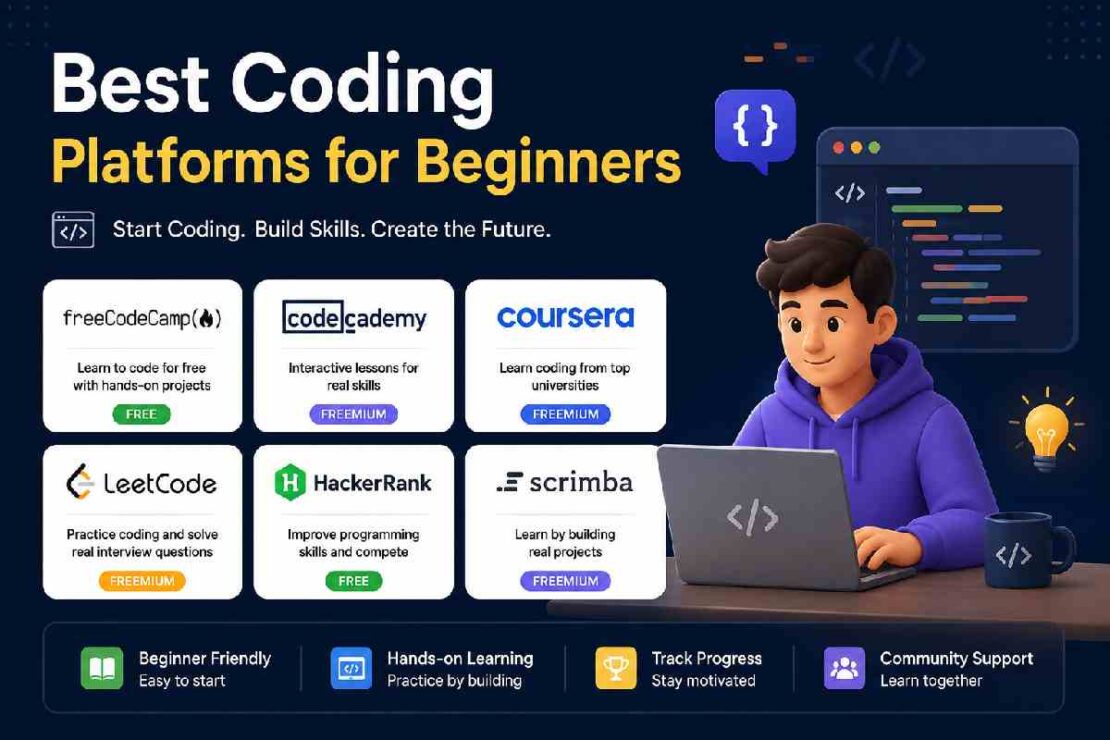
Choosing where to learn to code can be baffling; when it feels like thousands of best coding platforms for beginners want to train you up to get the job. Some use exercises that interact with you, others are made of video courses, still others focus almost exclusively on challenges as well as interview skills. All comes down to what you seek to gain, how you learn best, how much you can spend, and the level of direct work you will be doing.
In this analysis of the best 15 coding sites for beginners, we examine and measure everything we can – by measuring friendliness to beginners, quantity of hands-on exercises, quality of projects constructed, layout of the learning curriculum, price points, credentials offered, usefulness for career advancement… it’s all well and good to give you famous site names, but I aim to tell you precisely what to consider to get value for what you set out to learn.
The fast-reader summary: the best all-around free course starts the journey for anyone to become absolutely novice, which freeCodeCamp excels at; Codecademy gives you a guiding experience within interactive exercises, in the same vein as many best courses for absolute beginners; and The Odin Project really works well in web design at any level, using projects throughout; the best structured course and credential source remains Coursera and is among many of the most accessible and thorough options. Sites like LeetCode, HackerRank, Codewars and Exercism were far most useful for practicing for actual interviews.
Best Coding Platforms for Beginners: Quick Comparison

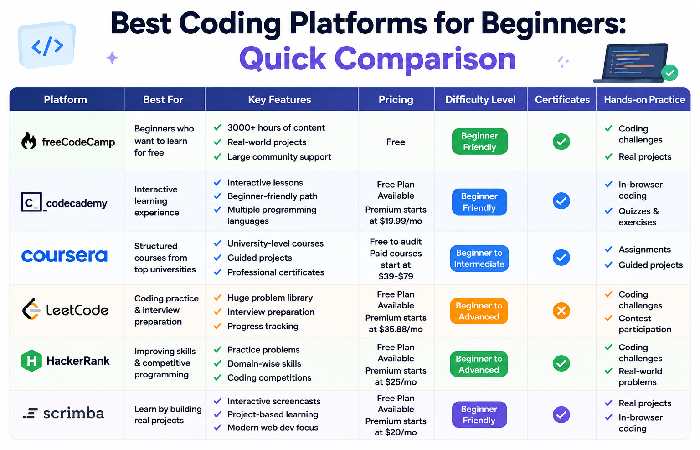
Plateform Best For Hands on projects on beginner-level Projects Cost Certificate FreeCodeCamp free Yes Guided learning free Yes
And another important factor this process is, if you have made me a coder I can write code like no one does, But if you had me writing code then I will surely practice, which is not similar the practice can not be learned It is an attitude learning a language. Codecademy interactive lessons free + paid yes with paid one The Odin project full stack web development free no Coursera structured courses and certs free and paid yes Scrimba interactive learning free and paid yes with some selective plans. Khan academy absolute beginnier free no W3schools Reference for quick reference Paid and free yes.
Udemy Inexpensive videos Paid yes Cs50 computer science basic Free/paid with certificate yes, but still you will be having free course as a resource, Exercism Practice the lang free no.
Hackerrank interviews practice Paid/Free Sometimes. Leetcode DSA and interview Paid/Free No. Codewars games practice free no, Mimo mobile lessons Paid/Free Sometimes.
Our 2026 Methodology: How We Ranked These Coding Platforms
There is no single “best” platform for every learner. A website that is excellent for interview preparation may be frustrating for someone who has never written a for loop.
For this comparison, we evaluated platforms against seven criteria:
- Beginner accessibility – Can someone with little or no programming experience get started?
- Curriculum structure – Does the platform provide a logical learning path?
- Interactive practice – Can learners write and test code instead of only watching videos?
- Projects – Does the platform help learners build something practical?
- Career relevance – Does the learning translate into portfolio or job skills?
- Cost/value – How much useful learning is available without paying?
- Progression – Can a beginner continue toward intermediate skills without immediately switching platforms?
This methodology also reflects an important distinction: learning to code and practicing coding are not the same thing.
LeetsCode, on the other hand, while very handy to test out algorithms does not actually fit in very well with starting to program from zero. Another instance; W3Schools is very helpful to learn syntax and have easy to check examples, but generally, projects are needed on top.
15 Best Coding Platforms for Beginners
1. freeCodeCamp — Best Free Coding Platform for Beginners
Best for: Beginners who want a comprehensive, free curriculum.
Cost: Free
Learning style: Interactive exercises, projects, certificationsBest for: Absolute beginners who want guided, browser-based coding.
For learning coding for free (you can pay for it through taking out a subscription though), you will have little trouble picking FreeCodeCamp high on your list of potential choices to learn through.
They have an integrated set of courses which incorporates:lessons, problems (challenges to fix problems with your code or create programs), projects, and certificates. Their current curriculum is quite broad as to the subjects it teaches: it currently includes python, javascript, responsive web design, and relational databases (and so on). It is also worthwhile to note, that the development work being done for the 2026 freeCodeCamp curriculum, is focused heavily toward a bigger project-based approach of getting certificates, with evaluative components instead of just the completion of the lessons themselves
Why beginners like freeCodeCamp
- Completely free learning model
- Interactive coding exercises
- Project-based learning
- Certifications
- Large learning community
- Strong web-development content
- Self-paced structure
Its major advantage is that you are encouraged to write code and build projects, rather than simply consume tutorials.
Best for
Choose freeCodeCamp if you:
- Have a limited budget
- Want to learn independently
- Prefer practice over long video lectures
- Want portfolio projects
- Are interested in web development or programming fundamentals
One drawback
Because the platform is self-paced, you need discipline. If you prefer an instructor explaining every concept before you practice, Codecademy or a structured Coursera course may feel easier.
2. Codecademy — Best Interactive Coding Website for Beginners
Best for: Absolute beginners who want guided, browser-based coding.
Cost: Free Basic plan; paid Plus and Pro plans
Some may find it the most beginner friendly platform out of these due to the ability to write and run code from a browser. The pricing chart on their website currently has a free tier called Basic, and paid tier Plus at $29.99 monthly, and $14.99 month to month if you are being billed Annually. The highest paying plan, called Pro at $39.99 monthly and $19.99 monthly will take you more in depth to include more, for instance, projects and additional curriculum will unlock from plan to plan.
What makes Codecademy different?
You learn by doing.
Instead of:
Watch video → read notes → try coding later
the experience is closer to:
Learn concept → write code → run code → receive feedback → continue
That reduces the setup barrier for beginners.
Best for
Codecademy is particularly useful if you:
- Have never programmed before
- Want immediate feedback
- Prefer short lessons
- Want to learn Python, JavaScript, SQL, HTML/CSS, or other popular technologies
- Need a more guided experience
Potential drawback
The free plan is useful for getting started, but many advanced learning paths, projects, and career features require a paid subscription.
3. The Odin Project — Best for Project-Based Web Development
Best for: Beginners who want to become web developers by building real projects.
One of the primary ways The Odin Project differs from normal curriculum institutions is that rather than putting students through hundreds of isolated videos, Odin takes the gathered curriculum and implements it into working assignments.
Students following Theodinproject.com’s Foundations curriculum will learn what Git, HTML, CSS, the command line and javascript look like and introductory problem solving concepts.
Here then after, they can opt for either of Full Stack JavaScript or Full Stack Ruby on Rails track. With JavaScript Full Stack, you would guide candidates throughout their journey of JavaScript basics and will equip them to explore through databases, React, NodeJS, PostgreSQL and can map their career plans.
Why it stands out
The Odin Project expects you to build things.
Examples include:
- Recipes website
- Landing page
- Rock Paper Scissors
- Calculator
- Full-stack applications
- API projects
- Database applications
That makes it particularly useful for learners who want a portfolio rather than just course-completion badges.
Best for
Choose it if your goal is:
Learn → Build → Publish → Create portfolio → Apply for web-development jobs
Potential drawback
It requires more independence than Codecademy. You also need to become comfortable installing development tools and working with Git and the command line.
4. Coursera — Best for Structured Courses and Certificates
Best for: Learners who want structured courses from universities and technology companies.
It also hosts programming courses from institutions including Duke University, Meta, Microsoft, Princeton University, IBM. Its current programming courses catalog offers beginner courses in Python, Java, JavaScript, C, C++, data structures and algorithms, and software development.
Examples include:
- Programming Fundamentals
- Programming in Python
- Programming with JavaScript
- Python Programming Fundamentals
- Java Programming and Software Engineering Fundamentals
- IBM Full Stack Software Developer
Coursera allows learners to preview some programming material for free and offers free trials for eligible programs. Certificates and full access to many programs generally require payment, although financial aid may be available for eligible learners.
Best for
Coursera is a strong choice if you value:
- Instructor-led structure
- University-backed courses
- Professional certificates
- Career-oriented programs
- A defined curriculum
5. Scrimba — Best for Interactive Video Learning
Best for: Learners who enjoy videos but still want to edit code during the lesson.
This was the concept behind Scrimba’s interactive video, aiming to add practice to the benefits of watching videos. Instead of just viewing someone writing code on a screen, you actually get to write code as part of the learning process.
Best for
- Front-end development
- HTML and CSS
- JavaScript
- React
- Interactive learning
- Visual learners
Potential drawback
Some of the more advanced content and career-focused features are available through paid plans.
6. Khan Academy — Best Free Option for Absolute Beginners
Best for: Students and complete beginners who want a gentle introduction.
Khan Academy has interactive lessons. Khan Academy teaches coding with JavaScript and Web Development. It has programming practice activities for variables, if/else, functions, loops, lists, and more, along with a library for many aspects of learning programming. It aims to give everybody a free education.
Why beginners may prefer it
The teaching style is less intimidating than jumping straight into a professional developer environment.
It can be especially useful for:
- School students
- Younger learners
- Complete beginners
- Learners who enjoy visual explanations
- People exploring whether programming is right for them
7. W3Schools — Best Coding Website for Quick Reference
W3Schools
Best for: Beginners who want quick explanations with immediate examples.
W3Schools is a perfect resource to find quick answers to “How do I…?”. It’s extremely helpful for answering the following types of questions and many more:
How do I write a heading?
What function/action does that CSS property have?
The simple explanation and interactive samples make diving into a topic immediately rather than having to finish a course in its entirety.
Best use
Use W3Schools as a learning companion, rather than your only learning platform.
A good combination is:
W3Schools → learn concept → code it yourself → build project
8. Udemy — Best for Affordable Course Variety
Best for: Learners who want a large selection of instructor-led courses.
Udemy is useful because you can search for a specific technology rather than committing to a single curriculum.
You can find beginner courses for:
- Python
- Java
- C++
- JavaScript
- Web development
- Data science
- SQL
- Machine learning
- App development
Advantages
- Huge course selection
- Video-based learning
- Practical projects in many courses
- Lifetime access is available on many individual purchases
- Frequent discounts
Disadvantage
The quality varies considerably between instructors.
Before buying a course, check:
- Recent reviews
- Last updated date
- Course curriculum
- Number of students
- Instructor experience
- Preview lectures
- Whether projects are included
9. CS50 — Best for Computer Science Fundamentals
Best for: Beginners who want to understand computer science, not just memorize syntax.
Harvard’s CS50 is a strong option for learners who want deeper fundamentals.
It introduces programming alongside concepts such as:
- Algorithms
- Memory
- Data structures
- C
- Python
- SQL
- JavaScript
- Web development
- Computational thinking
Why choose CS50?
Good for you if you want to learn how to program works, and not just syntax commands. CS50 might just be the one you need. Downside to this course Although for a first time ever beginner in computer, the course can prove to be a bit rigorous. You need a level of patience to sail through this course if you know nothing about coding.
10. Exercism — Best for Practicing Programming Languages
Best for: Beginners who already know basic syntax and want more practice.
Exercism is more practice-oriented than course-oriented.
Instead of walking you through every programming concept from scratch, it gives you exercises designed to improve your ability to write code.
It is particularly useful once you know basic concepts such as:
- Variables
- Conditions
- Loops
- Functions
- Arrays/lists
- Basic data structures
Best strategy
Don’t make Exercism your first destination if you don’t know what a variable or function is.
Use it after a beginner course to answer the more important question:
“Can I actually write this code myself?”
11. HackerRank — Best for Coding Practice and Interview Preparation
Best for: Learners who want structured coding challenges and eventually technical interview preparation.
HackerRank organizes programming practice around challenges and skills. It can be useful for Python, Java, JavaScript, SQL, problem solving, and other technical areas.
Its current subscription structure includes a Basic tier and paid options with additional AI tutoring, mock interviews, and practice features.
Beginner warning
HackerRank is better as a practice platform than as your only resource for learning programming from zero.
A better sequence is:
Learn Python → solve beginner exercises → practice on HackerRank → move toward interview problems
12. LeetCode — Best for Data Structures and Coding Interviews
Best for: Learners preparing for technical interviews.
LeetCode is extremely popular for algorithm and data-structure practice.
However, it is frequently misunderstood by beginners.
If you have never programmed before, jumping directly into difficult LeetCode problems can be discouraging.
Use LeetCode when you already understand:
- Variables
- Functions
- Loops
- Arrays
- Strings
- Basic data structures
- Complexity fundamentals
Then use it to improve problem-solving ability.
Best for
Interview preparation > first-time coding education
13. Codewars — Best Gamified Coding Practice Platform
Best for: Learners who enjoy challenges and gamification.
Codewars turns programming exercises into “kata” that you solve and progressively improve.
This makes it useful for developing a consistent coding habit.
One particularly useful feature is comparing your solution with solutions written by other developers. That can teach you different ways to approach the same problem.
Best for
- Daily coding practice
- Problem solving
- Language fluency
- Learning through repetition
- Gamification
14. Mimo — Best Mobile-First Coding Platform
Best for: People who want to learn coding in short sessions from a phone.
Mimo focuses on bite-sized programming lessons, making it useful for learners who don’t have hours available for traditional courses.
It can work well for:
- Beginners
- Daily practice
- Python
- HTML/CSS
- JavaScript
- Short study sessions
Best strategy
Use Mimo for consistency, but transition to a desktop development environment when you’re ready to build larger projects.
Learning syntax on a phone is convenient. Building a real application usually requires a more complete development environment.
15. GeeksforGeeks — Best for Programming Practice and DSA
Best for: Learners who want extensive programming explanations, DSA resources, and interview preparation.
GeeksforGeeks is particularly popular among students and developers preparing for technical interviews.
It contains resources covering:
- Programming languages
- Data structures
- Algorithms
- Competitive programming
- Interview questions
- Computer science concepts
- Development technologies
Beginner warning
The enormous amount of content can become overwhelming.
Don’t try to learn everything on the site at once.
Choose one language, one learning path, and one project.
Which Coding Platform Is Best for You?
Instead of asking:
“Which is the best coding platform?”
ask:
“Which platform is best for the way I want to learn?”
| Your Goal | Best Choice |
|---|---|
| Learn coding completely free | freeCodeCamp |
| Learn interactively | Codecademy |
| Become a web developer | The Odin Project |
| Earn structured credentials | Coursera |
| Learn through interactive video | Scrimba |
| Start from absolute zero | Khan Academy |
| Quickly learn web syntax | W3Schools |
| Buy a specific video course | Udemy |
| Learn computer science fundamentals | CS50 |
| Practice a programming language | Exercism |
| Prepare for coding assessments | HackerRank |
| Prepare for technical interviews | LeetCode |
| Make coding practice fun | Codewars |
| Learn on your phone | Mimo |
| Practice DSA and interview topics | GeeksforGeeks |
Best Coding Platforms by Learning Style
If You Are a Complete Beginner
Start with:
Khan Academy → Codecademy → freeCodeCamp
These platforms reduce the initial difficulty and let you start writing code relatively quickly. Khan Academy emphasizes approachable fundamentals, while Codecademy provides a more guided interactive environment.
If You Want to Become a Web Developer
A strong route is:
freeCodeCamp → The Odin Project → GitHub → Portfolio Projects
The Odin Project is particularly strong here because its curriculum progresses from foundations into JavaScript, React, databases, NodeJS, and employment preparation.
If You Want to Learn Python
Try:
Codecademy → freeCodeCamp → Coursera → Exercism
Use the first platforms to understand Python and Exercism to increase your independent coding practice.
If You Want a Job
Don’t rely on one website.
A practical combination is:
Structured course + projects + GitHub + coding practice + interview preparation
For example:
freeCodeCamp + The Odin Project + GitHub + HackerRank/LeetCode
If You Want a Certificate
Consider:
Coursera, Codecademy, or freeCodeCamp
But remember: a certificate is evidence that you completed a learning experience. It is not automatically proof that you can build software.
A portfolio project can often demonstrate practical ability more clearly.
Free vs Paid Coding Platforms: Which Is Better?
You don’t need to pay to begin learning programming.
Several strong platforms provide substantial free learning resources. freeCodeCamp describes its learning platform as free, while Khan Academy also maintains a free learning model. The Odin Project’s full-stack curriculum is free as well.
Free platforms are best when:
- You’re experimenting with coding
- You have a limited budget
- You’re comfortable learning independently
- You don’t need live instruction
- You want to build your own study schedule
Paid platforms can make sense when:
- You need a structured roadmap
- You want instructor-led content
- You want professional certificates
- You need career services
- You want additional projects or assessments
- You struggle to stay consistent without structure
The most expensive platform isn’t necessarily the best platform.
The best platform is the one that helps you consistently move from learning → practicing → building.
How to Set Up Your Coding Environment as a Beginner
One of the biggest mistakes beginners make is spending days configuring tools before writing their first program.
Your initial setup can be simple.
Basic Coding Setup
You typically need:
- A computer
- A modern web browser
- A code editor such as Visual Studio Code
- A programming language or runtime
- Git when you’re ready to manage projects
- A GitHub account for storing and sharing projects
For browser-based platforms such as Codecademy, you can often begin writing code without installing a full development environment.
For project-based curricula such as The Odin Project, you will eventually need to become comfortable with tools such as the command line, Git, and Node.js. Its Foundations curriculum explicitly introduces development-environment setup, Git, HTML, CSS, and JavaScript.
Screenshot opportunity
[Insert original screenshot: Beginner coding setup showing VS Code + browser + project folder]
This should be an original screenshot from your own setup rather than a stock image. Label the major areas so a beginner knows where to write code, run the program, and view the result.
Common Problems Beginners Face
“I understand tutorials but can’t write code myself.”
This is extremely common.
The solution is to reduce passive learning.
Try this pattern:
Learn → Close tutorial → Rebuild from memory → Get stuck → Search → Fix → Repeat
Don’t immediately copy the instructor’s code.
“I don’t know which programming language to learn.”
You don’t need to learn five languages.
Choose based on your goal:
| Goal | Good Starting Language |
|---|---|
| Web development | JavaScript |
| Automation | Python |
| Data analysis | Python |
| General programming | Python |
| Android development | Kotlin |
| iOS development | Swift |
| Enterprise development | Java/C# |
| Systems programming | C/C++ |
| Database basics | SQL |
For many complete beginners, Python or JavaScript provides a relatively accessible starting point.
“I keep switching between platforms.”
This is one of the biggest beginner traps.
You might spend Monday on Codecademy, Tuesday on YouTube, Wednesday on freeCodeCamp, Thursday on Udemy, and Friday searching for another “best coding course.”
The result is usually more research and less coding.
Choose one primary platform for 30 days.
Use other websites only when you need supplementary explanations or practice.
“I can’t solve coding challenges.”
Don’t immediately conclude that you aren’t good at programming.
Coding skill develops through problem decomposition.
When stuck, ask:
- What is the input?
- What should the output be?
- What smaller steps are required?
- What data do I need to store?
- Can I solve a simpler version first?
- What error is the program showing?
- Can I explain the problem in plain English?
Only then search for help.
A Beginner-Friendly 90-Day Coding Plan
You don’t need to finish 15 platforms.
You need a learning system.
Days 1–30: Learn the Fundamentals
Choose one platform.
For example:
Codecademy or freeCodeCamp
Focus on:
- Variables
- Data types
- Operators
- Conditions
- Loops
- Functions
- Arrays/lists
- Objects/dictionaries
- Basic debugging
Spend more time writing code than watching lessons.
Days 31–60: Build Small Projects
Build at least three small projects.
Examples:
- Calculator
- To-do list
- Number guessing game
- Quiz application
- Personal webpage
- Expense tracker
- Weather application
- Simple portfolio website
The objective changes from:
“Can I understand this?”
to:
“Can I build this?”
Days 61–90: Build One Larger Project
Pick one project and make it more complete.
For example:
Beginner web developer
Build a portfolio website.
Python learner
Build an expense tracker or automation script.
JavaScript learner
Build a task-management application.
Data learner
Build a small data-analysis project.
Publish the project on GitHub when appropriate and document what you learned.
A Simple Learning Formula That Works
A useful beginner formula is:
30% learning + 50% coding + 20% reviewing
Don’t spend 90% of your time watching tutorials.
For every hour you study:
- 20 minutes → Learn
- 30 minutes → Write code
- 10 minutes → Review and fix mistakes
The exact ratio can change, but the principle matters:
You learn programming by programming.
What Beginners Should Look for in an Online Coding Platform
Before paying for any platform, check these eight things.
1. Does it teach from your current level?
If you’re a complete beginner, avoid a course that assumes you already know programming.
2. Can you write code immediately?
Interactive coding is usually more useful than passive video consumption.
3. Does it include projects?
Exercises teach individual skills.
Projects teach you how to combine them.
4. Is there a clear roadmap?
A good roadmap answers:
What should I learn next?
5. Does it fit your goal?
Don’t choose an interview platform if your immediate goal is learning basic programming.
6. What is actually free?
A platform can advertise free learning while putting important projects or assessments behind a subscription.
Check the current plan before paying. Codecademy’s current pricing, for example, separates Basic, Plus, and Pro access.
7. How current is the content?
Programming changes.
Check the date of recent course updates, especially for frameworks and development tools.
8. What happens after the course?
A good platform should help you progress toward:
Practice → Projects → Portfolio → Real-world development
Are Coding Platforms Enough to Get a Job?
Not by themselves.
Completing a course does not automatically make someone job-ready.
A beginner aiming for a development role should eventually develop several layers of evidence:
Programming fundamentals
↓
Projects
↓
Git/GitHub
↓
Problem solving
↓
Debugging
↓
Technology-specific skills
↓
Portfolio
↓
Interview preparation
This is why combining platforms can be more effective than searching endlessly for one perfect website.
For example:
freeCodeCamp can provide structured learning and projects.
The Odin Project can provide a deeper project-based web-development path.
HackerRank or LeetCode can provide targeted problem-solving practice.
GitHub can showcase the work you actually built.
The Biggest Mistake: Choosing a Platform Instead of Choosing a Goal
The internet makes it easy to compare platforms for weeks.
But your real objective isn’t:
“Find the perfect coding website.”
Your objective is:
“Become capable of building something with code.”
That changes how you should evaluate platforms.
Frequently Asked Questions
Which is the best coding platform for beginners? If you’re a beginner, freeCodeCamp is likely the best and a great free way to start as they blend organized curriculum, interactive challenges, projects and certifications. Codecademy is also a good choice as it provides guided, browser-based, interactive lessons.
What is the best free coding platform for beginners? The best free coding resources are likely to be The Odin Project, Khan Academy and freeCodeCamp. They each serve different needs;freeCodeCamp will provide a fairly broad coding curriculum , The Odin Project is focused on the practice of developing with web design and projects, and Khan Academy has a more leisurely approach to learning.
Can I learn coding online for free? It is absolutely possible to learn to program without spending money on a course. Free coding resources like freeCodeCamp, The Odin Project,Khan Academyand many of the basic resources on other platforms are available and accessible.
Is Codecademy good for absolute beginners? I would recommend that yes! Because students have the capability of testing the code that is typed right into the browser, the beginner’s learning curve is made smoother. Codecademy basic can be used to acquire access to selected courses for no additional payment,whereas the paid version allows you additional access to all available courses and certificate programs.
Is The Odin Project good for beginners? It is particularly effective for those interested in web development,as they will gain hands-on experience throughout their entire Web Development curriculum. The Odin Project’s Foundations section is specifically designed to teach beginner skills like web-based development,Git,HTML, CSS, JavaScript and all the basic developer tools to implement everything.
Should I start with LeetCode as a beginner? While it’s possible, beginners will generally progress much better if they start by learning fundamentals, building projects, and then incorporate LeetCode, as it’s geared towards more challenging algorithmic problems and interview preparation.
Is a coding certificate enough to get a job? Absolutely not. While it can prove you finished a certain program. You need to build skills that are directly applicable to the job you apply for; this entails building projects on the side, utilizing and practicing version control with Git, and practicing how to write and execute code well.
How long does it take to learn coding? You can grasp basic concepts of programming in just a couple of weeks of dedicated learning, however, most beginners may find it takes months of consistent practice to confidently write real-world projects.
Should I learn Python or JavaScript first? In this case, it depends on your personal ambitions and what you would like to accomplish. If you simply want to gain an overview of programming or become acquainted with basic principles, Python will likely be a better introduction. If the intention is primarily centered around writing code for interactive Web applications or websites then learn JavaScript.
Final Verdict: Which Coding Platform Should You Choose?
There isn’t “one best” answer. The best coding platforms for beginners include:
For a comprehensive and free foundation, pick freeCodeCamp.
>For guided and interactive lessons, choose Codecademy.
>To become a web developer with a project-driven focus, try The Odin Project.
>To learn skills from accredited organizations and take professional development courses, consider Coursera.
>To learn the fundamentals of computer science, look into CS50.
>For quick reference or syntax lookups, use W3Schools.
>For the sheer joy of coding practice and challenge, look at Exercism, HackerRank, or Codewars.
After you establish some programming basics, it’s time to graduate to preparing for technical interviews with something like LeetCode.
Don’t choose the platform with the most extensive collection of courses. Instead, select one that aligns with your objectives, commit to it until you have tangible skills, and start coding.
Pick a platform that’s a good fit and dive in.