
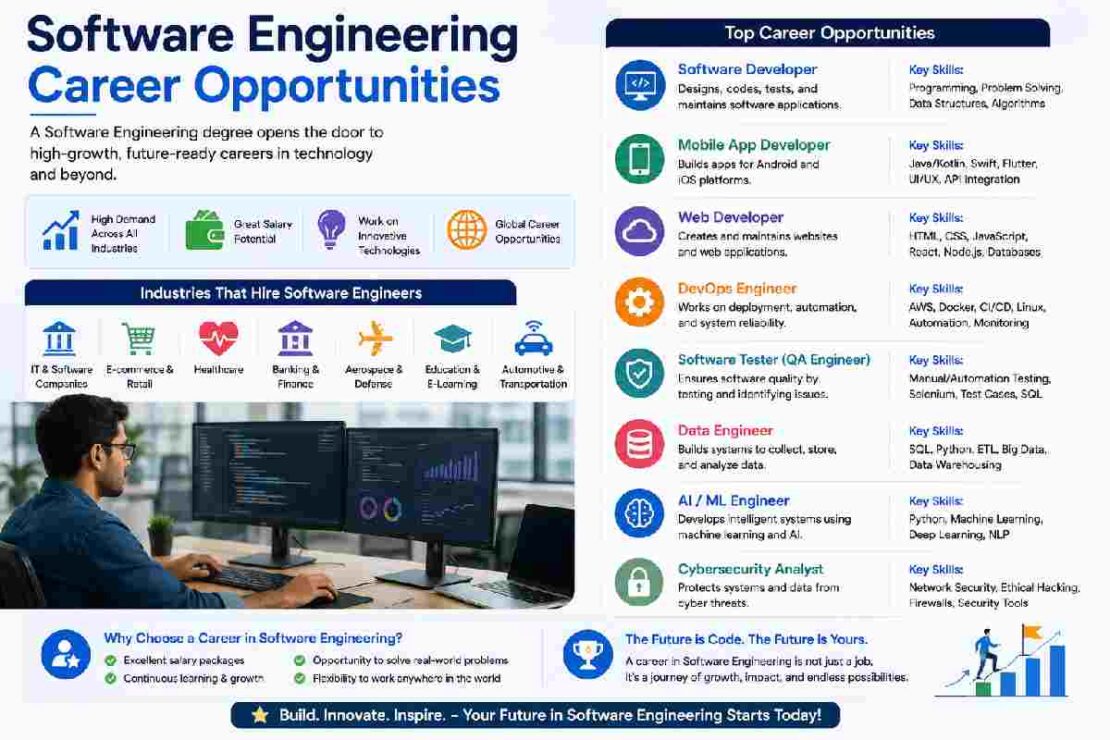
The #1 benefit to a software engineering education is the career flexibility it allows.
Start out as a developer, then transition into backend engineering, cloud,DevOps, cyber, AI, Data engineering, architecture, or into a technical lead position.
The #1 and #1 smart 2026 strategy is not to chase the biggest headline salary; establish a solid foundation, learn how modern software is actually produced, become well-acquainted with AI assist development, and specialize in where you can truly add value.
Learn how to learn: fundamentals, build real applications, get a first job, specialize, level up and continue. That will be a software engineering path with the most long-run flexibility.
What Career Opportunities Does Software Engineering Offer?
Through software engineering you gain an incredibly strong foundation of knowledge, skills and abilities that transfer remarkably well into just about any type of technology job out there. Some job functions you may find yourself working as are Software engineer, backend/frontend/full stack and mobile app engineer; Devolops and cloud engineer; Quality assurance/Automation engineer; and Data engineer; and AI/ML engineer. Outside of the above-listed you will also be considered for a variety of other roles such as cybersecurity engineer, site reliability engineer and senior software engineer, job descriptions include from that of software architect all the way up to Technical Lead and even Engineering manager.
With an 18% prediction by the WEF future of job’s report 2025 software and application developer is expected to be in the top 5 forecast roles for the entirety of 2030-or just beginning after it.
Other jobs that will likely see strong growth are those with duties including AI/ML engineers, big data engineers and fin tech engineers.
Best Software Engineering Career Paths in 2026
Here is a practical comparison of major software development job roles.
| Career | Main work | Core skills | 2026 demand |
|---|---|---|---|
| Software Engineer | Builds and maintains applications | Programming, DSA, APIs, databases | Very High |
| Backend Developer | Builds servers, APIs and data systems | Java/Python/Go, SQL, APIs | Very High |
| Full Stack Developer | Works across frontend and backend | JavaScript/TypeScript, React, Node, SQL | High |
| AI/ML Engineer | Builds AI and ML systems | Python, ML, data, deployment | Very High |
| Cloud Engineer | Designs cloud infrastructure | AWS/Azure/GCP, networking | Very High |
| DevOps Engineer | Automates development and deployment | CI/CD, Docker, Kubernetes | Very High |
| Cybersecurity Engineer | Protects systems and applications | Security, networking, cloud | Very High |
| Data Engineer | Builds data pipelines and platforms | SQL, Python, Spark, cloud | Very High |
| QA/Automation Engineer | Tests software automatically | Selenium/Playwright, APIs, CI/CD | Medium–High |
| Mobile Developer | Builds Android/iOS applications | Kotlin, Swift, Flutter/React Native | Medium–High |
Current 2026 career guides similarly identify AI/ML, cloud, DevOps, cybersecurity, MLOps and full-stack development among the strongest software-engineering paths.
1. Software Engineer

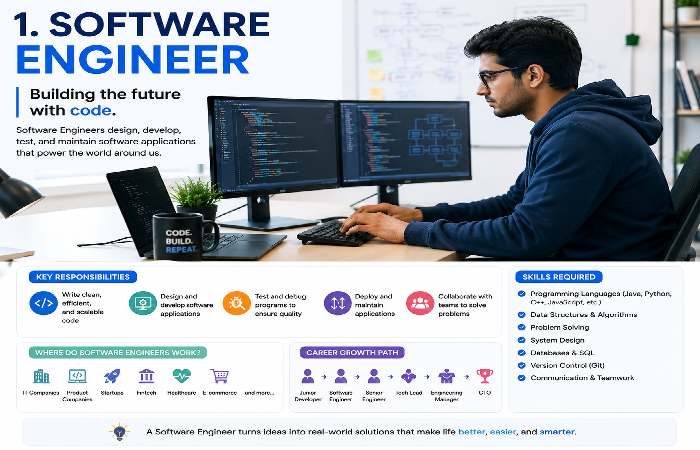
The traditional software engineer role remains one of the broadest options.
You may work on:
- Web applications
- Enterprise software
- APIs
- Mobile systems
- Internal platforms
- Distributed systems
- SaaS products
A software engineer usually needs strong programming fundamentals, data structures, algorithms, Git, databases, testing and software design.
The U.S. Bureau of Labor Statistics projects 16% employment growth for software developers from 2024 to 2034, with about 267,700 additional jobs projected over that period.
2. Backend Developer
Backend engineers build the systems users don’t directly see.
They work with:
- APIs
- Databases
- Authentication
- Business logic
- Distributed systems
- Performance
- Security
Popular technologies include Java, Python, Go, Node.js, PostgreSQL, MySQL, Redis and cloud platforms.
If you enjoy logic, architecture and solving technical problems more than visual design, backend development can be an excellent path.
3. Frontend and Full Stack Developer
Frontend developers create the user-facing side of applications.
Typical technologies include:
HTML → CSS → JavaScript → TypeScript → React/Angular/Vue
Full-stack developers combine frontend and backend development.
This is a popular entry route because you can demonstrate your ability through portfolio projects relatively quickly.
4. AI/ML Engineer
Artificial intelligence is creating another major specialization within software engineering.
AI/ML engineers may work on:
- Machine-learning models
- AI applications
- Recommendation systems
- LLM applications
- RAG systems
- Model deployment
- AI evaluation
- ML pipelines
But Python plays a unique part in this sector. GitHub’s analysis showed that a half of the new AI-focused repos found in their data between the early part of 2025 (which does have its set of typed languages including, indeed, TypeScript, and it was rising sharply) were 50% written in Python. One can simply be software-developer. Numerous software engineers are developing or managing an AI-built application and enhancing their skills.
5. Cloud Engineer
Modern applications increasingly depend on cloud infrastructure.
Cloud engineers work with platforms such as:
- AWS
- Microsoft Azure
- Google Cloud
- Kubernetes
- Terraform
- Networking
- Identity and security
A software engineer can move toward cloud engineering after developing a strong understanding of operating systems, networking and application deployment.
6. DevOps Engineer
DevOps combines software development with infrastructure and automation.
Typical responsibilities include:
- Building CI/CD pipelines
- Automating deployments
- Managing containers
- Monitoring applications
- Infrastructure automation
- Release management
Common technologies include Docker, Kubernetes, GitHub Actions, Jenkins and Terraform.
This path is especially suitable for people who enjoy automation and infrastructure rather than spending all day building application features.
7. Cybersecurity Engineer
Security is becoming increasingly important as software systems become more connected.
Software engineers can specialize in:
- Application security
- Cloud security
- Secure coding
- Identity and access management
- Vulnerability management
- Security automation
The BLS projects 29% growth from 2024–2034 for information security analysts, making security one of the faster-growing technology occupations in its current projections.
8. Data Engineer
Data engineers build the infrastructure that allows organizations to collect, process and store large amounts of information.
You’ll commonly encounter:
- SQL
- Python
- ETL/ELT
- Data warehouses
- Spark
- Kafka
- Cloud data platforms
This is a strong choice if you enjoy databases and large-scale systems more than user-interface development.
Software Engineer Salary in India
Salary is one of the most searched parts of the software engineering career path, but there is no single reliable salary number.
Pay changes based on:
- Experience
- City
- Company
- Role
- Technical specialization
- Interview performance
- Product vs services company
- Equity and bonuses
Current 2026 Indian salary sources show very wide ranges. For example, one current job-data source reports a median of ₹8.5 lakh per year across its disclosed software-engineering listings, with the middle 50% between ₹3.5 lakh and ₹19.5 lakh. Other 2026 sources report significantly higher ranges for product companies and senior specialists.
Because these datasets use different methodologies, don’t treat any online salary figure as a guaranteed salary.
Indicative Career Progression in India
| Experience | Typical career stage | Broad salary context* |
|---|---|---|
| 0–2 years | Junior/SDE-1 | ₹3.5–18 LPA |
| 2–5 years | Software Engineer/SDE-2 | ₹8–30 LPA |
| 5–8 years | Senior Engineer | ₹15–55 LPA |
| 8–12 years | Staff/Principal/Tech Lead | ₹25–85 LPA+ |
| 12+ years | Architect/Engineering Manager/Director | ₹40 LPA–₹1 Cr+ |
*Indicative market ranges compiled from current 2026 sources; actual compensation can be substantially lower or higher depending on employer, location, specialization and total compensation structure.
Software Engineering Career Path
The standard path a non-managerial IC is typically a: Student Intern Junior Engineer Software Engineer Senior Engineer Staff Engineer Principal Engineer. An alternate path an individual can choose: Engineer Tech Lead Engineering Manager Senior Manager Director VP Engineering. You can still have a career if you don’t want to be a manager. Outstanding technical engineers who excel can remain in the individual contributor (IC) space, while those who thrive on coaching, strategy, and coordinating efforts can develop into management.
Skills You Need for Software Engineering Jobs
Your degree or certificate gets you started. Your skills determine what you can actually build.
Technical skills
Start with:
- One programming language
- Data structures and algorithms
- Git/GitHub
- SQL
- APIs
- Debugging
- Testing
- Object-oriented programming
- Basic system design
Then specialize.
Professional skills
Don’t overlook:
- Communication
- Problem solving
- Documentation
- Collaboration
- Code review
- Time management
- Requirements analysis
Senior engineers are rarely judged only by how quickly they can type code.
Does AI Reduce Software Engineering Career Opportunities?
AI is morphing software engineering, but it doesn’t yet evidence the simple idea that it’s vanishing. The World Economic Forum names software and applications developers to be one of the most rapidly growing professions through 2030. Meanwhile, AI is also morphing how engineers work: The 2025/2026 GitHub research reports hyper-growth in AI- assisted development and that more than 180 million engineers were on GitHub, with AI increasingly factoring into a range of choices around workflows and programming languages.
In short, the pragmatic lesson here: Don’t try and beat AI at generating boilerplate code.
Learn to leverage AI to become a great architect, verifier, bug killer, debugger, test-ifier, security wizard, product thinker.
Future Scope of Software Engineering
The future isn’t limited to traditional web development.
Important growth areas include:
AI engineering
Building applications around models, agents, RAG and AI infrastructure.
Cloud-native development
Designing applications that operate across scalable cloud infrastructure.
Cybersecurity
Protecting increasingly complex applications and data.
Data engineering
Building systems that support analytics and AI.
Developer platforms
Creating internal tools that help engineering teams build and deploy software faster.
Robotics and IoT
Software is increasingly embedded in physical products, vehicles and connected devices.
The BLS specifically notes demand related to AI, IoT, robotics, automation, cybersecurity and software-enabled products such as connected devices and electric vehicles.
How to Choose Your Software Engineering Career Path
Don’t choose a specialization because someone claims it has the highest salary.
Instead, ask what kind of work you enjoy.
| If you enjoy… | Consider |
|---|---|
| Building websites | Frontend/Full Stack |
| Logic and APIs | Backend |
| Infrastructure | Cloud/DevOps |
| AI and mathematics | AI/ML |
| Databases and large datasets | Data Engineering |
| Security and investigation | Cybersecurity |
| Finding bugs | QA/Automation |
| Mobile applications | Android/iOS |
| Architecture and big systems | Systems/Platform Engineering |
| Mentoring and strategy | Engineering Management |
What Jobs Can You Get After a Software Engineering Course?
After completing a good software engineering course, possible entry-level roles include:
- Junior Software Developer
- Software Engineer
- Frontend Developer
- Backend Developer
- Full Stack Developer
- QA Engineer
- Automation Tester
- Junior DevOps Engineer
- Cloud Support Engineer
- Application Support Engineer
Your first role doesn’t have to be your final specialization.
For example:
Junior Developer → Backend Engineer → Senior Engineer → Platform Engineer
or
QA Engineer → Automation Engineer → SDET → Engineering Lead
Your career can evolve as your skills develop.
Common Career Problems and How to Fix Them
“I finished a course but can’t get interviews.”
Your portfolio may be too weak. Build two or three substantial projects and clearly document your contribution.
“Every job asks for experience.”
Look for internships, open-source contributions, freelance projects and junior roles where your skills can be demonstrated.
“I don’t know whether to learn AI, cloud or full stack.”
Start with core software engineering. Specialize after you understand programming, databases, APIs and deployment.
“AI can write code, so why should I learn programming?”
Because generated code still needs requirements, verification, debugging, testing, security review and integration. Strong fundamentals make AI tools more useful rather than less useful.
“I only know one programming language.”
That’s fine. Depth in one language is more useful initially than shallow knowledge of five.
Frequently Asked Questions
What will software engineering career paths in 2026 be booming in?
Our career paths include everything from Software Engineering, Backend & Fullstack Development to AI & ML Engineering, Cloud Engineering, DevOps, Cybersecurity, and Data Engineering. The guides we have released for 2026 already indicate there’ll be heavy emphasis on AI/ML, Cloud, DevOps, and cybersecurity career paths.
What job positions are obtainable after the course on software engineering?
You can opt for junior software developer, software engineer,frontend developer;backend developer;full-stack developer, QA Engineer,automation tester,cloud support engineer or Junior DevOps Engineer, according to your knowledge base and the quality of your training.
What are career progressions for a software engineer?
There is typically a career progression of Junior Engineer-Software Engineer-Senior Engineer-Staff/Principal Engineer. However some engineers focus on technical expertise, and develop toward engineering management.
What does average salary for a software engineer look like in India?
There is not one singular credible source for salary figures nationally. In current 2026 datasets;disclosed job information indicates the median to be somewhere near 8.5 LPA on one active, live dataset, with others citing notably higher rates, differing according to experience and place of work.
Is software engineering a good choice in 2026?
If one maintains a growing relevant skill base. Global research into the labor markets continue to rank the fastest growing sectors as application/software development, and current specializations as AI;cloud and cybersecurity creating further sub fields.
Is software engineering obsolete due to AI?
Artificial intelligence might alter development work flows, but software engineering involves problem analysis;architecture design, system integration, system testing and expert judgment. Engineer who collaborates with AI systems seems to be the best professional to choose.
Which engineering specializations pay best?
AI/ML specialization,cloud architecture, cybersecurity specialized back ends,specialization in specific platform engineering and tech leadership at upper levels can result in attractive compensation, but it greatly relies on the individual’s skill sets and the place where they work. A top paying specialized position may not be ideal for each and every student learning software engineering.
Final Takeaway
1. Benefit #1 of software engineering education career path is its career flexibility.
You could start as a developer and grow towards Backend engineering, cloud,DevOps, cyber, AI,Data engineering, architecture or as technical lead.
1. Strategy #1 and #1 smart 2026 strategy;do not chase the highest headline salary; develop fundamentals, understand how production software is really made, get to know AI assist development well and specialize where you can create actual value.
Learn how to learn;fundamentals, build actual products, have your 1st role, specialize, get senior and do so continuously. This will be a software engineering career path that will be most flexible in the long run.