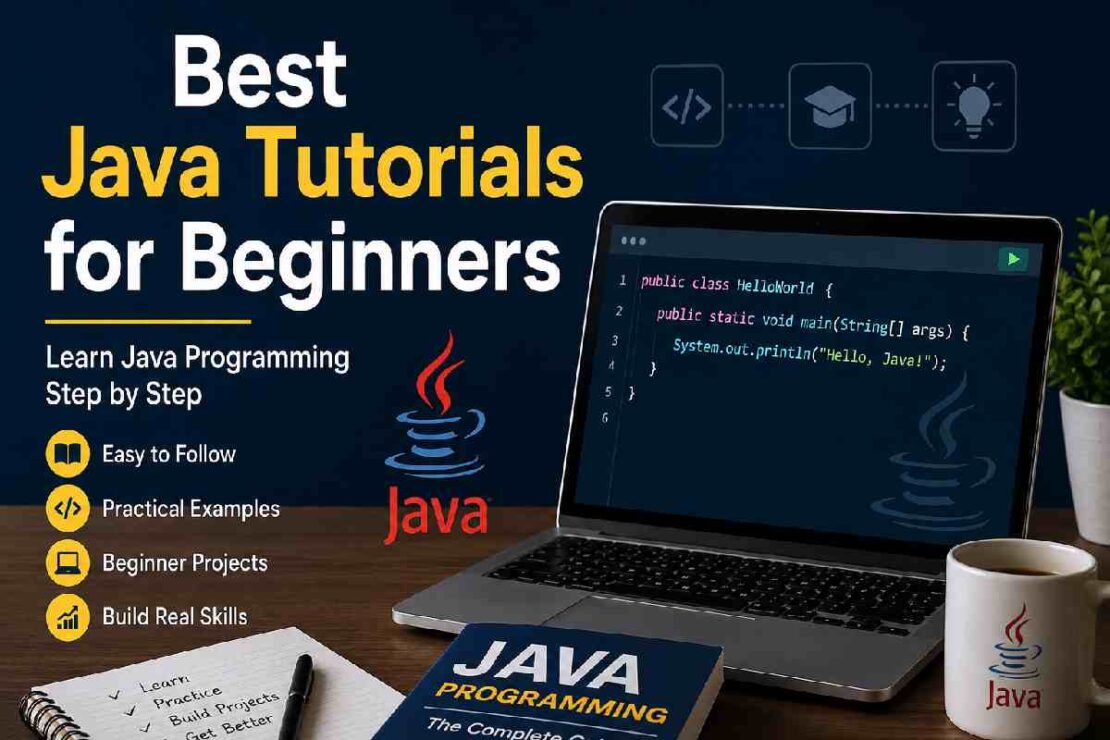
The Best Way to Learn Java Programming for Beginners If you’re learningJavaand are a complete beginner, it’s essential not to go into complex frameworks or learnbyheart ev
erysingle sintax onyourfirst day. Instead ofthat, start bylearningJava fundamentals, write some Java programs inshort chunks, practiceJava example coding challenges and incrementallyprogress toward object-oriented programmingand real Java project development. Today in2026, Java is still well alive with developments in JDK 26andJDK 25 being thepresent LTS. We offeran easytofollowguide with the best optionsto learn javaand providea realistic learningpath.
What Is Java?

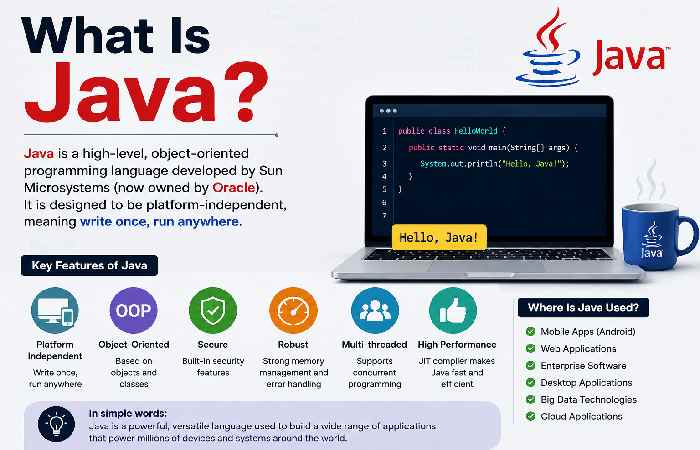
Java is a general purpose, object oriented language that works well in desktop, server, enterprise, and enterprise as well as cloud environments and others. There is a lot to be said for how Oracle’s 8-21 version java resources teach fundamental principles like classes objects, inheritance, date and data types, collections, exceptions, and so on. Java is still good stuff! So, if I am a total novice learning to code, I want to learn this:
Learn the syntax → understand programming concepts → build projects → learn frameworks.
Top Java Tutorials for Beginners Compared
There is no ideal JAVA course for everyone. It is depending whether you prefer documentations, lessons, courses and projects.
| Tutorial / Resource | Best For | Format | Beginner Friendly | Cost |
|---|---|---|---|---|
| Oracle Java Tutorials / Dev.java | Official documentation | Text + examples | ⭐⭐⭐⭐ | Free |
| Microsoft Learn Java resources | Structured beginner learning | Videos + learning resources | ⭐⭐⭐⭐⭐ | Free |
| Programiz Java | Simple explanations | Tutorials + examples | ⭐⭐⭐⭐⭐ | Free |
| Coding with John | Learning through video | Video | ⭐⭐⭐⭐⭐ | Free |
| Practical project-based tutorials | Building applications | Lessons + projects | ⭐⭐⭐⭐⭐ | Free/Paid |
Resources for learning Java from Microsoft currently have content for beginners on topics like the fundamentals of Java, strings, classes, packages, methods and modules, although the larger learning environment directs learners to the paid and free courses.
Programiz is helpful to those who are new to Java as its explanations of concepts about Java make them simple to understand and its examples are great for those with little to no experience.
What Our Competitor Analysis Found
Keywords like “Java tutorials for beginners” have content that consists more of tutorial libraries, video courses, educational platforms and official documentation compared to 500 word articles.
Competitor 1: Oracle
Oracle provides authoritative Java documentation and dedicated beginner learning paths. Its recommended beginner path includes getting started, learning the Java language, and essential Java classes.
Strength: Excellent authority and technical accuracy.
Weakness: Some classic Java Tutorials were written for JDK 8 and don’t reflect later improvements. Oracle itself recommends Dev.java for updated material.
Competitor 2: Microsoft
Microsoft’s Java beginner resources combine introductory explanations with videos and additional learning resources.
Strength: Beginner-oriented learning structure.
Weakness: Learners may need to move between multiple resources.
Competitor 3: Programiz
Programiz offers simple explanations, examples, and advances you through Java from the basics toward modern applications.
Strength: Super clear and approachable for beginners.
Weakness: The complete modern workflow is not as well-highlighted.
Competitor 4: Coding with John
Coding with John’s beginner course covers practical concepts including the first Java program, primitives, objects, constructors, arrays, file I/O, and beginner projects such as number guessing and Rock Paper Scissors.
Strength: Practical video learning.
Weakness: Video-first learners may still need written references.
Competitor 5: JavaTutorial.net
Java Tutorial Network provides free Java tutorials and examples, with beginner topics including Java basics, loops, arrays, classes, objects, inheritance, interfaces, and abstraction.
Strength: Large collection of practical examples.
Weakness: The breadth of content can feel overwhelming to someone starting from zero.
The SERP Content Gap
The biggest opportunity is to combine what these resources do well:
- Official, up-to-date Java information
- Simple explanations
- Setup instructions
- Code examples
- Beginner projects
- Comparison of learning resources
- Troubleshooting
- A clear path from Java basics to real development
That combination creates a stronger topical hub than simply publishing another generic Java tutorial.
How to Start Learning Java in 2026
1. Install the JDK
You need the Java Development Kit (JDK) to develop Java applications.
According to Oracle, as of August, 2026, the newest Java SE build is JDK 26 and the newest LTS build is JDK 25. If you are a novice programmer and wish to have a long-term stable learning environment, you should download JDK 25. If you are a developer who would like the newest available features, you should consider JDK 26 instead.
Suggested screenshot: Show the official Java download page and the installed JDK version in the terminal.
Example:
java --version
javac --version
You should see the installed Java and compiler versions.
2. Write Your First Java Program
Start with something extremely simple:
Public class HelloWorld
1. Create Java hello world: public static void main(String[] args) { System.out.println("Hello World!");} 2. Make sure that you've saved the file name as HelloWorld. Java in particular and saved within that one class as public static class HelloWorld 3. Ensure that you have the latest JDks (java development kit and Java run time) and the latest compilers have not just been saved on your system but they're also been linked, and the path name hasn't justbeenSaved as a document Saved into your system without any of the latest information so save your work after doing just about everything that you wanted to get it done a bit.
This tiny program introduces several important concepts: classes, the main() method, strings, and console output.
Don’t worry if the syntax looks unfamiliar. You’ll understand each part as you progress through your Java coding lessons.
3. Learn These Java Basics First
A good beginner sequence is:
- Variables and data types
- Operators
- Input and output
ifandelseswitchforandwhileloops- Arrays
- Methods
- Strings
- Classes and objects
- Constructors
- Inheritance
- Interfaces
- Exception handling
- Collections
Oracle’s beginner curriculum similarly emphasizes programming fundamentals, variables, classes, objects, loops, arrays, decision-making, and object-oriented concepts.
4. Build Beginner Java Projects
Reading tutorials isn’t enough. You need to write code.
Try these beginner Java projects in order:
| Project | Skills Practiced |
|---|---|
| Calculator | Variables, operators, methods |
| Number Guessing Game | Loops, conditions, input |
| Student Grade Calculator | Arrays, conditions |
| To-Do List | Classes, objects, collections |
| Banking System | OOP, methods, exception handling |
| Library Management System | OOP, collections, file handling |
Projects turn theoretical Java basics into practical programming skills.
Java Learning Roadmap
A simple roadmap looks like this:
Here are the key aspects in Java and their importance:
Core Java
OOP (Object-Oriented Programming)
Collections
Exceptions
File Handling
JDBC
SQL
Spring Boot
REST APIs
Real Projects
Don’t jump into Spring Boot after learning only about variables and loops. First lay a good foundation on core Java.
Common Problems Beginners Face
“Java is installed, but the command isn’t recognized.”
Your JDK may not be correctly configured in the system PATH. Verify the installation and check:
java --version
javac --version
“My class won’t compile.”
Make sure the filename matches the public class name.
For example:
public class HelloWorld
should normally be saved as:
HelloWorld.java
“I understand tutorials but can’t write programs.”
This is extremely common. Stop watching for a while and build something yourself.
Use the 30/70 rule:
30% learning + 70% coding and practice.
Frequently Asked Questions
So, should beginners learn java?
Yes, Java possesses an entire world class ecosystem and framework plus a great dealt of documentation and also the language in it is quite oriented toward objects-based on the coding system of yours which tends to benefit beginners since well as having Oracle and Microsoft produce some novice instructional materials on behalf of those learning the codex regarding their products.
Can I learn Java for free?
Yes. Oracle provides free Java learning resources, and several high-quality tutorial and video resources are available without payment.
Should I learn Java 25 or Java 26?
If you are a beginner and looking for long-term stable environment use Java 25 LTS. As on August 2026 latest feature release is Java 26.
How much time it take to learn Java?
Fundamentals can be learned in few weeks with consistent practice. Developing enough competence to build useful applications may take much more time than initially expected. Skill at programming develops with real life application and problem solving than through following tutorials.
What to learn after Core Java?
After learning core java and OOP, then try learning about collections, exceptions, file handling, JDBC and SQL then followed by spring boot, and REST API development.
Final Verdict
The best learning resources for beginners in Java are those that provide both thorough and up to date explanations and opportunities to test out your new knowledge. Official Oracle documentation guides for formal and structured approaches, learning beginner-friendly tutorials (e.g. Programiz, Microsoft Learn, Java-learn) and video tutorials when visual examples will aid the process are some valuable links I recommend to students and myself.
Above all, do not assume you are able to learn everything about the Java language in a day. Take it slow!
Build the foundations around Java basics, write simple code projects, create simple beginner Java projects and gradually advance to OOP, databases, APIs, and Sprint Boot. Java 25 LTS provides a solid foundation for learning in 2026. For the latest platform available, Java 26 is the best platform to take advantage of.