
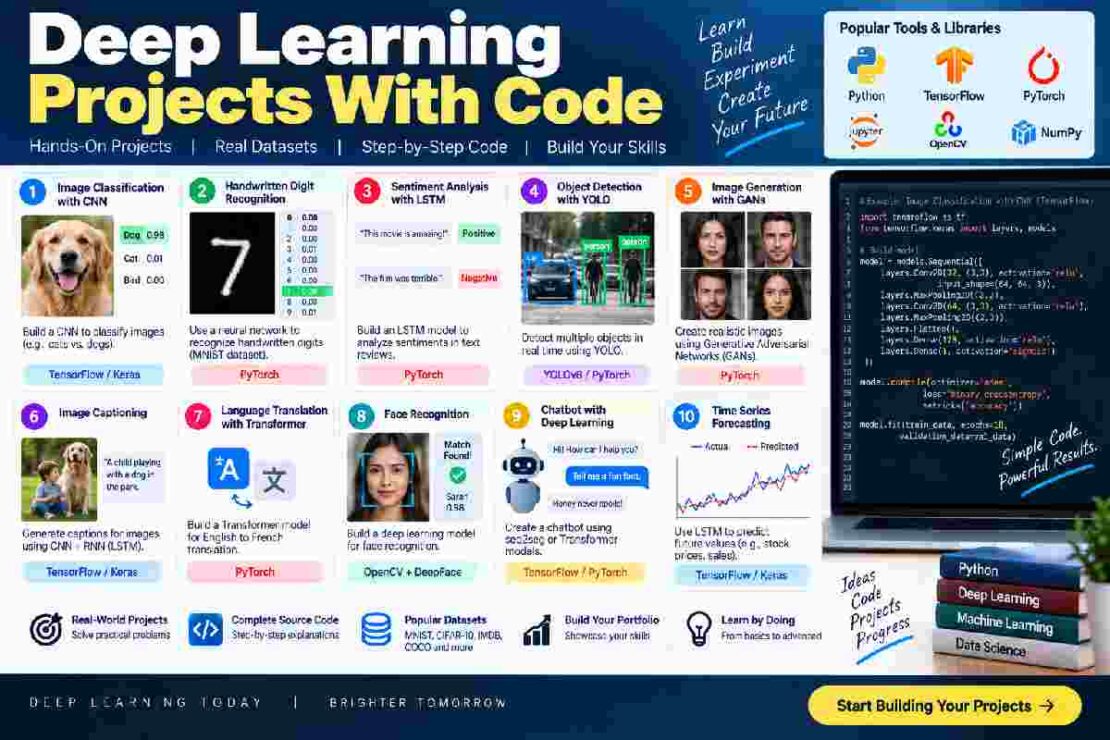
If you are looking for deep learning projects with code, practical projects are one of the best ways to move from basic concepts to real-world machine learning skills. Instead of only studying neural networks and algorithms, you can learn by building models, working with datasets, testing predictions, and improving results.
This guide covers beginner-friendly project ideas, useful tools, and practical tips to help you choose your first deep learning project.
What Are Deep Learning Projects?
Deep learning projects use neural networks to solve problems involving data such as images, text, audio, and numbers. Popular frameworks include PyTorch and TensorFlow, while Python is commonly used to build and train models.
A good beginner project should have a clear goal, accessible data, and a manageable level of complexity.
10 Deep Learning Projects With Code
1. Handwritten Digit Recognition
Create a neural network that recognizes handwritten numbers. This is a useful first project because you can learn about image data, model training, predictions, and accuracy.
2. Image Classification
Build a model that identifies different categories of images. You can start with a small dataset before moving to more complex computer vision tasks.
3. Sentiment Analysis
Train a model to classify text as positive, negative, or neutral. This project introduces natural language processing and text preprocessing.
4. Cat and Dog Classification
A cat-versus-dog classifier is a simple computer vision project that can help beginners understand convolutional neural networks.
5. Plant Disease Detection
Use images of plants to train a model that identifies possible diseases. This project also demonstrates how deep learning can be applied to practical problems.
6. Spam Message Detection
Build a text classification model that identifies spam messages. It is relatively straightforward and provides useful experience with text datasets.
7. Face Mask Detection
Create an image classification model that detects whether a person is wearing a mask. This project can introduce image preprocessing and computer vision workflows.
8. House Price Prediction
Use structured datasets to build a prediction model. While not always considered deep learning’s simplest use case, it can help you understand regression and model evaluation.
9. Object Detection
Move beyond image classification by building a system that identifies and locates objects within an image. This is a more advanced project for learners who already understand basic neural networks.
10. Text Generation
Experiment with a neural network that generates text based on training data. This introduces sequence modeling and provides a path toward more advanced NLP projects.
How to Choose the Best Project
When comparing deep learning projects with code, consider three things: your current skill level, the availability of training data, and how clearly you can measure the model’s performance.
| Project | Difficulty | Main Area |
|---|---|---|
| Digit recognition | Beginner | Computer vision |
| Spam detection | Beginner | NLP |
| Image classification | Beginner | Computer vision |
| Sentiment analysis | Beginner–Intermediate | NLP |
| Object detection | Advanced | Computer vision |
Start with a project that you can complete rather than immediately choosing the most complicated one.
Tips for Building Deep Learning Projects
Before writing your model, understand the dataset and define what success means. Split your data into training and testing sets, monitor performance, and look for signs of overfitting.
Keep your code organized and document important decisions. Adding screenshots of your setup, training process, and results can also make a project easier for others to understand.
For larger projects, consider using PyTorch or TensorFlow, depending on your requirements and preferred workflow.
Common Problems
Beginners often encounter low accuracy, incorrect data preprocessing, overfitting, slow training, or errors caused by mismatched input dimensions.
Check your dataset first, verify the shape and quality of your inputs, and evaluate training and validation performance separately.
Frequently Asked Questions
What is a good first deep learning project?
Handwritten digit recognition, simple image classification, and spam detection are approachable starting points.
Do I need Python?
Yes. Basic Python knowledge makes it much easier to work with popular deep learning frameworks.
Where can I find datasets?
Beginner projects can use publicly available datasets from established machine learning and research repositories.
Final Thoughts
The best deep learning projects with code are projects that help you understand how data, models, training, and evaluation work together. Start small, document your results, and gradually increase the complexity of your projects as your skills improve.
This approach can turn theoretical knowledge into practical experience and give you a stronger foundation for more advanced deep learning applications.