Last Updated: September 16, 2026
What do you need to know before taking this Tensor Flow deep learning tutorial For the most part, you don’t need to be an experienced programmer to take this course. It provides an easy way for newcomers and developers to start training, testing, and developing deep learning models with Python.
Depending on your goals, Tensor Flow offers you the perfect foundation to set up neural networks, image processing, or even future AI models.
What Is Tensor Flow?
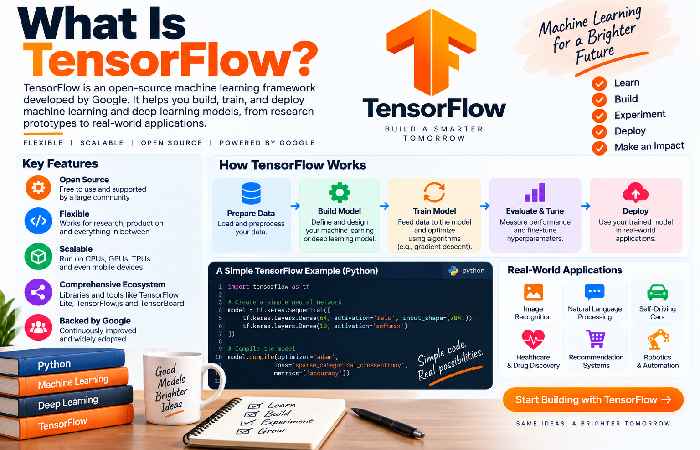
Tensor Flow is an open-source framework for developing and training models with data. It allows you to work with numerical data, train neural networks, and deploy models.
One of the main reasons for using Tensor Flow is that you’re not working alone – you’re working in an ecosystem of APIs and working with existing tools that have been built to experiment with different types of machine learning models.
For a beginner, Keras provides a simplified high-level way to develop neural networks.
What Do You Need to Know Before Learning Tensor Flow
There are several factors you need to know before you’re ready to learn Tensor Flow. These include:
Python basics (syntax, variables, functions, lists, dictionaries, conditional statements, loops)
NumPy basics
Machine learning basics
Understanding datasets, training, testing, model evaluation
You may need to spend some time brushing up on the basics of Python if you’re unfamiliar with it.
How Does Deep Learning with Tensor Flow Work?
Let’s look at a quick example of how deep learning with Tensor Flow works.
The data first has to be loaded into the model. Then, the data goes into the neural network, which produces a prediction.
This prediction is compared to the expected result using a loss function; then, the optimizer adjusts the internal model weights to reduce that loss, and so on and so forth.
A simple diagram:
Dataset Model Prediction Loss Optimization Improved Model
Once trained, you can evaluate the model using new data and verify whether it’s learned any useful patterns or is just memorizing the data.
Alternatives to Tensor Flow
The features below are provided by popular alternatives to Tensor Flow, such as PyTorch and Keras. Your decision on whether to use Tensor Flow should depend on the system you’re trying to develop and your learning style.
Feature Tensor Flow PyTorch Keras
Beginner friendly No No Very high
Python support Yes Yes
Neural networks Yes Yes
Training models Yes Yes
High-level API No Yes Very high
Conclusion
You don’t need to learn everything right away. Instead, get comfortable with working with tensors and developing neural network models and experiment with what you learn.
Start with Python and simple neural networks; learn how to prepare data and train a model; build on this knowledge by exploring more advanced techniques and ideas such as:
Convolutional neural networks
Image classification
Natural language processing
Transfer learning
Generative AI
Work on personal projects when you’ve learned enough rather than sitting through hours of video courses.
Common Tensor Flow errors
When you’re training models, you might run into errors like:
Import Error: No module named ‘tensorflow.python.framework. Capiconverter’
Incorrect data shapes, wrong input sizes, models that don’t have the right shapes and so on…
When you do encounter these errors, don’t give up. Read the message carefully; look at the shape and type of your data first.
Another mistake you’ll come across is trying many modifications at once. Use single-test experiments, and keep track of what works and what doesn’t.
Final words
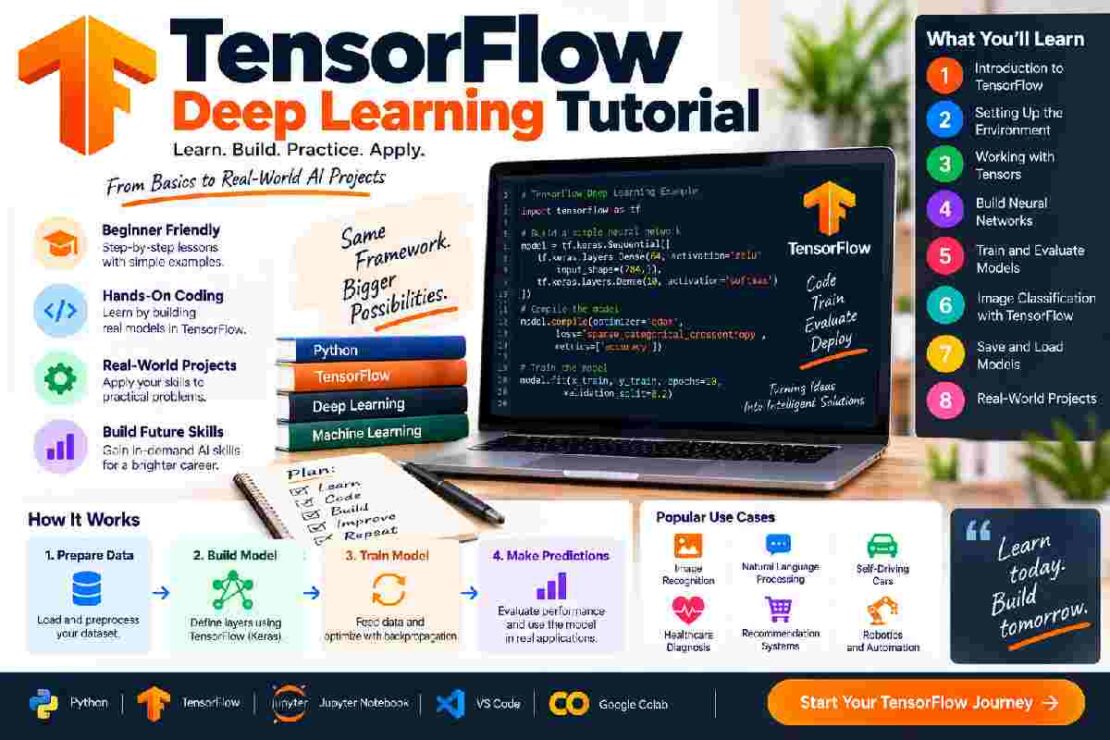
Tensor Flow Deep Learning Tutorial Find out how today’s neural-network design works with this excellent Tensor Flow deep learning tutorial. Once you grasp the Python and ML fundamentals, you can systematically work through Keras and Tensor Flow, building networks, fitting data, and enhancing your models. Do a couple of small projects, and the trial and error process to machine learning will be a much more efficient process than an infinite number of YouTube videos.