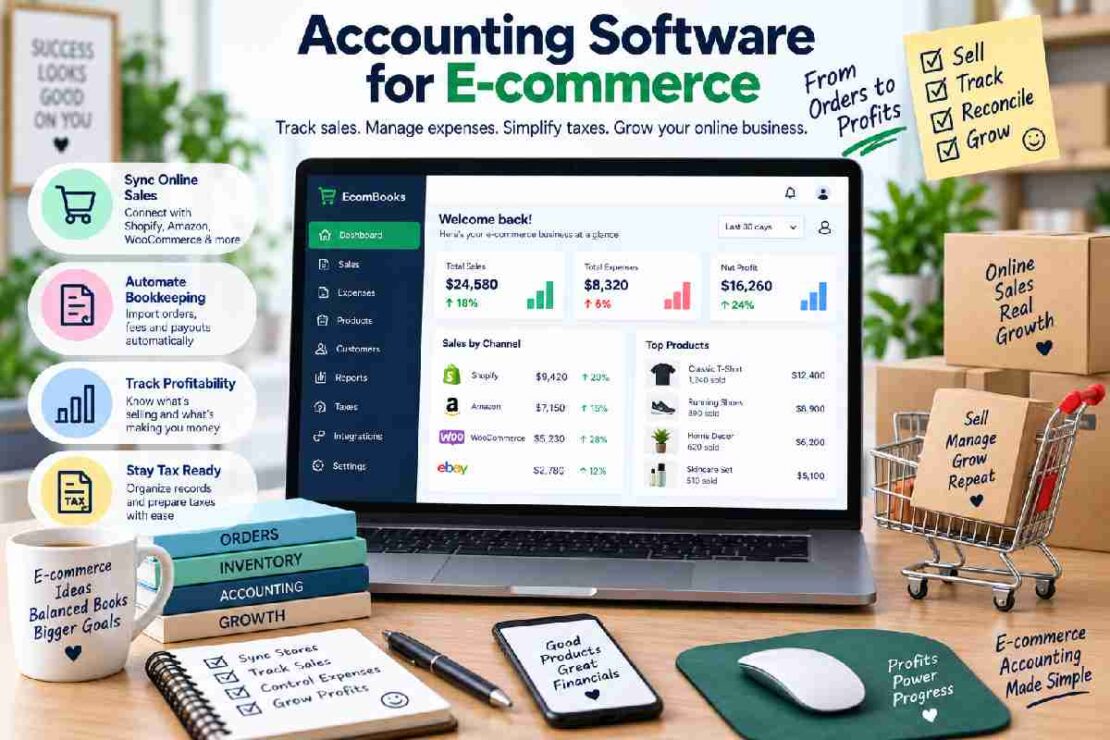
Having an online store consists of far more than only selling products online. You will also have to account for income, cost, goods sold (inventory), refunds, payment transaction charges, taxes and orders throughout your selling channel(s). Proper accounting software can centralize this information with a minimal amount of double entry.
No matter whether you are using Shopify, Amazon, market places or your own website you should select accounting software that integrates to make tracking financially efficient.
Best Accounting Software for E-commerce Compared
| Software | Best For | Key Strength |
|---|---|---|
| QuickBooks Online | Growing online stores | Complete accounting |
| Xero | Multi-channel sellers | Cloud accounting and integrations |
| Zoho Books | Small e-commerce businesses | Value and automation |
| A2X | Marketplace sellers | Automated transaction reconciliation |
| Sage | Established businesses | Accounting and financial management |
1. QuickBooks Online — Best Overall

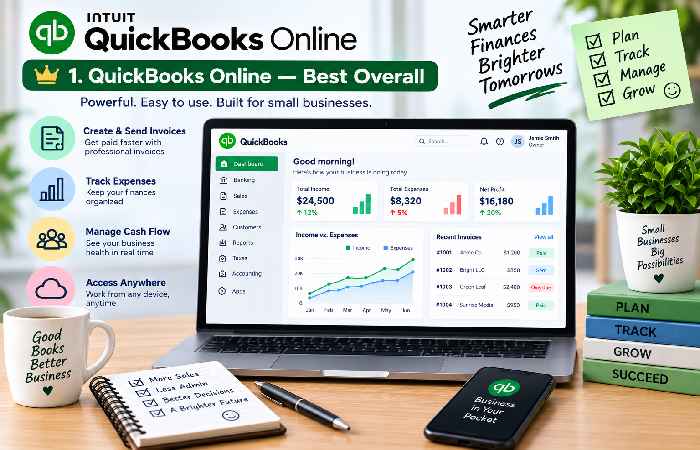
QuickBooks Online is a popular choice for e-commerce businesses that need more than basic bookkeeping. It provides tools for tracking income and expenses, managing invoices, reconciling bank transactions, and generating financial reports.
Its integrations with e-commerce platforms and payment services can help store owners bring sales and financial information into their accounting workflow.
Best for: Growing online stores that need comprehensive accounting.
Pros:
- Full accounting functionality
- Financial reporting
- Bank reconciliation
- Large integration ecosystem
- Suitable for growing businesses
Cons:
- Costs can increase as requirements grow
- E-commerce integrations may require additional tools
2. Xero — Best for Multi-Channel Sellers
Xero is cloud-based accounting software that can work well for businesses selling across multiple channels. It supports bookkeeping, bank reconciliation, expenses, invoicing, reporting, and integrations with third-party e-commerce applications.
For sellers operating a website alongside marketplaces, integrations can help reduce the need to manually enter every transaction.
Best for: E-commerce businesses with multiple sales channels.
Pros:
- Cloud-based
- Strong accounting tools
- Multi-channel integrations
- Bank reconciliation
- Useful reporting
Cons:
- Some integrations require additional services
- Costs can increase with additional apps
3. Zoho Books — Best Value
Zoho Books is an option for smaller online stores that want accounting tools without an unnecessarily complex setup. It includes invoicing, expense tracking, bank reconciliation, reporting, and other bookkeeping functions.
Businesses already using other Zoho applications may also benefit from the wider ecosystem.
Best for: Small e-commerce businesses looking for value.
Pros:
- Competitive pricing
- Accounting and bookkeeping tools
- Automation features
- Integrations with other business applications
Cons:
- Advanced requirements may require higher plans
- E-commerce functionality can depend on integrations
4. A2X — Best for E-commerce Reconciliation
A2X is designed specifically to help e-commerce sellers account for transactions from platforms such as Shopify and marketplaces. Rather than replacing a complete accounting platform, it works alongside accounting software to organize and reconcile sales data.
This can be particularly useful when a store has a high volume of orders, refunds, fees, taxes, and marketplace transactions.
Best for: E-commerce sellers dealing with large transaction volumes.
5. Sage — Best for Established Businesses
Sage offers accounting and financial-management solutions that can suit established businesses with more structured financial processes.
It may be a better fit for e-commerce companies that have moved beyond basic bookkeeping and need more robust accounting and reporting capabilities.
Best for: Established online businesses with more complex accounting needs.
What Should E-commerce Accounting Software Include?
The best e-commerce bookkeeping software should handle more than sales totals.
Look for:
- Sales tracking
- Expense management
- Inventory tracking
- Bank reconciliation
- Refund and return tracking
- Payment-processing fees
- Tax reporting
- Financial statements
- Multi-currency support
- E-commerce integrations
If you sell through Shopify, Amazon, Etsy, or multiple marketplaces, integrations become especially important.
Shopify Accounting Software: What to Look For
When choosing Shopify accounting software, check how the integration handles orders, refunds, taxes, discounts, shipping charges, payment fees, and payouts.
A good integration should reduce duplicate data entry and make it easier to reconcile the money that actually reaches your bank account with the sales recorded by your store.
Why Inventory Accounting Matters
Inventory can make e-commerce bookkeeping considerably more complicated.
Your accounting system may need to account for purchases, stock costs, sales, returns, shipping, and other inventory-related expenses. Inventory accounting software can help businesses maintain a clearer picture of product costs and profitability.
This becomes increasingly important as the product catalog and order volume grow.
How to Choose the Right Software
Start by looking at your sales channels.
A small Shopify store may only need straightforward accounting and inventory tracking. A business selling on Shopify, Amazon, and other marketplaces may need a multi-channel accounting software setup with automated reconciliation.
Before choosing a platform, check:
- Which e-commerce platforms does it integrate with?
- Can it reconcile marketplace payouts?
- Does it track inventory?
- Can it handle refunds and returns?
- Does it support your tax requirements?
- Can it scale as order volume increases?
Frequently Asked Questions
What’s the most suitable accounting software for ecommerce?
QuickBooks Online and Xero can be good, general purpose applications whereas the service of A2X will be highly valuable for those with more specialist ecommerce reconciliation needs.
Is accounting software required for a store which is online?
A store, which is at a very small scale may not require it but increasingly useful as your sales, stock levels and expense count increases or when sales channels expand to more than one avenue.
Which is the best accounting software to manage Shopify?
Again the scale and specific accounting needs of the store would deem necessary to be analyzed prior to making such a decision. Both QuickBooks Online, Xero and Zoho Books might be options, depending on integrations the specific workflow required on the store.
Will accounting software monitor my ecommerce stock count?
Certain accounting applications have stock count feature whereas some integrate with a stock management application. Research on a software’s capacity to manage its inventory before committing.
Final Verdict
Good e-commerce accounting software will link your various sales channels to your books while also trying to remove much of the manual work that accounting entails.
QuickBooks Online is an excellent choice all-around for growing stores. Consider Xero if you sell on multiple channels, Zoho Books if value is paramount for smaller shops, or A2X if the sole focus is on fully automated e-commerce reconciliation.
The feature set is less important than what your platform has to offer in terms of sales channels, Inventory and return management, payment reconciliation, and quality of data for better business decisions.