
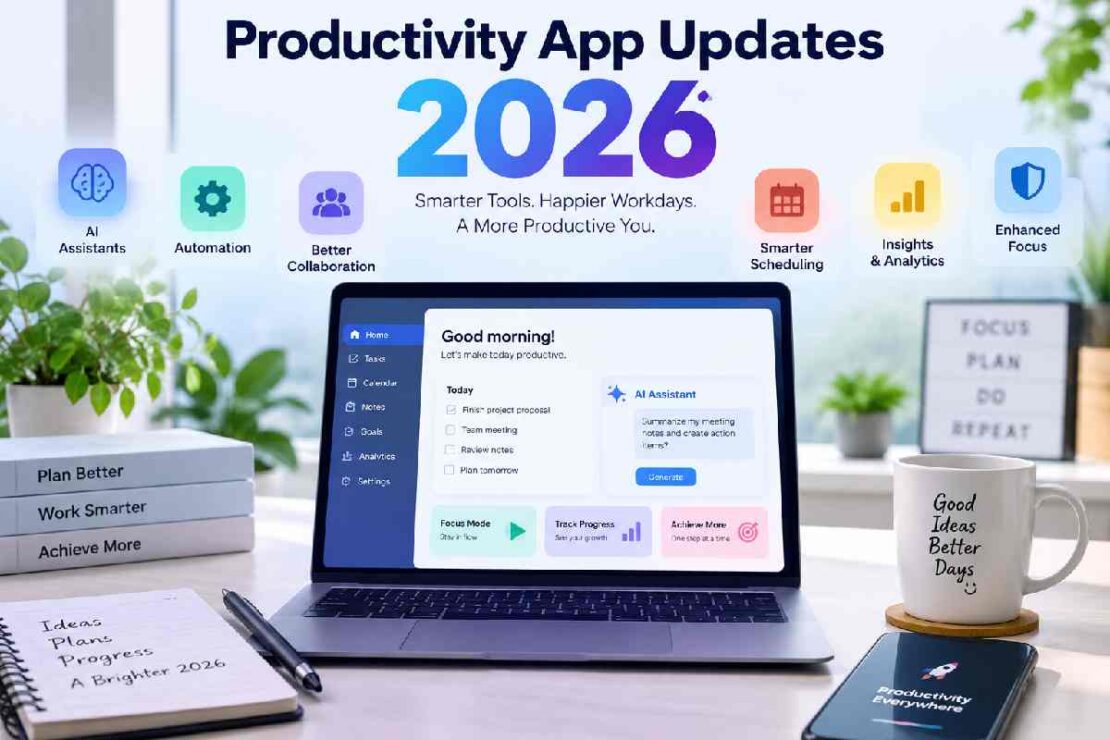
Updates to productivity apps have begun reshaping work in ways both practical and subtle, everything from how we plan our projects and handle tasks to how we collaborate with others, and how we organize our daily work. What began as the basic to-do list and calendar has turned into a broad application category, where modern applications integrate project management, collaboration, automation, AI, scheduling, and document sharing all in one tool.
For users, there lies a problem and a solution all in one place-where everyday work just gets easier, but keeping up with each and every software release can become overwhelming rather quickly.
This is why knowing which productivity apps update and when matters.
Regardless of if you’re trying to find the better task manager, comparison the top work management platforms, delve into AI productive apps, or find further value in the productivity apps you already use, this guide organizes the most essential features that will trend in 2026.
Ranging fromnew productivity app feature updates and improvements to AI, and from automating tasks to collaborating more fluidly, and secure apps to better mobile integrations, this pillar content will uncover what the updates include and how they impact your work.
What Are Productivity App Updates?

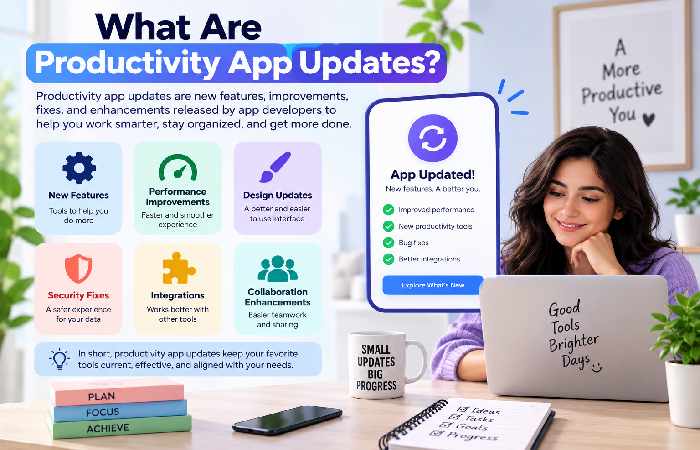
Productivity app update The term describes modifications in a previously existing product, released from the software providers. These may enhance it with a brand new element or feature, enhance the existent capabilities, resolve some technical defect or issue, modify the layout and/or its functionality, add enhanced security layers or to integrate with some other software. For example, this could take the form of, by presenting:
- A new AI writing assistant
- Automatic meeting summaries
- Improved task management
- Smart calendar scheduling
- New project templates
- Better team collaboration
- Workflow automation
- Enhanced search
- Mobile improvements
- New integrations
- Security enhancements
Some updates are very subtle and you might not see them effect how you use the software at all. Others may dramatically alter a workflow.
Which is why updates to productivity software is of especial importance to companies and users whose workflow and productivity hinges upon such software on a daily basis. A feature that might save just a few minutes per task used sporadically will not impact the average individual, but will represent a far more substantial impact when used by an organization hundreds of times a month.
Why Productivity App Updates Matter
It’s unlikely today’s companies purchase software once and then stop ever dealing with it again. It’s more like subscriptions that you perpetually update to the latest version as there is always active development going on by a software company, particularly in most productivity platforms. Features will get added/ changed based on customer feedback, updates in the tech, security needs, and as the competitive field shifts, meaning your application today might do things very different than it did a few months ago when you started.
Updates can improve efficiency
Smart update could remove extra process. Turn meeting notes into tasks and not manually create them. Far faster search by avoiding reading fifty some documents.
Have an AI help write an email instead of writing it fifty more times.
Individually a task could be incredibly small; individually they pile on really quickly.
Updates can also change the way teams work
A new collaboration feature can influence how employees communicate.
A project management update can change how managers assign work.
A new integration can remove the need to move information manually between applications.
For this reason, productivity updates are not simply technical announcements. They can influence real business processes.
The Biggest Productivity App Update Trends in 2026
The productivity software market continues to evolve around several major themes.
While individual applications have different roadmaps, many of the latest releases fall into similar categories.
1. Artificial Intelligence
The main story in modern productivity software is artificial intelligence Today, perhaps one of the most noticeable trends emerging from productivity software is artificial intelligence.They are integrating AI functions into the productivity platforms to enable them to assist users by helping to createcontent, summarize information, put together to-do list, find information, automate everyday tasks & more. And according to what your platform does, AI has the power to help with Writing & Editing, Meeting Summaries, Tasks, Planning Projects, Analyzing Data, Sending an Email, summarizing documents, research, brainstorming, workflow development.
The shift from current platforms now is it will start to bring artificial intelligence into the current work flow.
Instead of accessing another separate AI tools and copying and pasting among applications now you can find the AI assistance readily accessible within the productivity application already you are using. For the company, it also brings easier deployment of AI as now the employees need not learn another tool.
2. Smarter Task Management
- Task management continues to be core of productivity software.
But in the new generations of task managers more than simple to-do lists feature are seen now.
New task management features can organize the priorities of tasks, enable deadlines for tasks to be set, determine task owners, allow users to link tasks to larger project and more.
Some applications use the features of automation or AI to streamline organizations.
Take this example: A user can create a project and then have the application generate these suggestions:Tasks - Owners
- Deadlines
- Priorities
- Dependencies
- Project templates
The goal is not to eliminate human decision-making.
Instead, these features aim to reduce the administrative work involved in setting up and maintaining projects.
3. Workflow Automation
Automation is another major area of productivity technology updates.
Businesses often repeat the same processes every day.
A new customer may need to be added to a project.
A completed task may need to trigger a notification.
A new form submission may need to create a task.
A deadline may require notification.
These processes used to require manual workarounds.
You can configure automation to perform specific actions when you specify the rules.
Modern productivity apps also attempt to automate for technically inept users.
In lieu of manual configuration of workflow logic, some productivity apps ask users to type what they would like to accomplish in English (in their own words).
This can be particularly beneficial for small companies that don’t have any staff to administer IT.
4. Better Collaboration
Today, all workplaces rely more or less on teamwork. This could take the form of people across different cities/countries, or even in different timezones. Therefore, productivity applications have to help individuals share information with ease and coordinate.Recent improvements commonly focus on:
- Real-time editing
- Comments
- Mentions
- Shared workspaces
- Team dashboards
- Notifications
- Project visibility
- Meeting collaboration
- File sharing
The best collaboration updates are those that reduce the need for unnecessary communication.
If team members can see project status directly inside their workspace, they may not need to send another message asking for an update.
5. Improved Search and Knowledge Management
As organizations add more documents, tasks, messages, and files to productivity platforms, finding information becomes increasingly important.
Search is therefore becoming a major part of the productivity experience.
Modern search improvements may help users locate information across:
- Documents
- Projects
- Tasks
- Messages
- Comments
- Files
- Knowledge bases
AI-powered search can take this further by helping users ask questions instead of searching for exact keywords.
This is particularly useful for organizations with large internal knowledge bases.
6. Mobile Productivity Improvements
Productivity no longer happens only at a desk.
Professionals may review tasks while commuting, respond to messages from their phones, update project information between meetings, or check calendars while traveling.
For that reason, mobile improvements remain important.
A strong mobile productivity application should provide access to essential features without making users feel like they are using a reduced version of the desktop product.
Important mobile improvements can include:
- Faster navigation
- Better notifications
- Mobile task creation
- Offline access
- Improved synchronization
- Better document editing
- Voice input
7. Integration Improvements
No single application handles every business process.
Users often work with multiple platforms for communication, accounting, customer management, file storage, marketing, and project management.
Integrations connect these systems.
A productivity app update that adds a useful integration can therefore be more valuable than a cosmetic interface change.
For example, connecting a project management platform with another business application can reduce duplicate data entry and keep information synchronized.
When evaluating an update, always consider whether it works with the other tools already used by your team.
Latest Productivity App Features to Watch
The number of new features released by productivity companies can make it difficult to decide what deserves attention.
Instead of chasing every release, focus on features that solve a real problem.
Here are several categories worth watching.
AI Meeting Assistance
Meetings often create a second layer of work.
Someone has to take notes, identify decisions, record action items, and distribute follow-ups.
AI meeting features can help reduce this administrative burden.
Depending on the application, they may provide:
- Meeting summaries
- Key discussion points
- Action items
- Decisions
- Follow-up information
For teams that hold many meetings, this can be a particularly useful productivity improvement.
AI Writing Assistance
Writing is part of almost every professional workflow.
Employees create emails, proposals, reports, project briefs, documentation, and internal communications.
AI writing tools can help users:
- Create first drafts
- Rewrite text
- Summarize documents
- Adjust tone
- Improve clarity
- Generate outlines
The best use of these tools is usually as an assistant rather than a replacement for human review.
Users should still check facts, context, tone, and accuracy before publishing AI-generated material.
Smart Scheduling
Arranging schedules actually takes up a surprisingly big slice of the productivity pie.
Productivity apps these days seem eager to make calendars smarter and hence more productive by taking in account your availabilities, due dates, meetings and importance level of the task.
A wise arrangement is to find mutually available times for meetings or keep time chunks for deep work.
To busy people this can revolutionize their calendar from a recording sheet for all the appointments into a very active planning schedule.
Productivity Software Updates for Businesses
You need to think about updating employee productivity differently to an individual user. Just because a new feature appears it doesn’t automatically mean it’s worth rolling out to your whole team.
When you consider an update there are some fundamental questions to ask first:
1. Does it address a problem? Begin by considering the workflow as opposed to the feature. If you already do that efficiently, change isn’t needed.
2. How will it fit with existing tech? Take existing processes and test its compatibility first.
3. Will there be a training requirement? A feature isn’t useful if your staff cannot use it.
4. What security implications are there? Permissions, access control, user data, authentication and administrative actions are all pertinent.
5. Is the feature included in your subscription? This is crucial for AI features or enterprise tools.
Productivity App Updates for Small Businesses
Small businesses often have fewer employees and smaller technology budgets.
For these organizations, the most useful updates are usually those that reduce administrative work without adding complexity.
Useful improvements may include:
- Automated reminders
- Simple project templates
- AI-assisted writing
- Calendar integration
- Team task management
- Document organization
- Basic reporting
The key is simplicity.
A small business does not necessarily need the application with the largest number of features.
It needs the tools that fit its workflow without creating unnecessary management overhead.
Productivity App Updates for Remote Teams
Remote teams have different productivity requirements.
Employees cannot always walk over to a colleague’s desk or ask a manager for a quick status update.
This makes visibility especially important.
Useful updates for remote teams include:
- Shared project dashboards
- Better notifications
- Asynchronous communication
- Meeting summaries
- Shared documentation
- Time-zone support
- Task ownership
- Progress tracking
The goal is to make important information accessible without requiring everyone to attend another meeting.
Productivity Apps and AI Automation
AI and automation are increasingly overlapping.
Traditional automation generally follows predefined rules.
For example:
When task status changes → send notification.
AI-powered automation can potentially interpret more complex instructions.
For example:
Look at your project data and point out potential trouble spots.
It’s important to draw this distinction as AI can bring new flexibility to productivity systems.
But new flexibility brings the need for more oversight and the decision for humans to not assume that an automatically recommended solution is correct. Instead, for vital decisions, humans need to be the ultimate decision maker by taking responsibility for reviewing outputs.
Here’s how to assess a new productivity app feature
So don’t use the opportunity provided by new features necessarily; use a simple assessment before rolling the feature out:
1. Is there an actual problem your team is facing and will this new feature solve it?
2. What’s the time required for the current process and for the task with the new feature?
3. Apply your new feature to one smaller project.
4. Compare that time required from item #2 before and after you used your new feature. Is it actually saving your team time or enhancing visibility in some other helpful way?
5. Look for additional potential new problems it created like extra work, training needed, or confusing workflow.
Step 6: Decide whether to adopt it
If the benefits clearly outweigh the costs, introduce it more widely.
This approach prevents teams from adopting new features simply because they are new.
Productivity App Release Notes: Why They Matter
Release notes are one of the most useful sources of information for software users.
They explain what has changed between versions.
Depending on the company, release notes may include:
- New features
- Improvements
- Bug fixes
- Security changes
- Integration updates
- Deprecations
- Performance improvements
For business users, release notes can be particularly valuable because a seemingly small change may affect an existing workflow.
If your team relies heavily on a productivity application, checking its release notes regularly is a good habit.
How Often Should You Check Productivity App Updates?
You do not need to check every software announcement every day.
A monthly review is enough for many users.
During a monthly review:
- Check the release notes for your most important applications.
- Identify features relevant to your workflow.
- Test useful updates.
- Review any changes to pricing or plans.
- Check whether existing integrations still work.
- Update internal documentation if necessary.
Larger organizations may want a more formal software-update process.
This can include testing changes before they are introduced across the organization.
Common Problems After Productivity App Updates
Updates are designed to improve software, but changes can occasionally create problems.
A feature has disappeared
The feature may have been moved, redesigned, or restricted to a different plan.
Check the latest release documentation before assuming it was removed.
An integration stopped working
A software update may change how an integration connects.
Check the integration settings and reconnect the service if necessary.
The application feels different
Interface redesigns can temporarily reduce familiarity.
Give employees time to adjust and provide updated documentation where needed.
Performance changed
If an application becomes slower after an update, check whether another update is available and review the provider’s support documentation.
AI features are unavailable
AI capabilities may depend on region, account type, subscription level, or administrator settings.
Always check the requirements for the specific feature.
How Productivity App Updates Affect Different Users
Different users need different types of improvements.
| User | Most Valuable Updates |
|---|---|
| Students | Notes, calendars, task management |
| Freelancers | Scheduling, automation, client management |
| Small businesses | Collaboration, workflows, reporting |
| Marketing teams | Project management, content workflows |
| Developers | Documentation, task tracking, automation |
| Enterprise teams | Security, administration, AI, reporting |
This is why there is no single “best” productivity application for everyone.
The right choice depends on your work style and requirements.
Productivity App Updates vs. New Productivity Tools
There is an important difference between updating your existing application and switching to a new tool.
An update lets you improve the workflow you already have.
A new application may offer capabilities that your current software does not provide.
Before switching, check whether your existing platform has recently introduced a feature that solves the problem.
You may discover that you do not need another subscription after all.
This is one reason staying informed about latest productivity tools and existing software updates can help businesses control software costs.
When Should You Switch Productivity Apps?
An update does not always solve every problem.
Consider changing platforms when:
- Your current application no longer fits your workflow.
- Important features are consistently missing.
- Your team struggles with usability.
- Integrations are inadequate.
- Performance is consistently poor.
- The pricing no longer makes sense.
- Another platform offers significantly better functionality.
However, switching software has a cost.
You may need to migrate information, train employees, rebuild workflows, and recreate integrations.
Therefore, compare the expected benefits with the cost of migration.
Productivity App Updates and Software Costs
New features can sometimes influence subscription pricing.
Before adopting a new capability, check:
- Which plans include it?
- Are there user limits?
- Is AI usage restricted?
- Are advanced integrations included?
- Does the feature require an additional subscription?
A feature may be useful, but the total cost should be considered alongside its expected productivity benefit.
For businesses, calculate the potential return rather than judging a feature based only on its feature list.
How to Build a Better Productivity Stack
A productivity stack is the collection of software tools you use to manage work.
It might include:
- Task management
- Project management
- Communication
- Calendar
- Documents
- File storage
- Customer management
- Accounting
- Automation
The goal should not be to collect as many applications as possible.
A smaller stack with strong integrations can often be easier to manage.
When evaluating a new productivity app update, ask whether it allows you to remove another tool or simplify an existing process.
That can be more valuable than simply adding another feature.
A Simple Productivity Update Checklist
Use this checklist whenever an important software release arrives.
Before the update
- Read the release notes.
- Identify affected workflows.
- Check compatibility.
- Review account requirements.
- Consider security implications.
During testing
- Try the feature with a small group.
- Compare it with the old workflow.
- Record problems.
- Ask users for feedback.
After adoption
- Update documentation.
- Train users if necessary.
- Monitor performance.
- Measure productivity improvements.
- Review the feature after several weeks.
This creates a repeatable process rather than making software decisions reactively.
What to Expect From Future Productivity Technology Updates
Productivity software is likely to continue moving toward more intelligent assistance.
Future developments may focus on applications that understand context and help users complete multi-step workflows.
Instead of simply responding to a command, productivity systems may increasingly help coordinate information across tasks, documents, calendars, and projects.
Another important development is likely to be greater integration between applications.
Rather than keeping information isolated inside separate tools, users will expect their productivity systems to work together more naturally.
At the same time, security and privacy will remain important considerations.
The more information productivity platforms can access, the more important it becomes for users and organizations to understand how that information is handled.
How to Stay Updated Without Getting Overwhelmed
Following every productivity announcement is not practical.
A better approach is to create a small update routine.
Follow your most important apps
Choose the applications that your work depends on most.
Review updates periodically
A weekly or monthly review is usually enough for most users.
Ignore irrelevant features
Not every update needs to change your workflow.
Test before adopting
Try significant features before rolling them out to everyone.
Keep your tools organized
Remove unused applications and integrations periodically.
The objective is not to use every new feature.
The objective is to identify the updates that genuinely improve the way you work.
Frequently Asked Questions About Productivity App Updates
What are the latest productivity app updates?
What are this week’s most common productivity app updates? Most of the updates this week are related to AI assistant, task management, automation, collaboration, search, integrations, and better user experiences. The details of the updates depend upon the apps.
Why are productivity app updates important?
Updates can enhance performance, add valuable features, fix security vulnerabilities, and streamline routine processes.
How often should I check productivity app release notes?
Most users should review I would advise once a month to be enough. Some businesses with mission-critical applications may need to review every few weeks.
Are productivity app updates free?
It depends on the feature and the application. Some updates are free for everyone, while others are paid.
Are AI productivity features worth using?
These are helpful for executing over and over tasks like condensing information, writing tasks, to do list and preparing notes of meetings. These results are to be checked before finally used.
When a peer competitor releases a feature superior to mine, then even if they are not more popular than me, I am going to switch.
Not necessarily. Determine if there is a comparable feature on your current application or if your current application has a corresponding planned update. Moving to new software may incur migration, retraining, and integration costs.
What should businesses consider before adopting an update?
Consider checking the usability of the new system, security features, cost, possible integrations, admin features, training your employees, and impact on your current workflows.
Where can I find productivity app release notes?
How do software companies announce new releases? Many software vendors post release notes, product news, or update information on the main website or support pages.
Final Thoughts on Productivity App Updates
Productivity apps are changing rapidly, but that doesn’t mean you need to adopt every new feature. The most effective way to stay up-to-date is to utilize the productivity app changes and releases that actually solve real problems in the workplace:
* AI assistant features streamline tedious tasks.
* Automation brings repeated work to your fingertips.
* Collaboration features offer transparency throughout your team.
* Smarter search methods makes it easier to find information, fast.
* Improved integrations eliminate duplicate data migration and the work associated with it.
All of these advancements help improve your typical workday processes.
We’ve put together a Productivity App Updates center that can help you make the most of each change, without having to sift through every software development announcement yourself. You can browse our guides on new productivity app features, software releases, work management changes, AI productivity apps, comparison reviews, and how-to-guides for utilizing your current programs more effectively.
As productivity technology continues to develop throughout 2026, the ones with the most software at their fingertips will not win. The ones with workarounds that effectively utilize applicable tools, features, and updates in a true work-optimization way will triumph.
.