The Best Online Coding Platforms with Certificates for a resume Coding certificates may offer beginners, university students, aspiring professionals and even current industry professionals the opportunity to acquire new skills in programming and obtain a tangible recognition to add to their resumé or professional page. There is, however, a very important caveat : Not all coding certificates are equal. While an online certification from a learning website testifies that you’ve completed an online module, an online certification issued from a university or an industrial firm will weigh differently.
Thus, you cannot pick a platform simply based on the term ‘certification’.
Here’s our comparison of coding platforms, ranking the best in 2026 as per learning structure, practical application, certified outcomes, and level of suitability for beginners.
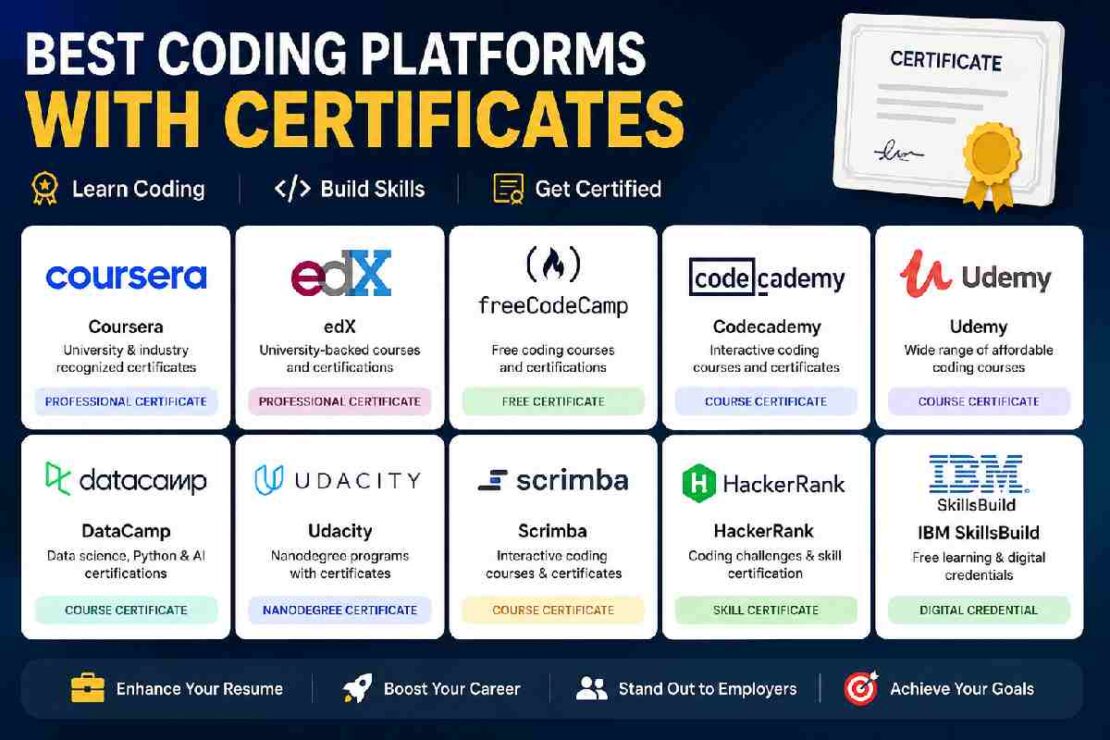
Best Coding Platforms With Certificates at a Glance
| Platform | Best For | Certificate | Hands-On Practice | Free Learning |
|---|---|---|---|---|
| Coursera | Professional certificates | Yes | High | Some |
| edX | University-backed learning | Yes | High | Audit options |
| freeCodeCamp | Free coding certifications | Yes | High | Yes |
| Codecademy | Interactive coding | Yes | Very High | Some |
| Scrimba | Interactive development | Yes | Very High | Some |
| Udemy | Affordable courses | Yes | High | Limited |
| DataCamp | Data and Python | Yes | Very High | Some |
| Udacity | Career-focused programs | Yes | Very High | Limited |
| HackerRank | Coding skills & challenges | Selected credentials | Very High | Yes |
| IBM SkillsBuild | Free professional learning | Badges/credentials | High | Yes |
Features and pricing can change. Check the provider’s current course page before enrolling.
1. Coursera – Best for Professional Certificates
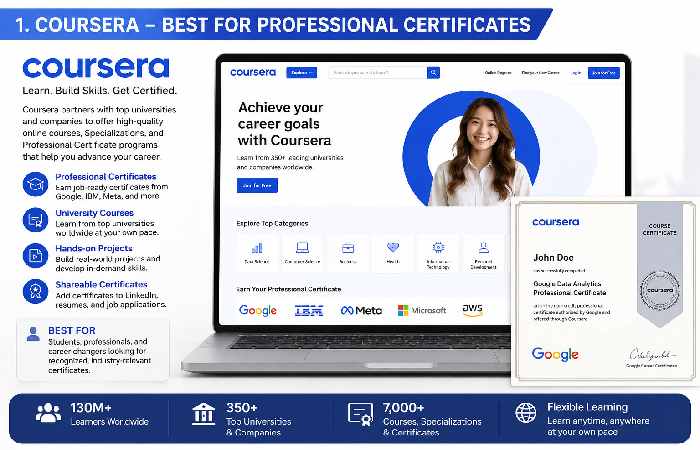
If the priority is to pair coding learning with a credible credential then Coursera is one of the best bets. Courses are provided by universities along with the best tech companies. Coursera covers computer programming, Python programming, web design, data science, machine learning/AI, and software design.
Some of the more career-oriented options – such as certificates in data analysis or deep learning by Google or IBM – will definitely appeal to anyone whose main motivation is getting certified.
Best for: Professionals, career switchers, students.
Why choose Coursera?
- Professional certificate programs
- University and company partnerships
- Programming and computer science courses
- Hands-on projects
- Shareable credentials
- Structured learning paths
If your goal is to put a certificate on your resume, look carefully at who issued the credential, not simply the platform hosting it.
2. edX – Best for University-Backed Coding Courses
For someone interested in an academically geared approach to programming, edX is a great resource. A famous example is Harvard’s CS50, an introductory CS course that teaches core computer science as well as languages like C, Python, SQL, HTML, CSS, and JavaScript. The Best Choice For: Students who want their hands to be in the fundamentals of computer science.
Why choose edX?
- University-backed courses
- Computer science fundamentals
- Programming courses
- Professional certificate programs
- Flexible online learning
edX can be especially useful if you want to understand why programming works rather than simply learning syntax.
3. freeCodeCamp – Best for Free Coding Certificates
If you’re looking strictly for free coding certificates, freeCodeCamp should be one of the initial platforms you research. They are very much based around learning a skill while completing a real world coding project that they use as a building block towards certification. As of 2026 comparisons, freeCodeCamp is still touted as one of the big players for obtaining an free online coding certificate.
Best for: Beginner coders that are self-motivated and on a budget.
The pros are:
– Learn at your own pace for free
– Lots of learning projects
–Coding exercises and drills
–Certification paths to follow
– Large programmer community to tap into
– Build yourself a portfolio
The downside is that you’ll need more self-motivation than you would in a bootcamp.
4. Codecademy – Best for Interactive Learning
Codecademy is an extremely interactive programming platform. Instead of consuming long lecture-style videos before trying your hand, on Codecademy, you can write code snippets right in the middle of a lesson. It is extremely useful especially for people whose method of learning is learning by doing.
Most suitable for: Beginners in programming looking to jump in immediately and write code.
It has learning paths in languages and technologies like Python, Javascript, SQL, Web Development etc. The biggest plus: The Learn Write code make mistakes, fix code, continue cycle. This gives more the feel of how actual programming really works compared to someone watching video for hours.
5. Scrimba – Best for Interactive Coding Courses
Scrimba is also a great choice if you’re a learner that wants to code throughout your lesson. The Scrimba team provides courses that are interactive, enabling learners to interact with the code. The 2026 comparison of coding courses made by Scrimba tests coding classes on format, price, availability for free, and any certifications offered.
Suitable For: Visual and interactive learners.
Scrimba is exceptionally valuable if someone is looking to get into front-end development.
6. Udemy – Best for Affordable Course Certificates
Udemy has a huge selection of programming courses covering Python, Java, JavaScript, web development, databases, software engineering, and more.
Many courses provide a certificate of completion.
Best for: Learners who want a specific skill at a relatively low course price.
The important thing to remember is that Udemy certificates are generally course completion certificates, not professional licenses or industry certifications.
That doesn’t make the learning useless. It simply means you should pair the credential with projects and demonstrable skills.
7. DataCamp – Best for Python, Data and AI
DataCamp is particularly useful for learners interested in Python, data analytics, data science, and machine learning.
Its interactive approach combines short lessons with coding exercises, making it easier to move from explanation to practice.
Best for: Data-focused programming learners.
Choose DataCamp if your goal is something like:
Python → SQL → Data Analysis → Machine Learning
rather than general software development.
8. Udacity – Best for Career-Focused Learning
Udacity heavily emphasize on career-focused technology training. They offer courses with practical, project-focused, job-relevant content, which is good for learners with a definite career plan. Ideal for: Those wanting to launch a career in software development, data science, AI, or technology field. The main draw comes from project-based learning, as opposed to getting a certificates without building anything worthwhile.
9. HackerRank – Best for Coding Practice
HackerRank is different from traditional online coding courses.
Its main strength is coding practice and technical problem solving. You can solve programming challenges and develop skills useful for technical assessments and interviews.
Best for: Developers preparing for coding interviews.
If you’ve completed a beginner course, adding HackerRank practice can help you answer a more important question:
Can I actually solve programming problems without following a tutorial?
That’s a valuable step toward becoming job-ready.
10. IBM SkillsBuild – Best Free Professional Learning
IBM SkillsBuild provides free learning resources and digital credentials across technology and career skills.
It can be useful for learners who want to combine free education with credentials associated with a major technology company.
Best for: Students and job seekers looking for free technology learning.
When comparing credentials, check whether you’re receiving a course completion certificate, digital badge, or professional certification because these represent different types of achievement.
Certificate vs Certification: What’s the Difference?
This is one of the most important things to understand before enrolling.
Certificate
A certificate usually confirms that you completed a particular course or learning program.
For example:
“Completed Introduction to Python”
It demonstrates learning activity, but it doesn’t necessarily prove professional-level competency.
Certification
A certification generally involves an assessment designed to validate specific skills or knowledge against a defined standard.
In other words:
Certificate = I completed this learning program.
Certification = I demonstrated that I meet a defined competency standard.
Don’t use these terms interchangeably when evaluating programs.
Are Online Coding Certificates Worth It?
Yes—but their value depends heavily on the issuer and what you can demonstrate alongside the credential.
A certificate becomes much more useful when it is supported by:
- Real coding projects
- GitHub repositories
- Practical assignments
- Portfolio websites
- Technical assessments
- Relevant work experience
- Recognized issuing organizations
A recruiter is unlikely to hire someone simply because they have ten course certificates.
They are much more interested in what the candidate can actually build.
What Makes a Coding Certificate Valuable?
Use this checklist before enrolling:
| Factor | Why It Matters |
|---|---|
| Issuing organization | Establishes credibility |
| Practical projects | Demonstrates applied skills |
| Assessment | Shows whether knowledge was tested |
| Verification | Makes the credential easier to validate |
| Curriculum quality | Determines what you actually learn |
| Industry relevance | Connects learning to real jobs |
| Portfolio opportunities | Gives you evidence beyond the certificate |
Best Free Coding Certificates in 2026
If your budget is limited, start with platforms that offer meaningful free learning or certification options.
Strong options include:
- freeCodeCamp – Free project-based certifications
- IBM SkillsBuild – Free technology learning and digital credentials
- HackerRank – Free coding practice and selected skill credentials
- Kaggle – Free data and machine learning learning resources
- University/open-course options – Free access may be available, although certificates can sometimes require payment
The crucial distinction is whether the course is free and whether the certificate is free. They are not always the same thing. Current 2026 comparisons specifically warn learners to check where a platform’s paywall appears.
How to Choose the Right Coding Platform
Don’t choose a platform just because it advertises a certificate.
Instead, match the platform to your goal.
If you’re a complete beginner
Start with Codecademy, freeCodeCamp, Coursera, or Scrimba.
If you want a professional credential
Consider Coursera or edX, particularly programs connected to established universities or technology companies.
If you want free certification
2. Take Free Courses and Be Mindful of What the Certification Really Is For example, take look at freeCodeCamp and IBM SkillsBuild but make sure to verify exactly what sort of certificate you get. If you are getting ready for interviews Get a HackerRank certification in addition to a basic programming course. If you are interested in data science and Python DataCamp, Coursera, and Kaggle is where you want to head.
If you are aiming to become web developer freeCodeCamp, Scrimba, Codecademy and Udacity is your bet.
When choosing to take online coding courses The certificate does say that it is accredited, so what does that mean? First research which institution is providing the accreditation and see that the education institute or professional body actually holds genuine credentials. I have a number of certificates but never do anything. Go and complete one or two small projects first then take a more course.
A lot of courses say that the certificate is free but charge money for the certificate?
This is very common when taking certificate course.
.
FAQ
Which coding platforms offer certificates?
Coursera, edX, freeCodeCamp, Codecademy, Scrimba, Udemy, DataCamp, Udacity, and several other platforms offer certificates or digital credentials-though the nature and validity vary depending on the platform.
Which sites give you free coding certifications?
FreeCodeCamp is probably the most well-known platform for free coding certificates.
A few others provide free learning with digital credentials, includingIBM SkillsBuild.
Are online coding certificates valid?
Whether or not a certification is valuable depends heavily on the issuing authority, as well as on the certificate itself. For example, a professional credential from a university or a tech giant might hold more weight than just an email with an automated course completion notice.
Will a coding certification get me hired?
Unless the certificate comes with direct job opportunities or is part of a high-profile curriculum, the answer is likely no. The skills gained on such platforms can and should be demonstrated through practical coding projects, a portfolio of work and demonstrated knowledge/skills.
What is the best coding platform for beginners?
The freeCodeCamp,Codecademy,andScrimbaplatforms are among the best for beginners, especially if you’d like a free education or a more interactive one respectively. Coursera also offers several beginner-friendly coding courses, including ones backed by universities and employers like IBM.
Are free coding certificates valuable?
Yes-to an extent.
You learn skills from free certificate programs-and when backed by demonstrateable projects, those certificates can prove to be very useful.
Final Verdict
The top coding certificate platforms are not necessarily those with certificates themselves.
If you’re seeking a free learning route, you should look to freeCodeCamp, or even IBM’s SkillsBuild. For practice-based learning, Codecademy, or even Scrimba might be a more solid option. If you want certifications with a professional and academic link, consider those on Coursera, or edX. For highly niche domains, consider DataCamp or Udacity as potential solutions.
However, it is even more important than obtaining certifications, not to collect nothing from learning except certificates. A clear path to learning seems like this:
course -> practice -> project -> certificate -> portfolio -> Job / Opportunity