
Last Updated: July 15, 2026
Introduction
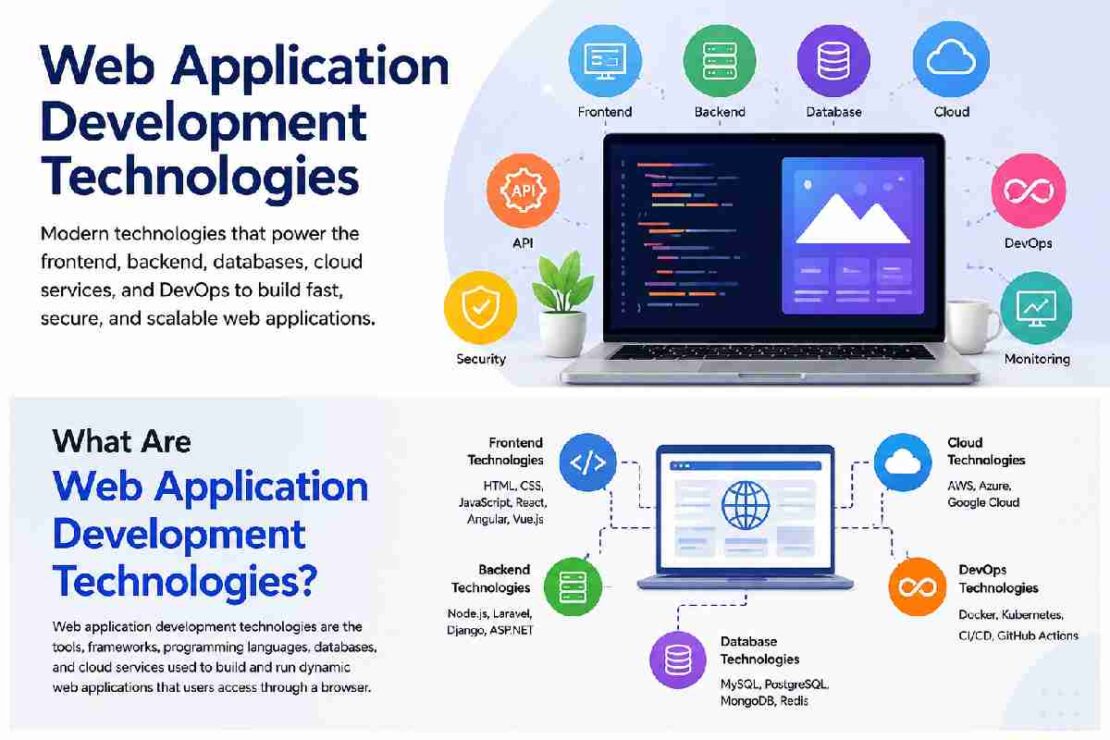
With recent progress in modern web application development technologies, businesses can now build faster, secure and highly scalable digital products. Whether you’re building an eCommerce site, SaaS platform, a CRM system, or a large enterprise portal, the technologies you choose for your web app will greatly affect its performance, security, costs of maintenance, and scalability prospects in the long run.
This is the guide you need if you want to discover top frontend and backend frameworks, database solutions, cloud technologies, and DevOps tools in 2026. You will be provided with a clear process to choose the right stack for your next web application development project and a comparison of such tech choices as React vs Angular vs Vue and Node.js vs Laravel vs Django.
What Are Web Application Development Technologies?

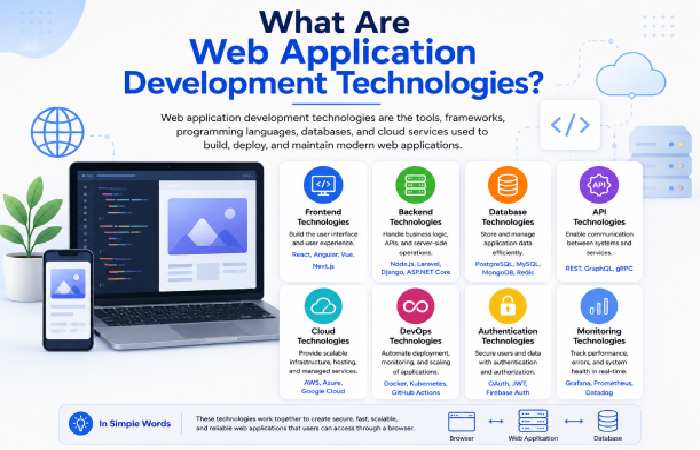
Here are technologies for building web applications The following are web development technologies: – Programming language(s) – Frameworks (web frameworks) – Cloud platform and PaaS(s) – Deployment tools – Databaases (including Database management systems) We need all of these to build the website as you know a fully developed stack. – front end developer skills – back end developer skills – databases (and Database Management System) – API(s) – Cloud hosting, and cloud based PaaS(s) –DevOps(automation, practices and tools ,CI/CD
Modern Web App Tech Stack Technologies (2026)
Use Primary Technology Frontend React, Angular, Vue.js, Next.js To build the User Interface (UI) of your app back-end Node.js, Laravel, Django, ASP.NET Core To build the logic of the system and accept requests to your systemdatabases PostgreSQL, MySQL, MongoDB, Redis To store the data of the systemAPI REST, GraphQL, gRPC For two systems or more systems to communicate Cloud AWS, Azure, GCP To leverage the services of storage, computing, networks, etc DevOps Docker, Kubernetes, GitHub Actions To build the process of automating operation and deployment authentication OAuth 2.0, JWT, Firebase Auth To protect the resource by issuing tokens and providing authorized accesses monitoring Grafana, Prometheus, Datadog To help understand the behavior of your systems in-depth
Frontend Technologies
Frontend technologies control everything users interact with.
React
Best for:
- SaaS products
- Dashboards
- Enterprise software
- Large-scale applications
Advantages
- Huge ecosystem
- Fast rendering
- Component-based
- SEO support using Next.js
Angular
Ideal for
- Enterprise systems
- Banking software
- Government portals
Advantages
- Built-in architecture
- Strong TypeScript support
- Long-term maintainability
Vue.js
Perfect for
- Startups
- MVPs
- Small businesses
Advantages
- Easy learning curve
- Lightweight
- Excellent performance
React vs Angular vs Vue
| Feature | React | Angular | Vue |
|---|---|---|---|
| Learning Curve | Easy | Difficult | Easy |
| Performance | Excellent | Excellent | Excellent |
| Flexibility | High | Medium | High |
| Enterprise Support | High | Very High | Medium |
| Community | Very Large | Large | Large |
| Best For | SaaS | Enterprise | Startups |
Backend Technologies
The backend powers authentication, databases, APIs, and business logic.
Node.js Development
Best suited for
- Real-time apps
- Chat applications
- Streaming platforms
- APIs
Advantages
- JavaScript everywhere
- Fast
- Event-driven architecture
- Huge npm ecosystem
Laravel Development
Laravel remains one of the most productive PHP frameworks.
Best for
- Business websites
- eCommerce
- CMS platforms
- CRM software
Benefits
- Elegant syntax
- Built-in authentication
- Queue management
- Excellent security
Django Framework
Python’s Django framework excels in rapid development.
Best for
- AI platforms
- Healthcare software
- Data-heavy applications
- Machine learning projects
Advantages
- Extremely secure
- Fast development
- Powerful admin dashboard
- ORM included
Backend Framework Comparison
| Framework | Language | Speed | Security | Scalability |
|---|---|---|---|---|
| Node.js | JavaScript | ⭐⭐⭐⭐⭐ | ⭐⭐⭐⭐ | ⭐⭐⭐⭐⭐ |
| Laravel | PHP | ⭐⭐⭐⭐ | ⭐⭐⭐⭐⭐ | ⭐⭐⭐⭐ |
| Django | Python | ⭐⭐⭐⭐ | ⭐⭐⭐⭐⭐ | ⭐⭐⭐⭐⭐ |
Database Technologies
Choosing the correct database improves application performance.
SQL Databases
Examples
- PostgreSQL
- MySQL
- SQL Server
Best for
- Banking
- ERP
- Accounting
- Inventory
NoSQL Databases
Examples
- MongoDB
- Cassandra
- Redis
Best for
- Social media
- Analytics
- IoT
- Big data
Database Comparison
| Database | Type | Best Use |
|---|---|---|
| PostgreSQL | SQL | Enterprise Apps |
| MySQL | SQL | Websites |
| MongoDB | NoSQL | Dynamic Data |
| Redis | In-memory | Caching |
| Firebase | Cloud NoSQL | Mobile Apps |
Cloud & DevOps Technologies
Modern applications rely heavily on cloud-native architecture.
Popular cloud platforms include
- AWS
- Microsoft Azure
- Google Cloud Platform
Popular DevOps tools
- Docker
- Kubernetes
- Jenkins
- GitHub Actions
- Terraform
Benefits include
- Faster deployment
- Automatic scaling
- Lower downtime
- Disaster recovery
- Continuous integration
2026 Technology Adoption Snapshot
| Technology | Estimated Enterprise Adoption | Trend |
|---|---|---|
| React | 68% | Strong Growth |
| Node.js | 65% | Strong Growth |
| Docker | 83% | Industry Standard |
| Kubernetes | 74% | Enterprise Standard |
| PostgreSQL | 58% | Growing |
| Django | 29% | Steady |
| Laravel | 34% | Stable |
| Vue.js | 22% | Moderate |
Note: The above are generalized industry-wide trends drawn from a combination of recent developer ecosystem survey reports and market intelligence for 2025-2026, and should not be considered specific market share figures, but used to compare against other data.
How to Choose the Right Web Application Technology Stack
Consider the following before selecting technologies:
- Project complexity
- Expected traffic
- Development budget
- Team expertise
- Security requirements
- Scalability goals
- Time-to-market
- Third-party integrations
For example:
- Startup MVP → Vue + Node.js + MongoDB
- Enterprise ERP → Angular + ASP.NET Core + PostgreSQL
- AI platform → React + Django + PostgreSQL
- eCommerce → React + Laravel + MySQL
Common Technology Stack Mistakes
Avoid pitfalls:
Selecting technologies only because of their popularity.
Ignoring long-term costs for maintenance.
Combining frameworks that don’t play well with each other.
Forgoing security from the beginning.
Overlooking the necessity for automatic testing and CI/CD pipelines.
Planning without room for future scalability.
Troubleshooting Common Development Challenges
| Problem | Possible Cause | Recommended Solution |
|---|---|---|
| Slow page loading | Large JavaScript bundles | Enable code splitting and lazy loading |
| API response delays | Inefficient backend logic | Optimize queries and add caching |
| Frequent deployment failures | Manual release process | Implement CI/CD pipelines |
| Database bottlenecks | Missing indexes | Optimize schema and indexing |
| Scaling issues | Monolithic architecture | Consider microservices where appropriate |
FAQ
What are the top web application development technologies of 2026?
Top most popular technologies in 2026 that we can expect in order to build high scalable web applications will be, in no order: React Node.js PostgreSQL Docker Kubernetes Laravel Django Cloud Technologies ( AWS, Azure, GCP)
What’s the best front end framework?
React, due to its extensive community support and flexibility Angular is great for building complex, enterprise-grade applications VUE is considered the best for the rapid development of a wide variety of projects
What back end framework to use?
Node.js if you have a real-time, or API-based application Laravel if you are looking to build business applications with PHP Django if you have a project with many data, perhaps AI driven, that you plan to write with Python
What database to use?
PostgreSQL, if you require a structured, well-defined relational database. MySQL is also a good option if a robust and established relation database is required. MongoDB is good if you deal with a document based approach and need that flexibility. Cache is sometimes handled through systems like Redis.
Why are DevSecOps tools important?
DevSecOps tools make applications more reliable by integrating automated tests, automated code reviews, and infrastructure provisioning for faster and safer delivery and release. They also enhance an application’sabilityto scale.
Conclusion
Selecting web application development technologies Selecting which web app development technology is one of the crucial decision factors that most of you face while planning to build an application, and no better can it get, as far as the technology stacks concerned. It’s not only dependent on what’s hot, but also depends on the purpose of your web application, traffic expectations, budget constraints, security considerations, and its growth prospects.
For more info Visit : https://en.wikipedia.org/wiki/Web_application