
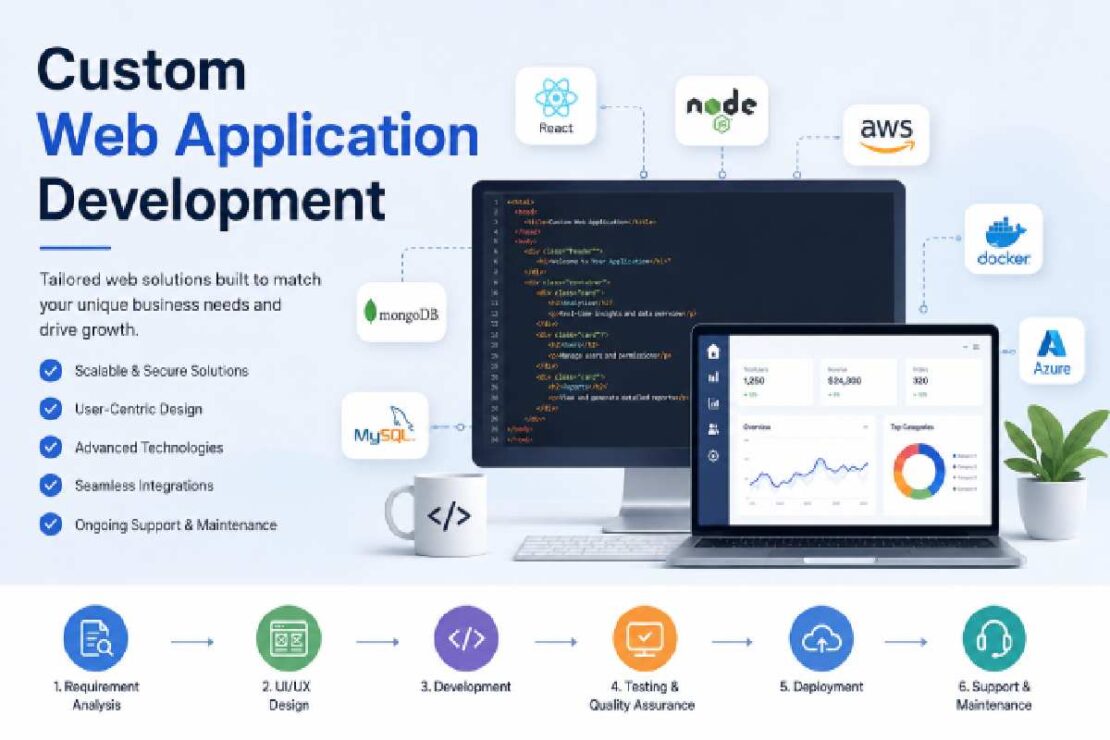
This business is no monolithic industry. Workflow is never the same for every team and many teams feel compelled to change their entire process to try and squeeze their requirements into a boxed product that just is not doing their needs. The answer is a custom web application.
Custom web applications are not standardized and are designed from scratch with the individual business needs in mind.
This is the alternative for companies that find the use of commercially available software limitations, such as excess functionality or functionality not suited for specific roles or processes. From customer portals to online marketplaces, or SaaS solutions for scalability and business process automation, there is no limit to what can be created. This comprehensive guide provides a full understanding of what custom web app development is, the various advantages that come with building a unique application, common custom app models and examples, and the considerations for choosing the right solution in 2026.
What Is Custom Web Application Development?
Custom Web application development service also known as a bespoke web application development is the design and also development as well as testing and then the deployment of browser based software program to fit the details needs of business organizations. These applications are developed on the basis of an arrangement of an firm in order to solve their very own organization issues, to match their present work process as well as to deliver a fantastic end client exposure to rather than simply the off shelf solutions.
Examples include:
- Customer dashboards
- Employee portals
- Online booking systems
- Learning management systems
- Healthcare portals
- Financial dashboards
- Inventory management systems
E-commerce Management Solution. If you sell products online you can operate everything from a web browser instead of software running on your PC. What Make Company Go Custom Web Application. The industry data published in 2026 demonstrated how the market spend for custom software has increased with the rising focus on better security and customer satisfaction as well as more efficiencies.
Major Benefits
| Benefit | Business Value |
|---|---|
| Personalized workflows | Matches business operations exactly |
| Better scalability | Supports future growth |
| Stronger security | Custom authentication and permissions |
| Higher performance | Optimized for business processes |
| Easy integrations | Connects with ERP, CRM, APIs, and payment gateways |
| Competitive advantage | Features unavailable in generic software |
| Improved customer experience | Faster and more intuitive interfaces |
Off-the-Shelf Software vs Custom Web Applications
| Feature | Off-the-Shelf Software | Custom Web Application |
|---|---|---|
| Customization | Limited | Unlimited |
| Ownership | Vendor-owned | Business-owned |
| Scalability | Moderate | Excellent |
| Security | Shared environment | Fully customized |
| Integrations | Limited | Extensive |
| Monthly Fees | Ongoing | Usually one-time development plus maintenance |
| Competitive Advantage | Low | High |
If there’s a specific business workflow, custom web applications often prove more economical in the long run.
Custom Software vs Web Applications
Many people confuse these terms, but they serve different purposes.
| Custom Software | Custom Web Application |
|---|---|
| Installed on devices | Runs in a web browser |
| Platform dependent | Cross-platform |
| Requires installation | No installation needed |
| Updates manually | Updates instantly on the server |
| Device storage required | Cloud-based access |
A custom web application is a type of custom software delivered through the web, making it easier to maintain and access across multiple devices.
Types of Custom Web Applications
CRM Web Application Development

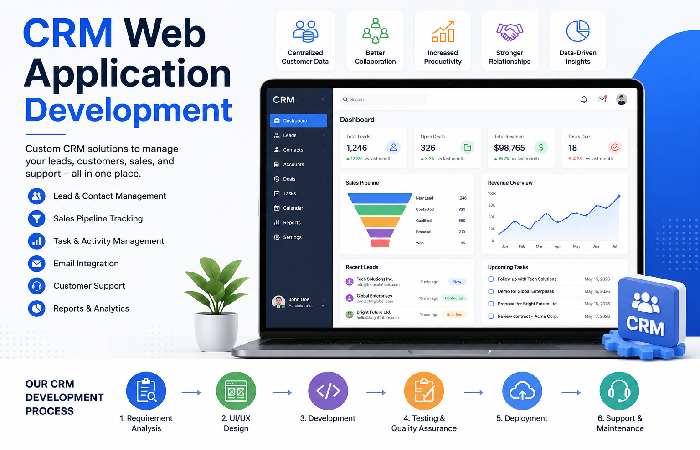
CRM software are applications that support organizations in managing contacts, potential customers, sales pipeline, marketing initiatives, support, and other aspects of customer interactions in a single system. Key capabilities include; Lead tracking Contact Management Sales Automation Email Integration Customer Support Dashboards Reporting & Analytics Recommended Internal Link: CRM Web application Development
ERP Web Application Development
Enterprise Resource Planning (ERP) applications connect multiple departments into one integrated system.
Typical ERP modules include:
- Finance
- Inventory
- Procurement
- Human Resources
- Manufacturing
- Payroll
Suggested Internal Link: ERP Web Application Development
SaaS Web Application Development
Software as a Service (SaaS) applications allow customers to access software through subscriptions.
Popular examples include:
- Project management tools
- Accounting software
- Marketing platforms
- Team collaboration tools
- Customer support platforms
Benefits include:
- Cloud hosting
- Multi-tenant architecture
- Subscription billing
- Automatic updates
Suggested Internal Link: SaaS Web Application Development
Progressive Web Applications (PWAs)
Progressive Web Applications combine the capabilities of websites and mobile apps.
Features include:
- Offline access
- Push notifications
- Fast loading
- App-like experience
- Home screen installation
PWAs are increasingly popular because they provide a native-like experience without requiring users to download an app from an app store.
Suggested Internal Link: Progressive Web Applications (PWAs)
Custom Web Application Development Process
Requirement Analysis
        ↓
Planning & Architecture
        ↓
UI/UX Design
        ↓
Frontend Development
        ↓
Backend Development
        ↓
Database Integration
        ↓
Quality Assurance Testing
        ↓
Deployment
        ↓
Maintenance & Continuous ImprovementCustom Web Application Examples
Real-world examples of custom web applications include:
- Online banking portals
- Hospital management systems
- University learning platforms
- Real estate property management systems
- Warehouse inventory dashboards
- Customer support portals
- Online appointment booking systems
- Business analytics dashboards
These applications are tailored to specific organizational requirements rather than serving a broad audience.
Common Challenges and Troubleshooting
Even well-planned projects can encounter issues. Here are some common challenges and how to address them:
| Challenge | Solution |
|---|---|
| Slow performance | Optimize database queries, enable caching, use a CDN |
| Security vulnerabilities | Implement secure coding practices, MFA, and regular audits |
| Integration failures | Use well-documented APIs and comprehensive testing |
| Scope creep | Define clear project requirements and change management processes |
| Poor user adoption | Conduct user research and usability testing early |
OWASP Developer Guide (for the Security section)
➜ OWASP Developer Guide
Frequently Asked Questions
What Is Custom Web App Development?
It is the act of building a web application, particularly with the requirements of your company and your specific operations.
Why Are Custom Web Apps Beneficial?
Some of the key advantages of custom web applications are the flexibility, expandability, security, the smooth flow of integration between other apps, and the tailored user experience.
How Do Custom Software & Web Apps differ?
The primary distinction is whether you have to set up software on your computer or run it within a web browser. A custom app could be designed for your desktop or web.
What is the Definition of Custom CRM Web App Development?
Building your personal, web-based systems to manage all your clients’ connections, your revenue generation, the marketing your business employs and the consumer care you deliver.
What’s Custom ERP Web App Development?
The objective of developing these personal, fully incorporated computer applications is the supervision of every part of the organization such as bookkeeping, supplies control, and human relations, and the acquisition of goods.
What Is A Progressive Web Application?
A progressive web app (PWA) is really a standard web app that includes the functionality you would typically only anticipate of local applications, such as an offline option and push notification performance, or as part of a personal menu of local applications.
Are custom Web Apps Safe?
In fact.
By sticking to the most current internet growth and security principles, we’ll build a protected app that incorporates robust protection such as sophisticated login procedures, encrypted data and authorization based upon user position.
What is the Duration of Custom Web App Development?
Due to so many aspects influencing growth, custom apps can have from a couple weeks to a couple several weeks from concept through deployment for basic applications of this type of application for small and medium businesses.
Conclusion
By opting for custom web application development, companies have the chance to create a software solution that perfectly fits with their operational needs, their customers’ expectations, and their long-term business goals. Generic web solutions offer limitations, on the other hand, a bespoke application grants the flexibility needed over integrations, features, security and future expandability, making it a smart move that businesses cannot ignore. A CRM, ERP, SaaS application, or a Progressive Web Application – whatever your goal is, setting well-defined objectives from the beginning and establishing a clear plan for its development process is essential to guarantee that the result will reflect the business’s ambitions. The technology Landscape in 2026 is already changed and by embracing bespoke web solutions now your organization will be ready to manage the changes.
Author Bio
Mohammed Sarvar is the Founder, Editor, and Senior SEO Strategist with expertise in web technologies, software development, SEO, and digital marketing. With years of experience creating research-driven content, he specializes in simplifying complex technical topics into practical, beginner-friendly guides. His work focuses on custom web application development, cloud technologies, cybersecurity, AI, and business software solutions, helping businesses make informed technology decisions. When he’s not researching the latest web development trends, Mohammed enjoys exploring emerging technologies, testing digital tools, and sharing actionable insights that improve online growth and business success.