So, you’re looking for a software engineering course syllabus. That’s probably because you don’t just want to see the list of modules covered. You want to know what you’re going to learn, what programming languages and technical subjects are important, how they’ll be tied together, and if you’ll end up career-ready for actual software development.
A typical course syllabus for modern software engineering would usually include programming, data structures and algorithms, databases and data management, operating systems, software architecture and design, testing, project management, cloud computing (e.g., AWS, Azure) and DevOps, as well as practical project work.
The specific syllabus however may differ greatly between university degree, diploma, certificate and professional online courses / bootcamps.
What Is a Software Engineering Course Syllabus?

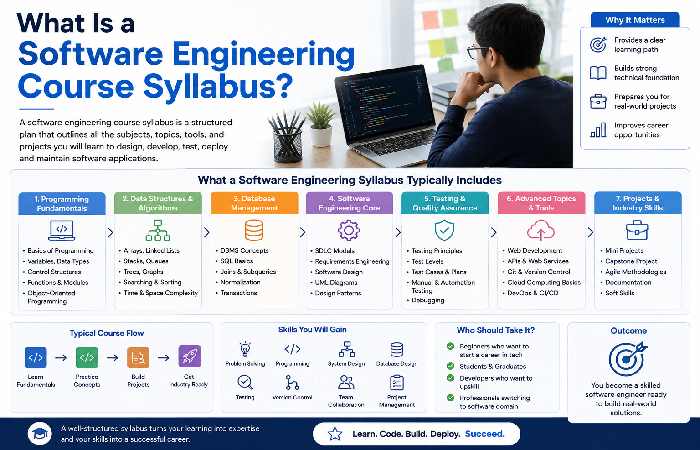
The syllabus for software engineering covers each stage in the planning, designing, and development cycle for software projects along with software maintenance, testing, and deployment. Typical university degrees in software engineering include the subjects of mathematics, computer sciences, programming, and engineering. However, many university degrees nowadays for careers in software engineering have introduced modern industry needs like full-stack development, cloud computing, system design and development, DevOps, and artificial intelligence supported development. For the years 2026 the curriculum includes the following topics:
Core Software Engineering Subjects
Although universities organize their programs differently, the following subjects appear frequently across software engineering curricula.
| Subject | What You Learn | Why It Matters |
|---|---|---|
| Programming | Python, Java, C/C++ or JavaScript fundamentals | Builds coding skills |
| Data Structures & Algorithms | Arrays, trees, graphs, searching, sorting | Problem solving and interviews |
| Database Management | SQL, database design, queries | Storing and retrieving data |
| Operating Systems | Processes, memory, files and concurrency | Understanding computing systems |
| Computer Networks | TCP/IP, HTTP, networking concepts | Building connected applications |
| Software Engineering | SDLC, Agile, requirements and design | Professional development practices |
| Software Testing | Unit, integration and system testing | Software quality |
| Software Architecture | Components, patterns and system structure | Building maintainable systems |
| Cloud Computing | Cloud services and deployment | Modern application delivery |
| DevOps | CI/CD, containers and automation | Faster, reliable releases |
| Project Management | Planning, estimation and risk | Managing software projects |
| Capstone Project | End-to-end application development | Practical experience |
University-level syllabi commonly include software lifecycle models, requirements analysis, software project management, testing and maintenance. A current JNTUK syllabus, for example, covers lifecycle models such as Waterfall, Agile and Spiral, project estimation, risk management and requirements analysis.
Software Engineering Course Modules
A useful way to understand the software engineering course modules is to divide them into four stages.
Module 1: Programming Foundations
This is where beginners learn how to write and understand code.
Typical topics include:
- Variables and data types
- Operators
- Conditions
- Loops
- Functions
- Arrays and collections
- Error handling
- Object-oriented programming
Python, Java, C++ and JavaScript are common choices, although the language depends on the institution.
Module 2: Computer Science Fundamentals
Once programming fundamentals are established, students usually move into:
- Data structures
- Algorithms
- Operating systems
- Computer networks
- Databases
- Computer architecture
These subjects explain what happens underneath an application rather than simply teaching students how to write code.
Module 3: Software Engineering Practices
This is where programming becomes software engineering.
Students learn about:
- Software Development Life Cycle (SDLC)
- Requirements engineering
- Software Requirements Specification (SRS)
- System modeling
- Software architecture
- Design patterns
- Agile development
- Version control
- Code quality
- Testing
- Maintenance
Formal university curricula commonly treat requirements, design, testing and maintenance as separate areas of study.
Module 4: Modern Development and Deployment
Industry-focused programs increasingly introduce:
- REST APIs
- Full-stack development
- Docker
- CI/CD
- Cloud platforms
- Microservices
- Kubernetes
- Infrastructure automation
- Application monitoring
Scaler’s current 2026 syllabus coverage, for example, includes full-stack development, system design, DevOps, Docker, Kubernetes, AWS services and CI/CD tools.
Programming Subjects for Software Engineers
You don’t need to learn every programming language.
| Language | Typical use | Beginner suitability |
|---|---|---|
| Python | Backend, automation, AI/data | Excellent |
| JavaScript | Web development | Excellent |
| Java | Enterprise/backend applications | Good |
| C++ | Systems and performance-focused development | Moderate |
| C# | .NET applications and games | Good |
Best approach: choose one language, become comfortable with it, and then learn another language when your projects require it.
Academic vs Industry-Focused Syllabus
One of the biggest differences between programs is their balance between theory and practical development.
| Curriculum type | Theory | Projects | Modern tools | Best for |
|---|---|---|---|---|
| University degree | High | High | Moderate–High | Long-term foundation |
| Diploma | Moderate | Moderate–High | Moderate | Faster technical entry |
| Online certificate | Low–Moderate | Moderate | High | Skill upgrading |
| Bootcamp | Low–Moderate | Very High | High | Practical career transition |
| Self-paced learning | Flexible | Depends on learner | Flexible | Independent learners |
There isn’t a universally “best” format. The right choice depends on whether your priority is a degree, career change, academic foundation, or specific development skill.
What Has Changed in Software Engineering Curricula in 2026?
The traditional syllabus hasn’t disappeared, but modern programs are adding technologies used in current development workflows.
A useful high-level comparison is:
Traditional foundation
Programming → Data Structures → Operating Systems → Databases → Software Engineering → Testing
Modern industry layer
Git → APIs → Cloud → DevOps → Containers → CI/CD → System Design → AI-assisted development
This doesn’t mean students should skip the fundamentals. The opposite is usually true: modern tools are easier to understand when you already know programming, databases, networking and software design.
How Long Does a Software Engineering Course Take?
The duration depends on the program.
A BTech/BE program generally spans several academic years, while MTech programs are commonly structured over four semesters. Certificate programs and bootcamps can be significantly shorter.
For example, current MTech software engineering structures include four semesters, with early semesters combining theory and practical work and later semesters emphasizing seminars and project work.
What Should a Beginner Look for in a Syllabus?
Don’t choose a course simply because it lists 20 or 30 subjects.
Look for these elements:
- Strong programming fundamentals
- Data structures and algorithms
- SQL and databases
- Git/GitHub
- Software development lifecycle
- Testing
- Real projects
- APIs
- Deployment
- Cloud fundamentals
- Security basics
- Code reviews or collaborative work
A syllabus that teaches only programming syntax may not provide enough exposure to the broader software development process.
Recommended Beginner Learning Path
If you’re self-learning, I would recommend this progression: Program Git Data Structures SQL APIs Testing Projects Cloud DevOps System Design Try to avoid learning everything in parallel. The best practice, though, is to build something after major points of learning: Program: Make calculator or expense tracking app Database: Build inventory app API: Consume a weather or book api. Testing: Add automated test for your API Project: Build full stack project like a task management application.
Cloud: Deploy your full stack application.
When you learn this way, the syllabus transforms from a list of concepts to a full-fledged portfolio.
Common Syllabus Problems and How to Handle Them
The syllabus contains too much theory
Theory isn’t useless. Learn the concept, then immediately connect it to a practical example.
There are too many programming languages
Don’t attempt to master all of them. Choose the language used for your projects and learn others later.
Cloud and DevOps appear too early
Build your programming and application fundamentals first. Deployment makes more sense after you understand how applications work.
The course has no projects
That’s a warning sign if your goal is practical development. Look for a program with labs, assignments, GitHub work or a capstone project.
The syllabus looks impressive but doesn’t explain outcomes
Look for specific skills rather than buzzwords. “Cloud computing” is vague; “deploy a containerized application using a cloud platform” tells you much more.
Frequently Asked Questions
Software engineering syllabus-subjects: subjects covered in the curriculum; Programming, data structure, algorithms, databases, operating systems, networking, software engineering, software design, software testing, project management, and cloud computing and DevOps.
Programming is part of the software engineering syllabus.
Yes. Programming is usually one of the fundamental aspects of the curriculum. Institutions teach languages such as Java, C, C++ or Python and JavaScript to students.
Is the software engineering syllabus similar to the computer science syllabus.
No. There is enough similarity, however, the software engineering syllabus focuses on processes used in developing software, its requirement, design, testing and maintenance. There are also considerable amount of projects based on this subject.
Is there any AI topic in the syllabus of 2026?
Some new syllabi include additional module or elective modules like AI, machine learning or AI aided development programs. The topics included may differ in content when viewed as subjects.
What software engineering subjects is it necessary for the beginners.
Start learning at the initial level by taking up programming, data structure and algorithms, database, and git along with fundamentals of software engineering and projects. Later add the relevant topics like testing, APIs, cloud, DevOps.
Is all the software engineering syllabus the same.
No. There are variety syllabus offered for the students depending on whether the course is offered by universities, colleges, bootcamps or as online training program. Even two of the BTech courses may cover completely different subjects with differing names and structure, different number of subjects included in each semester and option to take up different optional/electives as part of the degree course.
The Final conclusion:
A software engineering syllabus that offers the most relevant, detailed subjects is the best for the student, not necessarily the one with the longest. The subjects are structured in a logical progression; moving from basic programming to software development followed by testing, and ultimately to modern projects and deployment. The students seeking a career in software engineering are advised to start with programming, data structure and algorithms, database and git. While it is later needed to add concepts like testing, APIs, cloud and DevOps to these foundational programming concepts, a full computer engineering course will provide AI supported development as an additional topic.