Software Engineering Course: Quick Answer
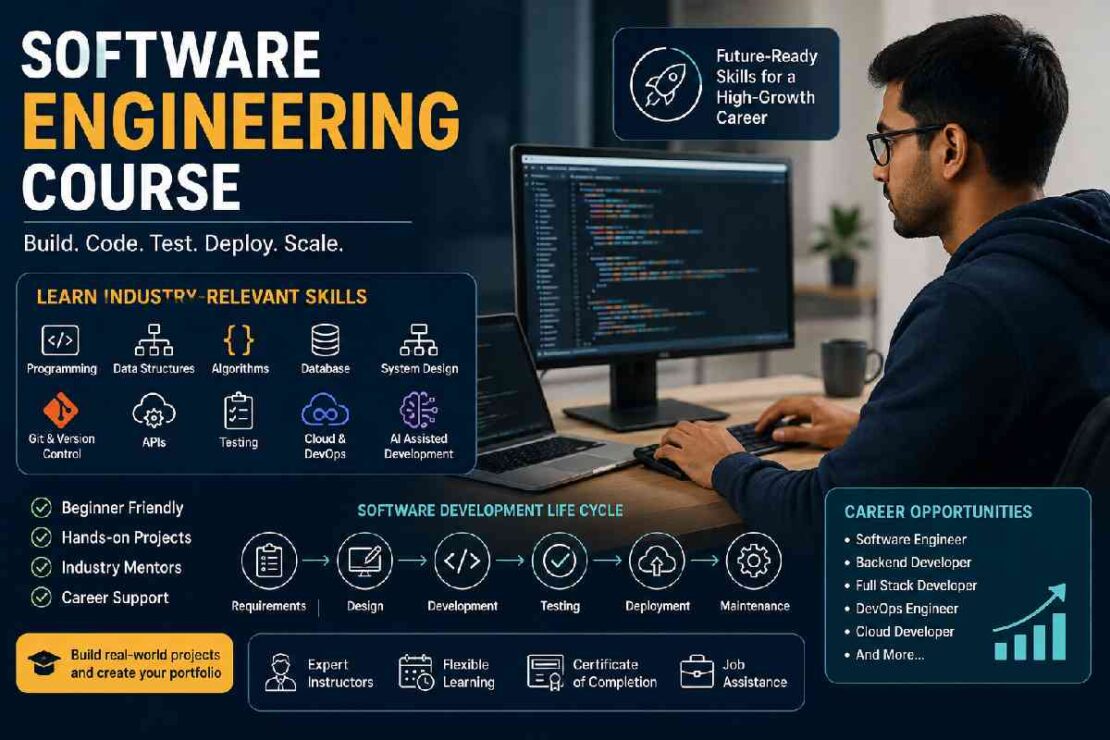
A course of software engineering helps you learn how to design, build, test, deploy, operate and improve applications using engineering principles. If the chosen programme is the engineering one, you may be taught programming, data structures, algorithms, databases, SDLC, Git, testing, API, cloud, DevOps, system design, security and development with AI. The 2026 courses for you are free courses (introductory), university certificate program, professional certificate courses, Coding boot camp, master’s postgraduate master program and bachelor program.
However, you do not have to pick the ideal method by programme name; you do so based on your skills, goal, finance budget, learning method, project portfolio, and programme depth.
A well-organized online learning course might be cost-efficient to see if working in the software developing field will fit you, particularly for the novices. But on the contrary, the longer one with significant projects, guidance, system designs and DevOps career support will probably be more fruitful.
Table of Contents
- What Is a Software Engineering Course?
- Why Learn Software Engineering in 2026?
- Learn During Your Software Engineering Course Top Online software engineering courses 2026 Comparison Software Engineering Courses eligibility Software Engineering Course Fee Structure And Duration
- Software Engineering Course Syllabus
- Skills You Should Build Alongside Your Course
- Free vs Paid Software Engineering Courses
- How to Choose the Right Course
- Software Engineering Projects for Beginners
- Career After a Software Engineering Course
- Software Engineering Career Outlook
- Common Mistakes Beginners Make
- Troubleshooting Your Learning Journey
- Frequently Asked Questions
- Final Verdict
What Is a Software Engineering Course?

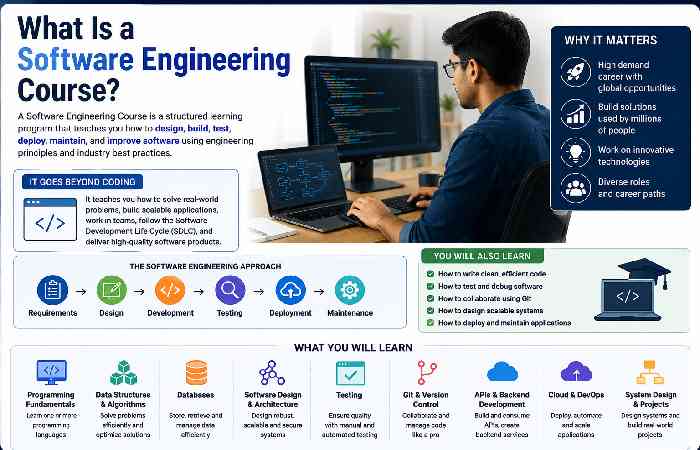
What a Software engineering class is All a software engineering course is, a planned teaching process on how to practically apply or use principles of creating reliable software. But more is said as that it. The software engineering path learning process A programming beginner tutorial will mostly teach the user on how to write functions, loops, create applications.
A software engineering course will teach how to solve bigger software issues via systematic approaches –Requirements analysis, software design, implementation, testing and the overall maintenances of the software system and process.
A typical software engineering curriculum might take the form of:
:
Programming
Data Structures
Databases
Software Design
Testing
Git
APIs
Cloud/DevOps
System Design
Projects
These latest modern courses cover AI-supported development, cloud-native architectures, automation, as well as collaborative development.
As an example, The IBM DevOps and Software Engineering Professional Certificate program on Coursera currently covers:Python, REST API’s, Micro services, Docker, Kubernetes, CI/CD, Git, Testing, DevOps, Cloud Native development. This is presented as part of the 15 course series, is classified as beginner and can be completed in 6 months at a commitment of around 10 hours per week.
Hopefully, you can see now clearly, that the modern software engineering curriculum includes the following courses.
Why Learn Software Engineering in 2026?
Software development is no longer limited to traditional web applications.
Software engineers now work on:
- Artificial intelligence applications
- Cloud platforms
- Mobile applications
- Financial technology
- Cybersecurity products
- Healthcare systems
- Automotive software
- IoT platforms
- E-commerce applications
- Enterprise software
- Developer tools
- Data platforms
- Automation systems
According to The World Economic Forum Future of Jobs Report 2025, software and applications developers will be the hottest job growth area from now until 2030. For this report, the organization interviewed more than 1,000 employers whose combined total employee pool size represents more than 14 million people and covers a variety of 55 economies.
One crucial lesson to walk away with is the 1-course approach won’t get you the job. You won’t glean a whole lot of value out of 1 class. Learn to write the foundations of software engineering + building things/projects + how to approach problems + utilize current technologies + to keep going!
What Do You Learn in a Software Engineering Course?
The exact curriculum varies, but a strong program should cover most of the following areas.
1. Programming Fundamentals
It’s important that you master at least one programming language.
Commonly chosen languages are:
Python
Java
JavaScript/TypeScript
C++
C#
Go
Don’t try and learn five languages simultaneously.
One programming language should be sufficient for most beginners to grasp these core programming concepts:
* Variables
* Data types
* Conditions
* Loops
* Functions
* Objects
* Classes
* Error handling
* File handling
* Modules
* Testing
The goal isn’t to learn syntax, but the programming concepts.
2. Data Structures and Algorithms
Data structures help you organize information efficiently.
You may study:
- Arrays
- Strings
- Linked lists
- Stacks
- Queues
- Hash tables
- Trees
- Graphs
- Heaps
You will also learn algorithmic concepts such as:
- Searching
- Sorting
- Recursion
- Dynamic programming
- Graph traversal
- Complexity analysis
This area becomes particularly important when preparing for technical interviews.
3. Software Development Life Cycle
A good software engineering course should explain how software moves from an idea to a working product.
The SDLC commonly includes:
- Requirements
- Planning
- Analysis
- Design
- Development
- Testing
- Deployment
- Maintenance
You’ll also encounter methodologies such as:
- Agile
- Scrum
- Kanban
- Waterfall
- DevOps
4. Version Control and Git
Git is one of the most important practical tools for software developers.
You should learn how to:
- Create repositories
- Commit changes
- Create branches
- Merge branches
- Resolve conflicts
- Review code
- Work with remote repositories
- Use pull requests
You should ideally finish your course with a public portfolio containing meaningful projects rather than only certificates.
5. Databases
Software applications need somewhere to store information.
Courses commonly introduce:
Relational databases
Examples include:
- PostgreSQL
- MySQL
- SQL Server
NoSQL databases
Examples include:
- MongoDB
- Redis
- DynamoDB
You should understand:
- Tables
- Relationships
- Primary keys
- Foreign keys
- SQL queries
- Indexing
- Transactions
- Basic database design
6. APIs and Backend Development
Modern applications frequently communicate through APIs.
You’ll want to understand:
- REST APIs
- HTTP
- JSON
- Authentication
- Authorization
- CRUD operations
- API testing
- Error handling
Depending on the course, you may build APIs using Python, Java, Node.js, Java/Spring, C#, or another backend technology.
7. Software Testing
Professional software engineering isn’t simply:
Write code → publish it.
Testing is a major part of development.
You may learn:
- Unit testing
- Integration testing
- End-to-end testing
- Regression testing
- Test-driven development
- Automated testing
- Debugging
A good course should make testing part of your projects instead of treating it as an optional chapter.
8. System Design and Architecture
This becomes increasingly important as you move beyond beginner-level development.
You’ll learn concepts such as:
- Scalability
- Availability
- Reliability
- Load balancing
- Caching
- Databases
- Queues
- Microservices
- Monoliths
- API gateways
- Distributed systems
Beginners don’t need to master advanced system design immediately.
But understanding the basics can make the transition from junior developer to experienced engineer much easier.
Best Online Software Engineering Courses in 2026
There isn’t one universal “best” course.
The best course depends on what you want to achieve.
Here are several types worth considering.
| Course / Provider | Best For | Approx. Format | Level | Main Strength |
|---|---|---|---|---|
| IBM DevOps & Software Engineering – Coursera | Beginners wanting structured learning | ~6 months* | Beginner | DevOps + software engineering |
| Software Engineering – edX | Learners seeking university-style learning | Varies | Beginner–Intermediate | Academic foundation |
| NPTEL Software Engineering | Indian students seeking low-cost academic learning | Semester-based | Intermediate | IIT/NPTEL ecosystem |
| Scaler Software Development Programme | Career switchers | ~12 months | Beginner–Advanced | DSA + system design + projects |
| upGrad Software Engineering Programs | Professionals and career switchers | 6–13+ months | Beginner–Advanced | Mentorship + career support |
| Simplilearn Software Engineering Programs | Job-oriented learners | Varies | Beginner–Advanced | Projects + career-focused learning |
| Class Central listings | Learners comparing many providers | Varies | All levels | Course discovery |
*Coursera currently lists the IBM certificate as six months at about 10 hours per week; actual completion time can vary.
edX currently lists software engineering courses and certificates from universities and industry organizations, including introductory software engineering, DevOps, full-stack development, and generative-AI-related programs.
NPTEL also provides software engineering-related learning through its academic ecosystem. One NPTEL software engineering course describes topics including lifecycle models, requirements specification, design, and testing, while listing programming prerequisites.
Competitor Analysis: What Are the Top Ranking Pages Doing?
For the keyword “software engineering course,” the current search landscape is dominated by course aggregators, education platforms, online learning providers, and career-focused education websites.
The major competitors reviewed for this article include:
- Careers360
- CollegeDekho
- Collegedunia
- upGrad
- Scaler
1. Careers360
Careers360 focuses heavily on course discovery and comparison.
Its strengths include:
- Course listings
- Eligibility
- Duration
- Fees
- Providers
- Career options
- Online degrees
- Certificates
Its current software engineering course page includes programs ranging from online postgraduate degrees to bootcamps and certificates, making it useful for users with commercial investigation intent.
Content gap: Aggregators can become very broad. A better article can help readers actually choose between learning paths rather than simply listing programs.
2. CollegeDekho
CollegeDekho targets users looking for:
- Software engineering courses
- Eligibility
- Fees
- Duration
- Online options
- Career scope
Its content includes comparisons of online programs and approximate course fees.
Content gap: Readers also need a beginner-friendly explanation of what they should learn before spending money.
3. Collegedunia
Collegedunia provides detailed information about course fees, duration, syllabus, certification, jobs, and salaries. Its current page includes examples ranging from inexpensive online courses to large postgraduate programs.
Content gap: Pricing alone doesn’t tell the reader whether a program is appropriate for their career goal.
4. upGrad
UpGrad features a mix of informational content and commercial course suggestions. It currently has some SE content that covers the domains of programming, systems design, databases, API’s, cloud, dev ops, project and career and specialization fields. It has a bunch of current course offerings from a short bootcamp to post-graduate level: Content gap: A neutral article should offer a comparison between the platforms, and should not make one of them implicitly victorious.
5. Scaler
Scaler’s 2026-oriented comparison focuses on practical employability, including:
- DSA
- System design
- Full-stack development
- Projects
- Mentorship
- Career support
- Flexibility
It compares courses offered at Scaler, Masai School, Crio. Do, NIIT StackRoute, Jigsaw Academy, PW Skills, Learnbay, Almabetter, Intellipaat, Coding Ninjas.
Gap: A more meaningful article would classify the courses-as free, beginning or expert-led, university-linked, career-changer, or high level-and list them within such categories, instead of ranking all the courses under one rating.
Search Intent for “Software Engineering Course”
The keyword has mixed informational + commercial investigation intent.
Informational intent
The user may want to know:
- What is software engineering?
- What does a software engineering course teach?
- Who can take it?
- What is the eligibility?
- How long does it take?
- What jobs can I get?
- What skills are required?
Commercial investigation intent
The same user may then want:
- Best online software engineering courses
- Course fees
- Course reviews
- Certificates
- University programs
- Placement support
- Mentorship
- Projects
- Career outcomes
Therefore, a page that only explains software engineering won’t fully satisfy the SERP.
Likewise, a page that only lists courses misses the beginner’s educational needs.
The winning content approach is to answer both.
Software Engineering Course Eligibility
Eligibility depends heavily on the type of course.
For beginner online courses
Many introductory courses have few or no formal academic requirements.
You may only need:
- Basic computer literacy
- Internet access
- A willingness to practice
- Basic mathematics
- Logical thinking
Some courses assume no programming experience, while others expect basic coding knowledge.
For certificate programs
Requirements vary.
Some professional certificates are designed for beginners, while advanced programs may expect:
- Programming experience
- Computer science fundamentals
- Mathematics
- Work experience
For example, the IBM DevOps and Software Engineering Professional Certificate is listed as beginner level.
For B.Tech/B.E. programs
Eligibility depends on the university and country.
In India, engineering degree admission commonly involves:
- 10+2 education
- Mathematics/Physics-related requirements
- Entrance examination or merit-based admission
Always check the individual institution’s latest admission requirements.
For M.Tech or postgraduate programs
You may need:
- A bachelor’s degree
- Relevant technical background
- Required entrance examination, where applicable
- Minimum academic marks
Eligibility should never be assumed from the phrase “software engineering course.”
A 10-hour online certificate and a two-year postgraduate degree are completely different educational products.
Software Engineering Course Fees and Duration
This is one of the biggest areas where beginners get confused.
There is no single software engineering course fee.
Current offerings range from free courses to programs costing several lakh rupees.
A current Collegedunia overview, for example, places broad Indian degree-level ranges around ₹1 lakh–₹5 lakh for B.Tech Software Engineering and ₹50,000–₹5.5 lakh for M.Tech Software Engineering, while online professional programs can occupy very different price bands.
Typical price categories
| Learning Path | Typical Duration | Approximate Cost | Best For |
|---|---|---|---|
| Free introductory course | Few hours–weeks | Free | Exploring coding |
| Paid self-paced course | Weeks–months | ₹500–₹20,000+ | Skill building |
| Professional certificate | 3–9 months | Varies | Structured upskilling |
| Bootcamp | 3–12 months | ₹50,000–₹3 lakh+ | Career transition |
| PG/advanced program | 9–24 months | ₹1.5 lakh–₹5 lakh+ | Career advancement |
| B.Tech/B.E. | ~4 years | Institution-dependent | Full academic pathway |
| M.Tech | ~2 years | Institution-dependent | Advanced specialization |
Important: Treat these figures as broad planning ranges, not guaranteed prices. Course providers frequently change discounts, payment plans, scholarships, and program structures.
Software Engineering Course Syllabus
A strong beginner-to-job-ready curriculum can follow this progression.
Module 1: Programming
- Variables
- Data types
- Functions
- Loops
- Conditions
- Object-oriented programming
Module 2: Data Structures
- Arrays
- Lists
- Stacks
- Queues
- Trees
- Hash tables
- Graphs
Module 3: Algorithms
- Searching
- Sorting
- Recursion
- Complexity
- Problem solving
Module 4: Databases
- SQL
- Database design
- Relationships
- Indexing
- Transactions
Module 5: Web/API Development
- HTTP
- REST
- JSON
- Authentication
- API design
Module 6: Software Engineering
- SDLC
- Agile
- Scrum
- Requirements
- Architecture
- Design patterns
Module 7: Testing
- Unit testing
- Integration testing
- Automation
- Debugging
Module 8: Git and Collaboration
- Git
- GitHub/GitLab
- Branching
- Pull requests
- Code reviews
Module 9: Cloud and DevOps
- Linux
- Containers
- Docker
- CI/CD
- Cloud fundamentals
Module 10: Advanced Engineering
- System design
- Scalability
- Microservices
- Security
- Performance
Module 11: AI-Assisted Development
In 2026, learners should also understand how AI coding tools fit into software development.
But don’t confuse AI-generated code with engineering knowledge.
You still need to understand:
- What the code does
- Whether it is secure
- Whether it is efficient
- How to test it
- How to debug it
- How to maintain it
That distinction is becoming increasingly important.
Skills You Should Build Alongside Your Course
A certificate alone is rarely enough.
Build these skills alongside your coursework.
Technical Skills
- Programming
- SQL
- Git
- APIs
- Testing
- Linux
- Cloud fundamentals
- Data structures
- Algorithms
- System design
Professional Skills
- Communication
- Team collaboration
- Documentation
- Problem solving
- Time management
- Code review
The U.S. Bureau of Labor Statistics specifically highlights analytical ability, communication, creativity, attention to detail, interpersonal skills, and problem-solving among important qualities for software developers, QA analysts, and testers.
Free vs Paid Software Engineering Courses
Free courses
Advantages
- Low financial risk
- Good for beginners
- Easy to experiment
- Often self-paced
- Useful for fundamentals
Disadvantages
- Less personalized support
- Less accountability
- Quality varies
- Career services may be limited
NPTEL and other academic platforms provide free learning content in various software and programming areas, with certification sometimes requiring a separate exam or fee. One NPTEL software engineering course, for example, states that its learning content is free while certification involves an examination fee.
Paid courses
Advantages
- Structured curriculum
- Mentorship
- Projects
- Assessments
- Career support
- Community
- Sometimes university credentials
Disadvantages
- Higher cost
- Marketing claims can be exaggerated
- Some programs contain unnecessary material
- A certificate doesn’t guarantee employment
The best reason to pay for a course is better learning structure and support, not simply the certificate.
How to Choose the Right Software Engineering Course
Use this checklist before enrolling.
1. Identify your current level
Are you:
- Completely new?
- Comfortable with basic programming?
- A developer wanting to specialize?
- A working professional changing careers?
Your answer should influence your course choice.
2. Check the curriculum
Don’t buy a course because its landing page says:
“Become a software engineer.”
Open the syllabus.
Check whether it covers:
- Programming
- DSA
- Databases
- Git
- Testing
- APIs
- Projects
- Deployment
- System design
3. Look for real projects
A strong program should make you build.
Examples:
- E-commerce platform
- Task management application
- Expense tracker
- REST API
- Chat application
- Inventory system
- Authentication system
- Full-stack application
4. Check instructor experience
Look for instructors who can demonstrate:
- Industry experience
- Software engineering expertise
- Teaching experience
- Practical projects
5. Investigate career claims
Be cautious about statements such as:
- Guaranteed six-figure salary
- Guaranteed job
- Become an engineer in 12 weeks
- 100% placement
- Zero skills required
Ask how the claim was calculated.
A course can improve your skills, but employment depends on your technical ability, portfolio, interview performance, location, experience, and the labor market.
Software Engineering Projects for Beginners
Projects are one of the easiest ways to turn theory into evidence of ability.
Beginner Project 1: Expense Tracker
Build an application that lets users:
- Add expenses
- Categorize expenses
- Edit transactions
- Delete transactions
- View monthly totals
Skills:
Programming + database + CRUD + UI
Beginner Project 2: Task Management App
Features could include:
- User registration
- Login
- Create tasks
- Update tasks
- Delete tasks
- Mark tasks completed
Skills:
Authentication + APIs + database + frontend/backend
Beginner Project 3: E-Commerce API
Build a backend API supporting:
- Products
- Categories
- Users
- Orders
- Payments simulation
- Authentication
This is a stronger portfolio project because it introduces real application architecture.
Beginner Project 4: URL Shortener
The application accepts a long URL and creates a short URL.
You’ll learn about:
- Databases
- APIs
- Routing
- Unique identifiers
- Redirects
- Basic scalability
A Practical 6-Month Software Engineering Learning Roadmap
If you’re starting from zero, don’t attempt to learn everything simultaneously.
Month 1 — Programming
Focus on:
- Python/Java/JavaScript
- Variables
- Conditions
- Loops
- Functions
- Basic OOP
Goal: Build 3–5 small programs.
Month 2 — Data Structures + Git
Learn:
- Arrays
- Strings
- Lists
- Hash tables
- Stacks
- Queues
- Git
- GitHub
Goal: Solve coding problems and publish projects.
Month 3 — Databases + Backend
Learn:
- SQL
- Database design
- APIs
- HTTP
- Authentication
Goal: Build a CRUD application.
Month 4 — Frontend + Full Stack
Learn:
- HTML
- CSS
- JavaScript
- React or another frontend framework
- API integration
Goal: Build a complete full-stack application.
Month 5 — Testing + Deployment
Learn:
- Unit testing
- Integration testing
- Docker basics
- CI/CD
- Cloud fundamentals
Goal: Deploy a working application.
Month 6 — System Design + Portfolio
Focus on:
- Architecture
- Scalability
- Caching
- Databases
- Interview preparation
- Resume
- GitHub portfolio
Goal: Have 2–4 polished projects and a clear target role.
Career After a Software Engineering Course
Completing a software engineering course can prepare you for several career paths, depending on the depth of your training and your experience.
Possible roles include:
| Career | Typical Focus |
|---|---|
| Junior Software Developer | Coding and application development |
| Software Engineer | Building and maintaining software systems |
| Full-Stack Developer | Frontend + backend |
| Backend Developer | APIs, databases and server-side systems |
| Frontend Developer | User interfaces and web applications |
| QA Automation Engineer | Automated software testing |
| DevOps Engineer | Deployment, infrastructure and automation |
| Cloud Engineer | Cloud infrastructure and applications |
| Application Developer | Business and consumer applications |
| Software Architect | Large-scale system design |
| Technical Lead | Engineering direction and team leadership |
Don’t assume the course title determines the job title.
A “software engineering course” may prepare you for development, testing, DevOps, cloud, or full-stack roles depending on the curriculum.
Is Software Engineering a Good Career in 2026?
The long-term outlook remains strong, although the entry-level market is competitive.
The U.S. Bureau of Labor Statistics projects 15% employment growth from 2024 to 2034 for software developers, QA analysts, and testers, compared with 3% for all occupations. It projects about 129,200 openings per year on average across the broader occupation group.
For software developers specifically, BLS projects 16% employment growth from 2024 to 2034.
The global picture also supports continued demand for technology skills. The World Economic Forum lists software and applications developers among the fastest-growing occupations through 2030.
However, there is an important qualification:
Demand for software engineers does not mean every course graduate gets a job.
Employers increasingly expect evidence that you can actually build and maintain software.
That means your portfolio matters.
How Much Can a Software Engineer Earn?
Salary varies enormously by:
- Country
- City
- Experience
- Employer
- Technology stack
- Role
- Industry
- Interview performance
For U.S. market context, BLS reports a May 2024 median annual wage of $133,080 for software developers. The lowest 10% earned below $79,850, while the highest 10% earned above $211,450.
Those figures should not be converted directly into an expected Indian salary.
For India, use current job portals, employer salary data, and location-specific market information when estimating compensation.
Real Setup Screenshots and Photos to Add
Because this article targets beginners, screenshots can significantly improve usability and perceived expertise.
Don’t use generic stock images where a real workflow screenshot would be more useful.
Recommended visuals:
Screenshot 1: VS Code Setup
Show:
- Project folder
- Source code
- Terminal
- Running application
Suggested caption:
“A typical beginner software development environment using VS Code and a project terminal.”
Screenshot 2: GitHub Repository
Show:
- Repository
- README
- Project files
- Commit history
Screenshot 3: Database
Show a simple database table or database client.
Screenshot 4: API Testing
Show Postman/Insomnia with:
- Endpoint
- Request
- Response
- Status code
Screenshot 5: Deployed Project
Show your actual application running in a browser.
SEO tip: Add descriptive image alt text rather than keyword-stuffing every image.
Example:
alt="software engineering project running in VS Code"
Common Mistakes Beginners Make
Mistake 1: Buying the most expensive course
Price doesn’t equal quality.
A ₹2 lakh program isn’t automatically better than a ₹5,000 course.
Mistake 2: Collecting certificates
Ten certificates don’t compensate for zero projects.
Build something.
Mistake 3: Learning too many languages
Start with one.
Master fundamentals before expanding.
Mistake 4: Ignoring Git
Git isn’t an optional “advanced developer” tool.
Learn it early.
Mistake 5: Avoiding debugging
Debugging is part of software engineering.
If your program breaks, don’t immediately copy another solution.
Understand why it broke.
Mistake 6: Depending entirely on AI coding tools
AI can accelerate development, but it can also produce incorrect, insecure, or inefficient code.
Use AI to:
- Explain code
- Generate test cases
- Suggest approaches
- Help debug
- Brainstorm solutions
But review everything.
Troubleshooting: What If You’re Stuck?
“I can’t understand programming.”
Slow down.
Don’t jump into frameworks.
Return to:
- Variables
- Conditions
- Loops
- Functions
- Simple exercises
Programming becomes easier when you solve many small problems.
“I understand tutorials but can’t build anything.”
This is extremely common.
Use the tutorial-to-project rule:
- Watch the lesson.
- Close the tutorial.
- Rebuild the feature yourself.
- Change one requirement.
- Debug your own version.
If you can only reproduce a tutorial while watching it, you haven’t fully learned the concept yet.
“I keep getting errors.”
Don’t immediately search for the entire error message and copy the first answer.
Instead:
- Read the error.
- Identify the file.
- Identify the line.
- Understand what the program expected.
- Test one change.
- Run it again.
This is how you develop debugging skills.
“I don’t know which language to choose.”
A simple approach:
Python: beginner-friendly, automation, backend, data and AI
JavaScript/TypeScript: web development and full-stack
Java: enterprise software and backend systems
C++: performance-intensive systems and competitive programming
C#: Microsoft ecosystem and application development
Don’t spend three months comparing languages.
Pick one and start building.
What Makes a Software Engineering Course Worth Paying For?
Before paying, score the course against these factors:
| Factor | Importance |
|---|---|
| Curriculum depth | ★★★★★ |
| Real projects | ★★★★★ |
| Instructor quality | ★★★★☆ |
| Mentorship | ★★★★☆ |
| Testing/DevOps coverage | ★★★★☆ |
| Career support | ★★★☆☆ |
| Community | ★★★☆☆ |
| Certificate | ★★☆☆☆ |
| Marketing claims | ★☆☆☆☆ |
The certificate should be near the bottom of your decision list.
Your skills and portfolio should be near the top.
Software Engineering Course: Who Should Take It?
A software engineering course can be suitable for:
Complete beginners
Start with an introductory programming course before moving into full software engineering.
College students
Use online courses to supplement academic learning with practical development.
Career switchers
Choose a structured program with projects, mentorship, interview preparation, and career guidance.
Existing developers
Focus on:
- System design
- Cloud
- DevOps
- Architecture
- Security
- AI engineering
Working professionals
Prioritize flexible courses that fit around your schedule.
Who Should Not Enroll Yet?
You probably shouldn’t immediately purchase an expensive bootcamp if:
- You haven’t tried programming
- You don’t know whether you enjoy coding
- You haven’t compared the syllabus
- You are buying because of a salary advertisement
- You haven’t checked the refund policy
- You expect the course to guarantee employment
Start with a free or inexpensive introductory course first.
After 2–4 weeks of actual coding, you’ll have a much better idea of whether software engineering is right for you.
Frequently Asked Questions
What is a software engineering course?
What is a software engineering course? Software engineering courses focus on the techniques, tools, and technical principles used in software design, development, testing, deployment, and maintenance. Depending on the specific course, you may learn about programming, databases, Git, APIs, testing, the cloud, DevOps, and system design.
What is the best software engineering course for beginners?
There is no “best” for everyone. A good beginner course would prioritize a solid understanding of programming, hands-on projects, practical exercises, and a clear learning path from coding fundamentals to software development.
Can I learn software engineering online?
Absolutely. You can learn many aspects of software engineering online, including programming, software development, testing, databases, DevOps, cloud, and system design. Many universities (like edX, Coursera, NPTEL) offer software engineering courses or related programs.
Can I become a software engineer without a computer science degree?
Yes, particularly for certain software development roles. However, hiring requirements vary between employers.
A degree can open up more opportunities, but employers also value a strong portfolio, demonstrated skills and experience, and successful technical interviews.
According to the U.S. BLS, software developers, QA analysts, and testers usually require a bachelor’s degree, but this can vary.
How long does a software engineering course take?
It depends on the program’s structure. Self-paced courses can take weeks or months, professional certificates can take several months, bootcamps typically take several months to a year, and academic degrees take 2-4 years or more.
What is the software engineering course fee?
It varies from free online resources to several lakhs for specialized courses or degrees. When choosing, consider the curriculum, projects, mentorship, credentials, and career support, rather than just the price alone.
Is software engineering difficult?
It can be challenging at the beginning due to the need to develop logical reasoning, programming skills, debugging abilities, and problem-solving aptitudes. Consistent practice, however, makes the learning process considerably smoother.
Which programming language should I learn first?
Python, JavaScript, Java, C++, and C# are common and good starting languages. The best choice will depend on your career aspirations. Beginners should aim to master one language before trying to learn multiple ones simultaneously.
Do software engineering courses include projects?
Many job-oriented courses do incorporate projects. The quantity and quality can differ; make sure to check if you’ll be guided through pre-made examples or encouraged to build software from scratch independently.
Is a software engineering certificate enough to get a job?
Usually, no. A certificate demonstrates completion of training, but employers will look beyond it to evaluate your programming skills, projects, problem-solving abilities, GitHub activity, technical interview performance, communication skills, and experience.
Are free software engineering courses worth it?
Yes, especially for beginners. Free courses offer a cost-effective way to learn the basics before investing in more comprehensive programs.
Should I choose a degree or an online course?
The decision depends on your individual circumstances, goals, and available resources. A degree provides a broad academic foundation and may satisfy formal education requirements. An online course can offer a faster, more focused path to acquiring specific skills.
Final Verdict: Which Software Engineering Course Should You Choose?
The right software engineering course isn’t necessarily the one that costs the most money, has the most advertising, or lists more certificates than there are units in a quantum computer.
Pick it by its destination.
If you are an absolute beginner: Pick an introduction to programming with a clearly defined beginner structured course and dive in.
If you are a university student: Pair your computer science learning with practical development work in a good structured course.
If you are career-switching: Aim for a curriculum covering programming, DSA, full-stack development, databases, git, testing, projects, system design and interviews.
If you are already a developer: Go directly for something aimed at architecture, cloud, DevOps, security, distributed systems, or AI driven development.
If you cannot afford too much, have limited resources: Look at quality free course content from established educational players, until you save up enough money for a more extensive course.
Here’s a summary that boils the whole thing down in the simplest possible way:
Focus less on the certificate and more on the skills that you can demonstrate. By the end of it, you should be able to confidently pull open a github account and show some actual applications running, that you can describe the architecture of, what design decisions you took, how you test it, debug it, and most importantly how to clearly explain what you’ve built over a “completed a software engineering course”.