There are literally tens of thousands of software engineering online courses available in 2026, from free academiclectures to highly specialized professional certificates and extensive career programs. The problem is not the choice, the problem is how to choose a course depending on your current skillset, wallet, career direction and your learning style preference. We have compared the main choices of online software engineering courses in 2026, taught what you should know to choose, highlighted what is free, and how to choose what is best for you – either a certificate, a self-paced course or a career development program.
What Should You Learn in an Online Software Engineering Course?
A strong course should go beyond teaching programming syntax.
Look for a curriculum that covers:
- Programming fundamentals
- Data structures and algorithms
- Git and GitHub
- Databases and SQL
- Software development lifecycle
- Software design
- APIs
- Testing and debugging
- Version control
- Cloud fundamentals
- DevOps and CI/CD
- Real-world projects
- Basic system design
Current software engineering catalogs reflect this broad skill set. Coursera, for example, currently lists courses covering SDLC, architecture, programming, Git, testing, deployment, cloud-native development and CI/CD.
Best Online Software Engineering Courses Compared

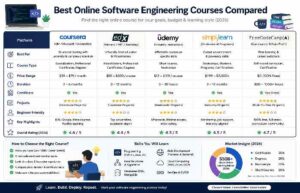
There isn’t one course that is best for everyone. Your choice should depend on your starting point and objective.
| Course type | Typical duration | Cost | Projects | Certificate | Best for |
|---|---|---|---|---|---|
| Free university course | 20–100+ hours | Free | Low–Moderate | Usually optional | Learning fundamentals |
| Self-paced course | 5–40 hours | Low | Moderate | Often | Beginners |
| Professional certificate | 2–6 months | $$ | High | Yes | Career development |
| Bootcamp | 3–6+ months | $$$ | Very high | Usually | Career changers |
| University online degree | Years | $$$$ | High | Degree | Formal education |
Class Central’s 2026 catalog illustrates just how broad the market has become: it currently identifies thousands of free courses as well as thousands of certificate-bearing options.
1. Coursera: Best for Structured Certificates
Coursera is a strong choice if you want a structured learning path from recognizable universities and technology companies.
Current software engineering offerings include:
- IBM Introduction to Software Engineering
- IBM Applied Software Engineering Fundamentals
- IBM Full Stack Software Developer
- Microsoft Full-Stack Developer
- University software engineering specializations
- Java programming and software engineering programs
The IBM beginner course currently covers software development lifecycle, architecture, full-stack development, design patterns, Python and development tools.
Best for: Beginners who want structured coursework and a certificate.
Watch out for: A certificate alone doesn’t demonstrate that you can build software. Complete the projects and keep your work in a portfolio.
2. Class Central: Best for Comparing Courses
Class Central is useful when you don’t know which provider to choose.
Its 2026 software engineering catalog lets learners filter courses by:
- Free courses
- Certificates
- Beginner level
- University courses
- Duration
- Language
It currently lists more than 17,000 software engineering courses.
Best for: Comparing multiple providers before enrolling.
Watch out for: A massive catalog can create choice overload. Narrow your options based on your goal first.
3. Simplilearn: Best for Career-Oriented Learning
Simplilearn focuses heavily on practical and career-oriented training.
Its current software engineering programs highlight areas including:
- CI/CD pipelines
- Containerization
- Deployment
- Infrastructure as code
- Microservices
- Monitoring
- Security
- Cloud technologies
Its 2026 lineup also includes full-stack development with generative AI and other career-focused programs.
Best for: Learners who want a structured career-oriented program.
Watch out for: Compare the curriculum and total cost with other providers before committing.
4. Free Software Engineering Courses
You don’t have to spend thousands of dollars to start learning software engineering.
Free options include university courses, open educational resources, YouTube courses, documentation and selected courses that provide free access to learning material.
The NPTEL IIT Kharagpur software engineering course is another such free video series which touches on life cycle models, requirements analysis, software design, software testing.
Coursera enables learners to “watch the first module for free” for most courses, while some courses provide trial access, and for other programs, there is financial aid.
But, and this is a crucial distinction.
Free course ≠ free certificate.
Some platforms allow you to study course material without paying but charge for a verified certificate.
A 2026 Class Central review of free developer certifications also notes that completely free certificates have become less common, although free learning and some free credentials remain available.
Online Software Engineering Course With Certificate: Is It Worth It?
A certificate can help demonstrate that you’ve completed structured training, but it shouldn’t be your primary goal.
Before paying for a certificate, ask:
- Does the course teach practical skills?
- Does it include projects?
- Is the instructor or provider credible?
- Does the curriculum match current development practices?
- Can I demonstrate what I learned on GitHub?
- Is the certificate recognized by employers or relevant to my goal?
A certificate combined with demonstrable projects is considerably more useful than a certificate by itself.
How to Choose the Best Software Engineering Course Online
Use this simple scoring system before enrolling.
| Factor | Importance |
|---|---|
| Curriculum quality | ⭐⭐⭐⭐⭐ |
| Hands-on projects | ⭐⭐⭐⭐⭐ |
| Beginner accessibility | ⭐⭐⭐⭐ |
| Instructor quality | ⭐⭐⭐⭐ |
| Git/GitHub | ⭐⭐⭐⭐ |
| Testing | ⭐⭐⭐⭐ |
| Career support | ⭐⭐⭐ |
| Certificate | ⭐⭐⭐ |
| Price | ⭐⭐⭐⭐ |
| Community/mentoring | ⭐⭐⭐ |
Don’t choose based solely on ratings.
A current 2026 course-ranking guide makes the same broader point: star ratings alone don’t provide a useful comparison between fundamentally different course types.
What Does a Good 2026 Learning Path Look Like?
Don’t start with Kubernetes, microservices, or system design from scratch.
Go like this:
Programming Git Data Structures SQL APIs Testing Projects Cloud DevOps System Design
Part 1: Programming
pick one language like Python, JavaScript, Java, or C#.
Learn about variables, functions, loops, data structures, OOP, error handling.
Part 2: Developer tools
learn about Git, GitHub, editor like VS Code, command line and debugging.
Part 3: Application building
build application consuming databases and APIs
Part 4: Engineering Practices
add testing, code review, documenting, security and CI/CD to it.
Part 5: portfolio building
try to build two, or four larger projects and log your learning throughout.
Troubleshooting: Why the online courses aren’t working.
‘I did few courses and still not able to code.’
Stop acquiring certificates. Start building projects.
Take one course and try to build the final project from it without Copying instructors’ code.
‘ I don’t know which programming languages to pick.’
Pick the one based on the domain you want to build. Python seems to be a good starting point for now for any programmer, while JavaScript good for web development
“I keep getting stuck.”
Use documentation, communities, debugging tools and AI assistants to understand the problem—not simply to generate the entire solution.
“I can’t afford a paid course.”
Start with free university content and open resources. Once you understand your preferred area, consider paying for a structured program if you actually need mentoring or a guided curriculum.
Are Online Software Engineering Courses Worth It in 2026?
Yes—but the value depends heavily on what you do with them.
Online learning works particularly well when you need flexibility, want to change careers, or need to learn a specific technology without committing to a full degree.
The strongest approach is:
Course + projects + GitHub + documentation + problem solving + practical experience
rather than:
Course + certificate + another course + another certificate.
Frequently Asked Questions
I can study software engineering entirely online?
Yes. You can pick up programming, software development, databases, testing, cloud computing, and more online.
BUT you have to actively code rather than passively watch.
Best Online software engineering course for beginners?
Look for university courses on Coursera by IBM, or other university offerings available from Class Central.
Free software engineering course?
There are multiple options for free university and online courses.
The NPTEL IIIT Kharagpur course on software engineering is an example of this video course format.
I can obtain an online software engineering certificate?
Yes, there are many online options for software engineering certificate programs. You need to check if there is a fee associated with the online certificate.
How long do an online software engineering course take?
It will vary, ranging from a couple of hours to several weeks. A professional online certificate course will take longer to complete than a general introduction to software engineering.
I need any prior programming experience?
Not generally. Many courses are intended for absolute beginners. Master the basics of programming first and then proceed to deeper software engineering concepts.
Final Verdict
The top software engineering online programs are often the cheapest and have the shortest programs.
If you’re completely new, focus on how it teaches you how to code, how to build software, and introduces you to Git, databases, and testing-especially if the course involves building an actual project. If you’re trying to pivot into a new career, then an intensive professional certificate or bootcamp might be the way to go. For those who have a very limited budget, free college computer science programs can sometimes offer quite a lot.
Whichever way you go, and however you’ll eventually try to prove that you know software engineering, the most important takeaway is to just do it.
Learn. Build. Test.
Deploy.
Document. Repeat.
That process will actually help you become a software engineer far more than earning a lot of certificates will.
Internal-Link Cluster
Use this content piece as the hub and naturally link out to the following, once they are created: