Last Updated: September 15, 2026
When comparing the iPhone vs Samsung ecosystem, the phone itself is only part of the story. What really matters is how well your phone works with the other devices you use every day.
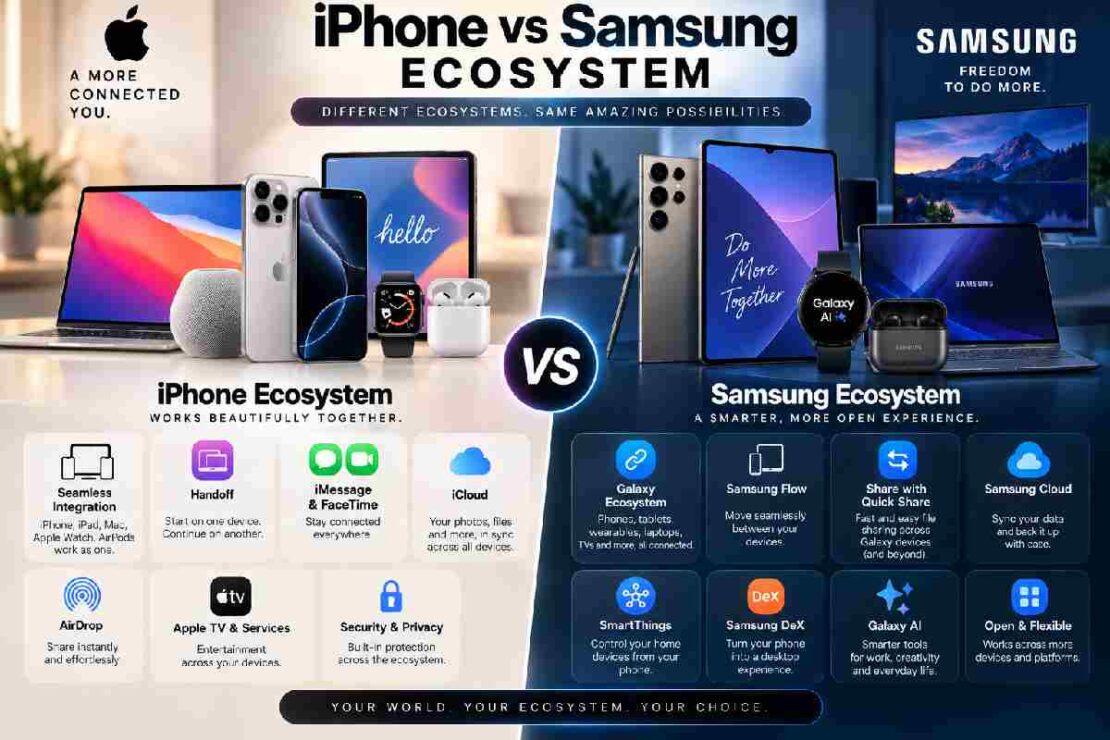
Apple and Samsung both have mature ecosystems in 2026. Apple connects the iPhone with devices such as the Mac, iPad, Apple Watch, AirPods and Apple TV. Samsung connects Galaxy phones with Galaxy Buds, Galaxy Watch, Galaxy tablets, Galaxy Books and SmartThings devices.
The better ecosystem depends largely on what you already own—and what you plan to buy next.
iPhone vs Samsung Ecosystem: Quick Comparison
| Feature | Apple Ecosystem | Samsung Galaxy Ecosystem |
|---|---|---|
| Laptop integration | Mac | Windows/Galaxy Book |
| Tablet integration | iPad | Galaxy Tab |
| Smartwatch | Apple Watch | Galaxy Watch |
| Earbuds | AirPods | Galaxy Buds |
| File sharing | AirDrop | Quick Share |
| Cross-device tasks | Continuity/Handoff | Continue on Other Devices |
| Smart home | Apple Home | SmartThings |
| Desktop experience | Mac + Continuity | Samsung DeX |
| Best for | Apple users | Android/Windows users |
Apple’s Ecosystem: Everything Works Together
Apple’s biggest advantage is how tightly its devices communicate with one another.
For example, if you have an iPhone and Mac, you can start writing an email on one device and continue on the other using Handoff. You can also copy text or images on one Apple device and paste them on another through Universal Clipboard. Apple also supports AirDrop for quickly moving photos and files between nearby devices.
These features are not necessarily exciting when you read them on a specification sheet. They become valuable when you use them every day.
Imagine taking a photo on your iPhone and immediately finding it on your Mac. Or receiving a call on your Mac without reaching for your phone. Those small conveniences add up.
Apple Watch integration is another major part of the ecosystem. Current Apple Watch models require an iPhone for setup, making the relationship between the two devices particularly close.
Apple is best if you already own:
- MacBook or Mac
- iPad
- Apple Watch
- AirPods
- Apple TV
If several of those devices are already sitting on your desk, switching away from iPhone can mean giving up some of the smoothest parts of that setup.
Samsung’s Ecosystem: More Flexible
Samsung takes a slightly different approach.
The Galaxy ecosystem connects phones with Galaxy Buds, Galaxy Watch, Galaxy tablets, Galaxy Books and SmartThings devices. Samsung’s current Galaxy S26 ecosystem also supports features such as cross-device calling and texting, Continue on Other Devices, Link to Windows, Multi-Control and Samsung DeX.
DeX is particularly interesting.
Instead of simply mirroring your phone screen, compatible Galaxy devices can provide a desktop-style experience when connected to a monitor or TV. That makes Samsung appealing to people who want their phone to play a bigger role in their work setup.
Samsung also has SmartThings for connected home devices, while SmartThings Find can help locate Galaxy phones, tablets, watches and other compatible devices.
iPhone vs Samsung Ecosystem: Which Is Easier?
For beginners, Apple’s ecosystem is probably easier to understand.
Apple controls the hardware and operating systems across its main product range, so many features feel consistent from one device to another.
Samsung offers more flexibility, but there are more combinations of devices and settings to consider. It also works well with Windows, which is useful if your computer is not a Mac.
Samsung’s ecosystem can therefore be a better fit for someone who uses Android, Windows and Google services rather than living entirely inside Apple’s world.
Which Ecosystem Is Better for You?
Choose Apple if:
- You use a Mac or MacBook.
- You own an Apple Watch.
- You regularly transfer files between Apple devices.
- You want simple cross-device features.
- You prefer a tightly controlled ecosystem.
Choose Samsung if:
- You use a Windows PC.
- You want more device flexibility.
- You like multitasking and DeX.
- You own Galaxy Buds or Galaxy Watch.
- You want SmartThings integration.
Final Verdict
There is no universal winner in the iPhone vs Samsung ecosystem debate.
Apple wins for seamless integration. Its Continuity features, AirDrop, iCloud, Apple Watch and Mac integration make the experience remarkably cohesive.
Samsung wins for flexibility. Galaxy phones work across Samsung’s own devices while also offering useful connections with Windows PCs and a wider Android environment. Samsung’s current ecosystem includes features such as Link to Windows, Multi-Control and DeX.
The simplest rule is this:
If you already own Apple devices, buy an iPhone. If you already use Galaxy and Windows devices, Samsung is probably the smarter choice.
Your ecosystem should make your life easier—not force you to rebuild it every time you buy a new phone.