Last Updated: September 2, 2026
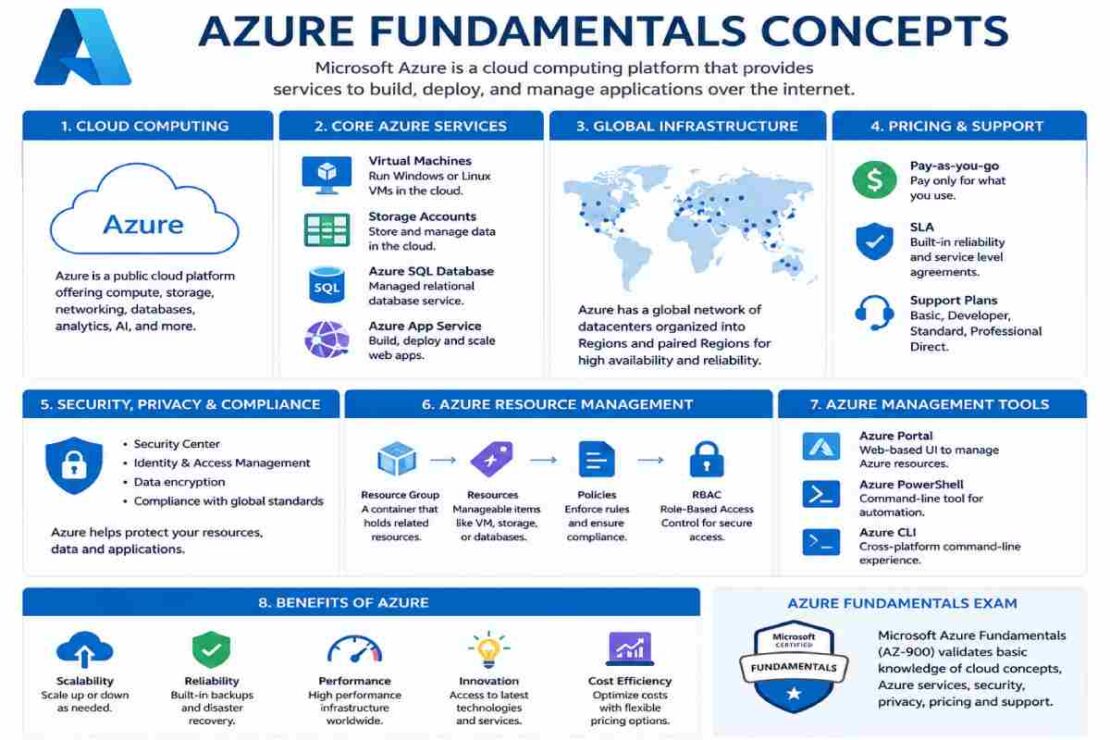
Azure fundamentals concepts are the building blocks of Microsoft’s cloud ecosystem. Whether you are preparing for the AZ-900 certification, helping your company migrate to the cloud, or just starting your IT career, understanding these core ideas is your first step.
This Article Is Part of the Programming Resource Hub
Explore more programming tutorials, coding guides, development tips, and learning resources inside our
Programming Resource Hub.
This Article Is Part of the Programming Resource Hub
Explore more programming tutorials, coding guides, development tips, and learning resources inside our
Programming Resource Hub.
In this guide, we will break down complex jargon into simple analogies, compare Azure to AWS and Google Cloud using the latest 2026 data, and give you a roadmap to mastering the cloud.
Why Learn Azure Fundamentals in 2026?
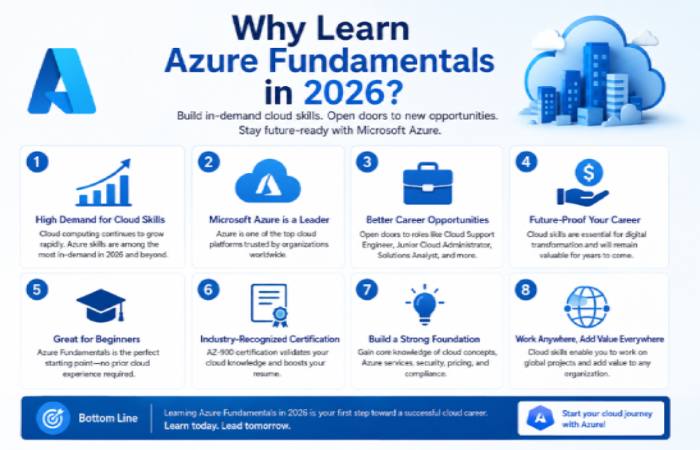
The cloud landscape is shifting rapidly. As of early 2026, Microsoft Azure is not just a “player” in the cloud market; it is a dominant force, particularly in the realm of Artificial Intelligence (AI).
Recent financial data reveals that Azure and other cloud services revenue increased by 39% year-over-year, with a massive backlog of $625 billion in future contracts. This demand is fueled by AI workloads, with OpenAI alone accounting for 45% of Microsoft’s backlog .
For beginners, this means one thing: Azure skills are future-proof. Learning the fundamentals now puts you in the driver’s seat for the AI-driven economy.
Top 5 Competitor Analysis & Search Intent
To write this guide, we analyzed the top-ranking pages for “azure fundamentals concepts.” Here is what they are doing and what users actually want:
| Competitor Focus | Common Search Intent | Content Gap We Fill |
|---|---|---|
| Exam Dumps (AZ-900) | Transactional: Users want to pass the test fast. | Educational: We focus on understanding, not just memorizing. |
| Microsoft Docs | Navigational: Users already know what they need. | Beginner-Friendly: We translate “Microsoft-speak” into plain English. |
| Vendor Comparisons | Commercial: Users comparing Azure vs. AWS. | Integrated: We compare AND teach you Azure in one place. |
| Basic Glossaries | Informational: Users need definitions. | Holistic: We cover definitions plus architecture and setup. |
| Old Tutorials (2023-24) | Informational: General cloud info. | Current: We include 2026 updates (AI, New Regions, Security). |
Primary Search Intent: Informational + Commercial. You want to learn what Azure is (Info), but you also want to know if learning it is worth your time and money (Commercial).
Part 1: Core Azure Fundamentals Concepts (The “Why”)
Before you touch a mouse, you need to understand the philosophy of the cloud.
1. What is Microsoft Azure?
Azure is a cloud computing platform. Imagine instead of buying a $5,000 computer for your office, you rent one from Microsoft’s super-secure data center for the hours you need it. That is Azure.
2. The New Shared Responsibility Model (2026 Update)
In 2026, security is shifting. Microsoft is pushing a Zero Trust model. This means you shouldn’t automatically trust traffic just because it’s inside your network.
-
Microsoft handles: Physical security, hardware, and the hypervisor.
-
You handle: Your data, endpoints, and identity management (Who has the keys to the castle?) .
3. Cloud Models (The Decision)
-
Public Cloud: Everything is on Azure (Netflix, Spotify).
-
Private Cloud: Your own data center (Banks, Governments).
-
Hybrid Cloud: Both. This is the most common strategy for 2026.
Part 2: Azure Architecture (The “Where”)
You cannot learn Azure fundamentals concepts without geography. Where does your data live?
Azure Regions vs. Availability Zones
Microsoft has 70+ announced regions globally—more than any other cloud provider . But not all regions are built the same.
-
Region: A geographical area (e.g., “Qatar Central” or “Saudi Arabia East”).
-
Availability Zone: One or more data centers inside a Region.
2026 Update: Microsoft is aggressively expanding. The Saudi Arabia East region is set to go live in Q4 2026, featuring three Availability Zones to support the Kingdom’s Vision 2030 .
Visual Guide (Mental Map):
[Management Group] -> [Subscription] -> [Resource Group] -> [Resource (e.g., VM)]
-
Resource Group: Like a “digital filing cabinet.” If you delete the cabinet (RG), you delete all the files inside.
-
Azure Resource Manager (ARM): The “foreman” that manages all your resources. You talk to the foreman using code (Bicep/JSON) .
Part 3: The Building Blocks (The “What”)
Here are the three pillars of Azure you must know for the exam and real life.
Compute: Virtual Machines (VMs)
A VM is an emulated computer running on a physical server.
-
Use Case: Moving your old office server to the cloud.
-
2026 Trend: Serverless is eating the world, but VMs remain king for legacy apps.
Storage: Azure Blob Storage
“Blob” stands for Binary Large Object. Think of it as a massive parking lot for trucks (your data). You can park a tiny car (a text file) or a massive semi-truck (a 4K video).
-
Tiers:
-
Hot: Frequent access (Costly storage, cheap access).
-
Cool: Infrequent access (Cheaper storage, costly access).
-
Cold/Archive: Long-term backups.
-
Networking: VNet (Virtual Network)
Think of a VNet as an air-gapped bunker. By default, no traffic enters or leaves. You have to build “doors” (Endpoints) and “gateways” (VPN/ExpressRoute) to let specific things in .
Part 4: Azure vs. AWS vs. Google Cloud (2026 Data)
As a beginner, you might wonder if you are learning the “right” cloud. The answer is: They are winning together.
| Feature | Microsoft Azure | AWS | Google Cloud (GCP) |
|---|---|---|---|
| AI Strength | Enterprise + OpenAI Integration (Copilot) | Broadest AI Services (Bedrock) | Gemini Models (Best for pure research) |
| 2025 Q4 Growth | 39% Revenue Growth | 24% Growth (Fastest in 13 quarters) | 48% Revenue Growth |
| Best For | Businesses using Windows/Office | Startups & E-commerce | Data Analytics & ML |
| Global Reach | 70+ Regions (Most Coverage) | Most Points of Presence | Best Network Latency |
The Verdict: If your company uses Microsoft products (Teams, Outlook, Windows Server), Azure is the obvious choice due to native integration.
Part 5: Identity & Security (Zero Trust)
In 2026, you cannot pass AZ-900 without understanding Microsoft Entra ID (formerly Azure Active Directory).
-
Conditional Access: The “bouncer.” If you log in from a weird location at 3 AM, it asks for extra proof.
-
RBAC (Role-Based Access Control): The “employee badge.” A janitor (Reader) can see the building, but only an executive (Contributor/Owner) can change the thermostat.
Troubleshooting & FAQ for Beginners
“Why can’t I see my resource?”
Solution: Check your Region dropdown at the top right of the portal. You might be looking at “East US” while your resource lives in “West Europe.”
“My costs are exploding!”
Solution: Use the Azure Pricing Calculator before deploying. Also, set a Budget Alert (e.g., “Email me if this demo costs more than $10”).
“I forgot to turn off my VM.”
Solution: Use Azure Automation or Logic Apps to auto-shutdown VMs at 7 PM every day.
FAQ Section
Q: Do I need to know coding for Azure Fundamentals?
A: No. The AZ-900 exam focuses on concepts. However, knowing basic scripting helps in real life.
Q: How often is the AZ-900 exam updated?
A: As of January 2026, the exam updated to focus more heavily on AI services (OpenAI integration) and Zero Trust security models .
Q: Is Azure more expensive than AWS?
A: For Windows workloads, Azure is cheaper. For Linux workloads, it is comparable. Azure offers a hybrid benefit (using your on-prem Windows licenses in the cloud) that AWS cannot match.
Q: What is the difference between a Resource Group and a Subscription?
A: A Subscription is the “Bank Account” (billing). A Resource Group is the “Folder” (organization). You can have many folders in one bank account.
Conclusion
Mastering Azure fundamentals concepts opens the door to high-paying roles in DevOps, AI Engineering, and Security. You now understand the geography (Regions), the building blocks (VMs & Storage), and the security (Entra ID).
Your 2026 Roadmap:
-
Create a free Azure account (You get $200 credit).
-
Deploy a free “Linux Virtual Machine” using the portal.
-
Delete it immediately (to save costs).
AZ-900 Microsoft Azure Fundamentals Topic Cluster
AZ-900 Microsoft Azure Fundamentals Topic Cluster
This Article Is Part of the Programming Resource Hub
Explore more programming tutorials, coding guides, development tips, and learning resources inside our
Programming Resource Hub.
Microsoft Office 2021 Free Download Full Version 64-Bit Topic Cluster
Best Free Apps for Productivity Topic Cluster
This Article Is Part of the Software Resource Hub
Explore more software guides, application reviews, installation tutorials, troubleshooting tips, and productivity resources inside our
Software Resource Hub.
microsoft office 2021 free download full version 64-bit
This Article Is Part of the Mobile Apps Resource Hub
Explore more mobile app guides, Android and iPhone tutorials, app reviews, productivity apps, and troubleshooting resources inside our
Mobile Apps Resource Hub.
Mobile Apps
Explore smart home technology, home automation systems, connected devices, and IoT solutions that make homes safer, smarter, and more efficient. Find setup guides, reviews, and buying advice.