Last Updated: September 15, 2026
Want an iPhone vs Samsung?

Then perhaps you want answers to a simple question: Which phone should I buy? That answer is not quite as simple as both faster chips and better camera pixel counts.
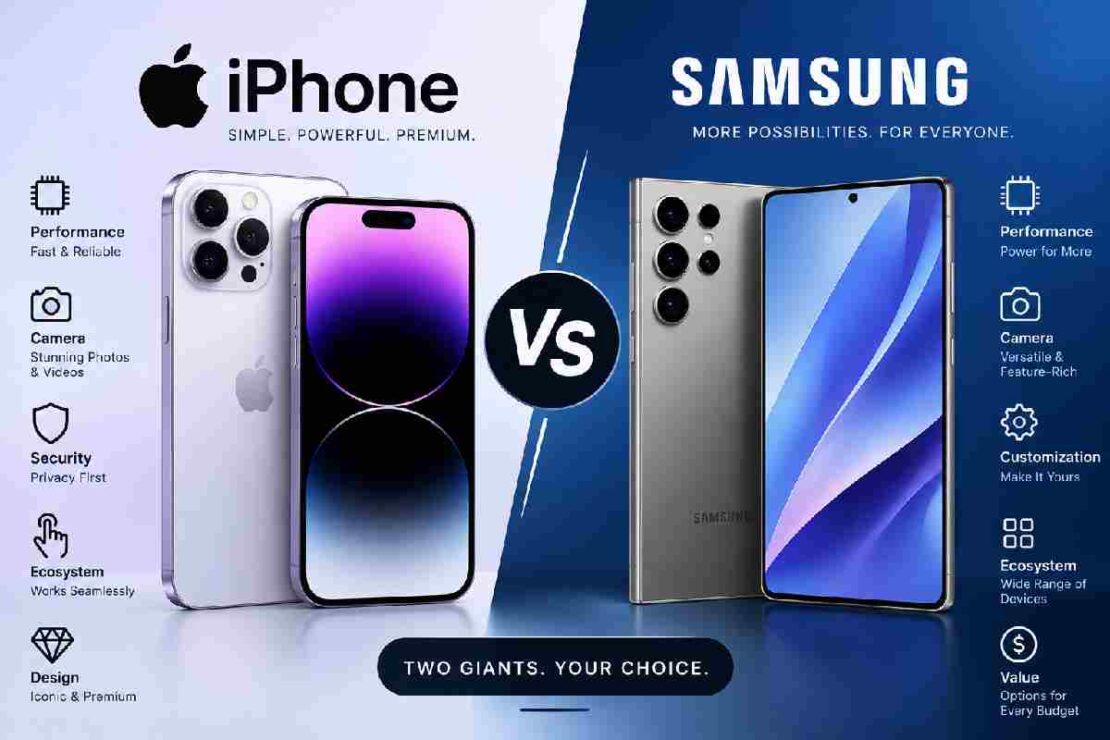
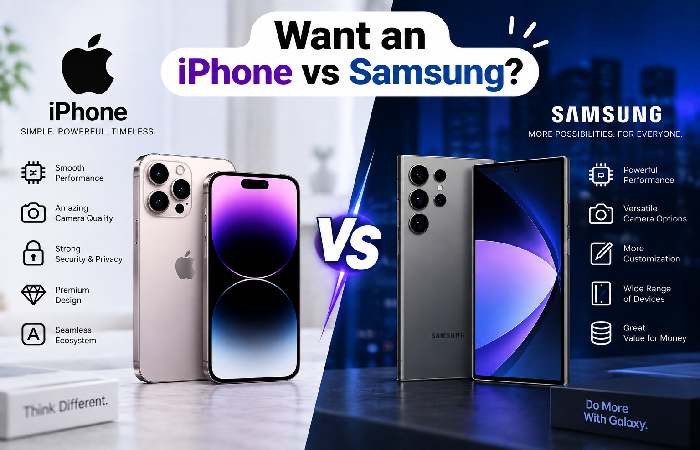
In 2026, Both Apple and Samsung make incredible phones, but they do offer the very best of their own brands in very different ways: Apple offers the most refined experience of the well-integrated iPhone (smartphone hardware and iOS, Apple Intelligence, privacy, a much larger ecosystem) Samsung offers a much broader range of hardware, Android flexibility, many more camera features, fast-refresh-rate displays, multitasking, Galaxy AI, S Pen, foldables, and much more.
That’s why there is not one single best choice for all. Some want an iPhone and everything that entails – simple software, focus on video, ecosystem, longevity. Others want a Samsung and everything that entails – more customization, flagship display tech, camera tech, charging tech, multitasking, and more product choices.
iPhone vs Samsung: Quick Comparison
| Feature | iPhone | Samsung Galaxy |
|---|---|---|
| Operating system | iOS | Android with One UI |
| Software style | Simple and tightly controlled | Highly customizable |
| Flagship example | iPhone 17 Pro / Pro Max | Galaxy S26 Ultra |
| Display | Excellent OLED, ProMotion on Pro models | Dynamic AMOLED, up to 120Hz |
| Camera strength | Video, consistency and natural processing | Zoom, versatility and detailed photography |
| Performance | Excellent custom Apple silicon | Excellent Snapdragon/Galaxy-optimized silicon |
| Battery | Strong optimization | Large batteries and fast charging |
| Charging | MagSafe/wireless ecosystem | Fast wired and wireless options |
| AI | Apple Intelligence | Galaxy AI + Google AI integration |
| Multitasking | Simple and controlled | More flexible |
| Stylus | No built-in Apple Pencil for iPhone | S Pen on compatible Galaxy models |
| Foldables | Available in Apple’s 2026 lineup, depending on model | Mature Galaxy Z foldable lineup |
| Customization | Moderate | Extensive |
| Ecosystem | Apple devices work extremely well together | Galaxy + Android + Windows/Google ecosystem |
| Budget choice | More limited | Much wider range |
| Best for | Simplicity and Apple ecosystem | Flexibility and feature variety |
iPhone vs Samsung: What Is the Main Difference?
The biggest difference is not the processor, camera or screen.
It is the philosophy behind the software and hardware.
Apple controls both the iPhone and iOS. That gives the company tight control over how the hardware, operating system and apps work together.
Samsung uses Android and adds its One UI software layer. This gives Samsung more room to offer customization, multitasking tools and features that appeal to power users.
Think of it this way:
Your options are constrained. Your user experience is more integrated. Your setup is easier.
You get more options.
You have more control.
Which is right for you?
Answering that question is what drives what we show you here. We explain the background below and pit the two platforms against each other.
iPhone vs Samsung Comparison: Design and Build Quality
2. Apple and Samsung are intense competitors in this high-end smartphone market, and you are assured of flagship quality on both phones. The iPhone 17 Pro has an aluminium unibody with Ceramic Shield 2 while the Galaxy S26 Ultra has a Corning Gorilla Glass protective finish over its Armor Aluminum frame. It is more about design philosophy than it is build quality.
Apple is much more conservative.
The iPhone’s interface and physical design is intentionally kept familiar from one generation to the next. Samsung goes further. The company has been at the forefront of curved screens, foldables, S Pen support, different camera placements and ultrathin flagship designs.
Which Has Better Design?
Choose iPhone if:
- You prefer a familiar, understated design.
- You already use Apple products.
- You want a consistent hardware experience.
Choose Samsung if:
- You like larger displays.
- You want an integrated stylus.
- You want foldable options.
- You prefer more hardware variety.
The Galaxy S26 Ultra, for example, weighs 214g and measures 7.9mm thick according to Samsung’s specifications. It also includes built-in S Pen support.
iPhone vs Samsung Comparison: Display
As one of the best on the market when it comes to smartphone screens, Samsung is keeping up that legacy with the Galaxy S26 Ultra. The phone features a 6.9-inch QHD+ Dynamic AMOLED 2X display with an adaptive refresh rate of up to 120Hz. You can expect all the same great stuff from both displays when using them day to day when reading text and viewing HDR video content, such as high contrast and brilliant colours and performance viewing angles. The iPhone 17 Pro offers a 6.3-inch Super Retina XDR OLED display, and the iPhone 17 Pro Max gives a 6.9-inch display.Samsung’s advantage
Samsung tends to provide more display flexibility, particularly through its Android interface, always-on display options and large-screen multitasking.
iPhone’s advantage
Apple’s displays offer excellent color reproduction, smooth animation on Pro models and strong integration with iOS.
Display winner
Samsung wins for flexibility and large-screen features.
iPhone remains excellent for users who prefer Apple’s polished display experience.
iPhone vs Samsung Comparison: Performance
Performance is one area where specs comparisons can be tricky. Apple uses its own A-series silicon. IPhone 17 Pro series: Apple A19 Pro chip Samsung Galaxy S26 Ultra: special Snapdragon 8 Elite Gen 5 platform Both flagship-class platforms.For normal activities such as:
- YouTube
- Chrome
- Maps
- Photography
- Video calls
- Banking
- Streaming
you are unlikely to notice a meaningful difference.
Both platforms have more than enough processing power for everyday users.
Gaming
The situation becomes more interesting for gaming.
The iPhone has historically benefited from strong graphics performance and excellent game optimization.
Samsung offers a larger ecosystem of Android games and more flexibility around gaming tools, displays and accessories.
If you are a serious mobile gamer, compare the exact models rather than assuming the entire iPhone or Samsung range is better.
Performance winner
Tie for most users.
Both brands offer more performance than the average user needs.
iPhone vs Samsung Comparison: Camera
The camera battle is one of the biggest reasons people search for an iPhone vs Samsung comparison.
And this is where choosing a winner becomes difficult.
Samsung Galaxy S26 Ultra is equipped with a 200 MP wide camera, a 50 MP ultrawide camera, a 50 MP telephoto camera and a 10 MP telephoto camera Samsung features 3x and 5x zoom, 2x and 10x zoom with optical quality, as well as 100x zoom, digital zoom.
That makes Samsung particularly attractive to people who frequently photograph:
- Wildlife
- Sports
- Concerts
- Buildings
- Landscapes
- Distant subjects
Apple takes a different approach.
The iPhone 17 Pro focuses heavily on computational photography, consistency and video.
Samsung camera strengths
Samsung generally has the advantage when you want:
- Long-range zoom
- Flexible focal lengths
- High-resolution photography
- Extensive camera controls
- AI-powered editing
- More experimental camera features
iPhone camera strengths
iPhone is particularly attractive if you care about:
- Video
- Social media content
- Consistent exposure
- Natural-looking results
- Fast point-and-shoot photography
- Color consistency between cameras
Camera winner
Samsung wins for zoom and hardware versatility.
iPhone wins for many users who prioritize video and consistency.
Rather than asking which camera is objectively better, ask what you photograph most often.
iPhone vs Samsung Comparison: Video Recording
If video is your main priority, the iPhone deserves serious consideration.
Apple has spent years building the iPhone around high-quality mobile video. Pro models offer professional-oriented recording formats and tools designed for creators.
Samsung is also extremely capable and supports high-resolution video recording, including 8K recording on the Galaxy S26 Ultra.
Samsung’s advantage is flexibility.
Apple’s advantage is the overall consistency of the video experience.
For a casual user recording family events, either phone will produce excellent footage.
For a creator who edits footage regularly, the specific recording formats, accessories and editing workflow can become much more important.
Video winner
iPhone for most serious mobile video creators.
iPhone vs Samsung Comparison: Battery Life
Battery life is a another measurement that raw specifications don’t always speak for themselves. Samsung’s Galaxy S26 Ultra has a 5,000mAh battery and Samsung rates it for up to 31 hours of video playback. Apple doesn’t typically present iPhone battery information in this mAh battery-centric way, instead giving measured battery performance and video playback numbers. What’s great is real-world application.
Your battery life depends on:
- Screen brightness
- Mobile network strength
- Gaming
- Camera use
- Video streaming
- Background apps
- GPS
- Refresh rate
- AI features
Samsung has an advantage for users who want a large battery combined with faster charging.
Apple’s strength is power efficiency and tight hardware-software optimization.
Battery winner
Samsung for battery capacity and charging flexibility.
iPhone remains competitive in real-world endurance.
iPhone vs Samsung Comparison: Charging
Samsung has traditionally been stronger on wired charging speeds.
The Galaxy S26 Ultra can charge up to 75% in around 30 minutes under Samsung’s stated conditions.
Mag Safe adds a different dimension to Apple’s charging experience Mag Safe is a critical part of the company’s accessory ecosystem, so if you are already invested with Mag Safe, stands, chargers or car mounts, the iPhone ecosystem is more convenient. Samsung offers more widespread Android compatibility and faster wired charging that may be more what you are looking for.
Charging winner
Samsung for fast charging.
iPhone for the overall MagSafe accessory ecosystem.
iPhone vs Samsung Comparison: Software
This may be the most important category of the entire comparison.
iOS
iOS is designed around simplicity and consistency.
Apple controls the operating system, the hardware and the App Store.
The result is an experience where most things work in a predictable way.
That is a major reason people stay with iPhones for years.
Samsung One UI
Samsung’s One UI gives you significantly more control.
You can customize:
- Home screens
- Widgets
- Icons
- Themes
- Multitasking
- App layouts
- Notifications
- Lock screens
- Shortcuts
- System behavior
Power users often appreciate this flexibility.
Software winner
iPhone for simplicity.
Samsung for customization.
iPhone vs Samsung Comparison: AI Features
Artificial intelligence has become a major part of smartphone buying decisions.
Apple uses Apple Intelligence, while Samsung combines Galaxy AI features with Google’s AI ecosystem.
Samsung’s Galaxy AI features include tools for image editing, translation, productivity and contextual assistance.
The Galaxy S26 series also adds AI-driven experiences involving features such as Now Brief, Circle to Search and integrations involving Bixby, Gemini and Perplexity.
Apple’s strategy is more tightly connected to the Apple ecosystem.
The important lesson is that AI capabilities change quickly.
A feature that gives one phone an advantage today may become standard across both platforms after a software update.
AI winner
Samsung currently has the broader feature-oriented AI toolkit.
However, AI should not be the only reason to buy either phone. Check whether the specific AI features you want are available in your country and preferred language.
iPhone vs Samsung Comparison: Ecosystem
This is where brand loyalty becomes understandable.
If you own:
- MacBook
- iPad
- Apple Watch
- AirPods
an iPhone becomes significantly more attractive.
Moves like device continuity, Air Drop, iCloud, Handoff and Apple Watch integration are challenging when you leave Apple. Pixel offers features like device continuity, Air Drop, iCloud, Handoff and Apple Watch integration that make it difficult to migrate away from Apple. They have their own Galaxy devices, tablets, watches, buds, Smart Things and Windows integrations available. Samsungs are more at home with more mixed Android / Windows environments.
Ecosystem winner
iPhone for Apple households.
Samsung for mixed-device households.
If your laptop is Windows-based and you use Google services heavily, Samsung may fit your setup more naturally.
iPhone vs Samsung Comparison: Customization
This category is easy.
Samsung wins.
Android and One UI give users considerably more control over how their phone looks and behaves.
Samsung’s Good Lock ecosystem can provide additional customization options.
iOS has become much more customizable than it once was, but Apple still maintains stronger boundaries around the user experience.
Choose iPhone if you want the phone to feel polished without requiring much setup.
Choose Samsung if you enjoy changing and tuning your phone.
iPhone vs Samsung Comparison: Multitasking
Samsung has a clear advantage for productivity-oriented users.
Galaxy devices offer features such as:
- Split-screen apps
- Floating windows
- Multi-window workflows
- Samsung DeX
- S Pen functionality on supported models
This can make a Galaxy Ultra phone feel closer to a small computer.
The iPhone is optimized primarily as a smartphone rather than a desktop replacement.
Multitasking winner
Samsung.
iPhone vs Samsung Comparison: S Pen
The Galaxy S26 Ultra includes a built-in S Pen.
This is something the iPhone simply does not replicate.
You can use the S Pen for:
- Notes
- Marking up documents
- Drawing
- Precision selection
- Handwriting
- Productivity
- Creative work
If you regularly take handwritten notes or annotate documents, this feature alone could make Samsung the obvious choice.
Winner
Samsung.
iPhone vs Samsung Comparison: Software Updates
Long-term software support is now a strength of both companies.
Samsung states that the Galaxy S26 series receives seven generations of OS upgrades and seven years of security updates.
Apple has historically supported iPhones for many years with major iOS updates, although Apple’s support policy is not presented in exactly the same seven-year-generation format as Samsung’s.
The more important point for buyers is this:
You do not need to replace a modern flagship after only two or three years simply because software support has ended.
Both companies are investing heavily in longer device lifecycles.
Software-support winner
Close to a tie.
Samsung has made its formal seven-year commitment very clear for eligible flagship devices.
Apple has an exceptionally strong track record of keeping older iPhones supported.
iPhone vs Samsung Comparison: Security and Privacy
Apple has built much of its brand around privacy and security.
Its closed ecosystem gives Apple significant control over apps, hardware and software distribution.
Samsung also takes security seriously through Samsung Knox, Android security updates and hardware-level security features.
For ordinary users, both platforms provide strong security when the phone is kept updated and protected with a secure passcode.
The biggest security mistake is usually not choosing the wrong phone.
It is failing to:
- Install updates
- Use a strong screen lock
- Enable two-factor authentication
- Avoid suspicious apps
- Avoid unknown links
- Back up important data
Security winner
iPhone has an edge in simplicity and ecosystem control.
Samsung provides strong modern Android security with extensive controls.
iPhone vs Samsung Comparison: Price and Value
Price is where Samsung’s wider lineup becomes a major advantage.
Apple’s premium models are expensive, and Apple’s lineup is relatively focused.
Samsung sells phones across a much wider price range.
That means a buyer with a limited budget has far more Samsung options.
At the premium end, however, prices overlap considerably.
For example, Apple’s iPhone 17 Pro started at ₹1,34,900 in India, while Samsung launched the Galaxy S26 Ultra from ₹1,39,999.
That makes the flagship comparison much closer than simply saying Samsung is cheaper.
The real difference appears when you move down the price ladder.
Samsung is usually better if:
- Your budget is limited.
- You want a large display for less.
- You want 120Hz at a lower price.
- You want multiple camera lenses.
- You want more hardware choices.
iPhone is attractive if:
- You want strong resale value.
- You plan to keep the phone for years.
- You already own Apple devices.
- You value consistent software.
- You want strong video performance.
iPhone vs Samsung: Which Is Better for Students?
For students, Samsung often provides more hardware flexibility at different price points.
A Galaxy device can be particularly useful for students who:
- Take handwritten notes
- Multitask between apps
- Use Google services
- Want split-screen functionality
- Need a large display
- Want to spend less
An iPhone makes more sense for students already using MacBooks, iPads or AirPods.
Student winner
Samsung for flexibility and value.
iPhone for Apple ecosystem users.
iPhone vs Samsung: Which Is Better for Photography?
Choose Samsung if your priority is:
- Zoom
- Distant subjects
- Flexible camera hardware
- High-resolution images
- AI photo editing
Choose iPhone if your priority is:
- Video
- Consistent colors
- Point-and-shoot reliability
- Social media video
- Simple camera controls
There is no universal camera winner.
iPhone vs Samsung: Which Is Better for Gaming?
Both are excellent gaming phones at the flagship level.
iPhone benefits from powerful Apple silicon and strong game optimization.
Samsung benefits from high-refresh-rate displays, powerful Snapdragon hardware, larger screens and Android gaming flexibility.
If you play games for hours every day, look beyond the brand.
Compare:
- Sustained performance
- Thermal management
- Display refresh rate
- Battery life
- Charging speed
- Game compatibility
- Controller support
Gaming winner
Tie at the flagship level.
iPhone vs Samsung: Which Is Better for Business?
For business users, the answer depends heavily on the workflow.
Samsung has a major advantage for people who want:
- Multitasking
- Large screens
- S Pen
- DeX
- File management
- Split-screen workflows
iPhone is attractive for users who depend on:
- Mac
- iPad
- Apple Watch
- AirPods
- FaceTime
- iMessage
- Apple’s productivity ecosystem
Business winner
Samsung for power-user productivity.
iPhone for Apple-centric businesses.
iPhone vs Samsung: Which Should You Buy in 2026?
Here is the easiest way to decide.
| If you care most about… | Better choice |
|---|---|
| Simplicity | iPhone |
| Customization | Samsung |
| Video | iPhone |
| Zoom photography | Samsung |
| Apple ecosystem | iPhone |
| Android flexibility | Samsung |
| Multitasking | Samsung |
| S Pen | Samsung |
| Foldables | Samsung’s Galaxy Z range |
| Fast charging | Samsung |
| MagSafe accessories | iPhone |
| Long-term value | iPhone |
| Budget options | Samsung |
| Privacy-focused simplicity | iPhone |
| Large display choices | Samsung |
| Professional mobile video | iPhone |
| AI features and experimentation | Samsung |
| Windows/Google integration | Samsung |
iPhone vs Samsung Comparison: Pros and Cons
- Simple and consistent software
- Excellent video recording
- Strong Apple ecosystem
- Excellent app optimization
- Strong resale value
- Long-term software support
- Excellent performance
- Strong privacy and security controls
iPhone Cons
- Less hardware variety
- Less customization
- Expensive premium models
- Limited multitasking compared with Samsung
- No built-in S Pen equivalent
- Fewer budget choices
Samsung Pros
- Excellent displays
- Extensive customization
- Powerful camera zoom
- Fast charging
- Large battery options
- S Pen on Ultra models
- Strong multitasking
- DeX
- Foldable phones
- Wide range of prices
Samsung Cons
- One UI can feel more complicated
- More settings can overwhelm beginners
- Some features vary by model and region
- Android app experience can differ between devices
- Flagship specifications can make the buying decision more complicated
Common iPhone vs Samsung Buying Mistakes
1. Comparing megapixels only
A 200MP camera does not automatically produce better photos than a 48MP camera.
Sensor size, lens quality, stabilization, processing and software matter too.
2. Choosing based only on benchmark scores
A benchmark score does not tell you whether the phone is comfortable to use every day.
3. Ignoring the ecosystem
If you own a MacBook and Apple Watch, switching to Samsung requires more consideration.
If you use Windows and Google services, Samsung may integrate more naturally.
4. Buying too much phone
Not everyone needs an Ultra or Pro Max.
A standard flagship may provide everything you need for considerably less money.
5. Ignoring storage
High-resolution photos and 4K video can consume storage quickly.
Choose storage based on how long you intend to keep the phone.
Troubleshooting: What If You Cannot Decide Between iPhone and Samsung?
If the comparison still feels too close, use this five-question test.
Question 1: What phone do your friends and family use?
This should not determine your purchase, but ecosystem compatibility can affect messaging, file sharing and group communication.
Question 2: What computer do you use?
Mac users often get more value from iPhone.
Windows users may find Samsung more flexible.
Question 3: Do you customize your phone?
If yes, Samsung is probably the better fit.
If no, iPhone may be more comfortable.
Question 4: Do you shoot more photos or videos?
For zoom photography, Samsung is compelling.
For video, iPhone is particularly strong.
Question 5: How long will you keep the phone?
If you plan to keep it for four or five years, software support, battery replacement options, storage and resale value become more important than launch-day specifications.
Frequently Asked Questions
Is iPhone better than Samsung?
Neither is universally better. iPhone is generally better for users who prioritize simplicity, Apple ecosystem integration, strong video and consistent software. Samsung is better for users who want customization, multitasking, powerful zoom cameras, fast charging, S Pen functionality and more hardware choices.
Is Samsung better than iPhone for cameras?
Samsung has an advantage in zoom and camera versatility, particularly on Ultra models. iPhone has a strong reputation for video and consistent image processing. Your photography style should determine the choice.
Which lasts longer, iPhone or Samsung?
Both modern flagship phones can last for many years when properly maintained. Samsung now provides seven generations of OS upgrades and seven years of security updates for eligible Galaxy S26 devices. Apple also has a long track record of supporting older iPhones with major iOS updates.
Which is better for gaming, iPhone or Samsung?
Both flagship platforms provide excellent gaming performance. iPhone benefits from powerful Apple silicon, while Samsung offers high-refresh-rate displays, powerful Snapdragon hardware and extensive Android gaming flexibility.
Is Samsung cheaper than iPhone?
Samsung offers more inexpensive phones, so it provides more options at lower prices. At the premium level, however, prices can be quite close.
Which has better battery life?
Samsung often has an advantage in battery capacity and charging speed, while Apple benefits from tight hardware-software optimization. Actual battery life depends on the model and how you use it.
Which has better AI?
Samsung currently offers a broad set of Galaxy AI features alongside Google’s AI ecosystem. Apple Intelligence provides Apple’s own AI features integrated into iOS. AI capabilities are evolving quickly, so check the exact features available on the model and in your region before buying.
on, better multitasking, powerful zoom, faster charging, S Pen functionality or a foldable phone.
Final Verdict: iPhone vs Samsung in 2026
The best iPhone vs Samsung comparison does not end with one brand winning every category.
Instead, the winner depends on the type of user you are.
Choose iPhone if you want:
- A simple and polished experience
- Excellent mobile video
- Strong Apple ecosystem integration
- Long-term software support
- Strong resale value
- Minimal configuration
Choose Samsung if you want:
- More customization
- Better multitasking
- Powerful zoom
- Fast charging
- Larger hardware variety
- S Pen functionality
- Foldable phones
- More control over your smartphone
At the flagship level, both Apple and Samsung offer outstanding hardware. The real difference is what happens after you turn the phone on.
If you want your phone to stay out of your way and work seamlessly with other Apple products, the iPhone is likely the better choice.
If you want your phone to give you more control, more features and more ways to customize your experience, Samsung is likely the better choice.
So, instead of asking “Is iPhone better than Samsung?”, ask:
“Which phone fits the way I actually use technology?”
That question will usually lead you to the right answer.