Last Updated: September 16, 2026
If you’re looking for a Python deep learning tutorial that doesn’t make the subject feel unnecessarily complicated, you’re in the right place. Python has become one of the most popular languages for deep learning because its libraries make it much easier to build, train, test, and experiment with neural networks.
The good news is that you don’t need to be a mathematics expert to begin. A basic understanding of Python, along with some patience and hands-on practice, is enough to get started.
What Is Deep Learning With Python?
Deep learning is a branch of machine learning that uses neural networks with multiple layers to learn patterns from data. Instead of manually telling a computer what features to look for, a deep learning model can learn useful representations from examples.
Python acts as the programming language around this process. Libraries such as Keras, TensorFlow, and PyTorch provide the tools needed to create and train neural networks. Modern Keras can also work with TensorFlow, PyTorch, and JAX backends.
For beginners, this combination is useful because you can concentrate on understanding the model instead of writing every mathematical operation from scratch.
What Do You Need to Learn First?
Before jumping into neural networks, I’d recommend getting comfortable with a few Python basics:
- Variables and data types
- Lists and dictionaries
- Loops and conditions
- Functions
- Basic object-oriented concepts
- NumPy arrays
- Pandas for working with datasets
- Simple data visualization
You should also understand basic machine-learning ideas such as training data, testing data, features, labels, and model evaluation.
You don’t need advanced linear algebra to start learning practical deep learning. The current third edition of Deep Learning with Python, for example, is designed for people with Python experience and introduces concepts through practical code and intuitive explanations.
Best Python Deep Learning Tools
| Tool | Best Use |
|---|---|
| Keras | Beginner-friendly model development |
| TensorFlow | Deep learning and production workflows |
| PyTorch | Research and flexible model development |
| JAX | High-performance numerical computing |
| Google Colab | Running notebooks without local setup |
Keras is a particularly comfortable starting point if you’re new to deep learning. You can build a simple neural network with relatively little code and then gradually explore what happens inside the model.
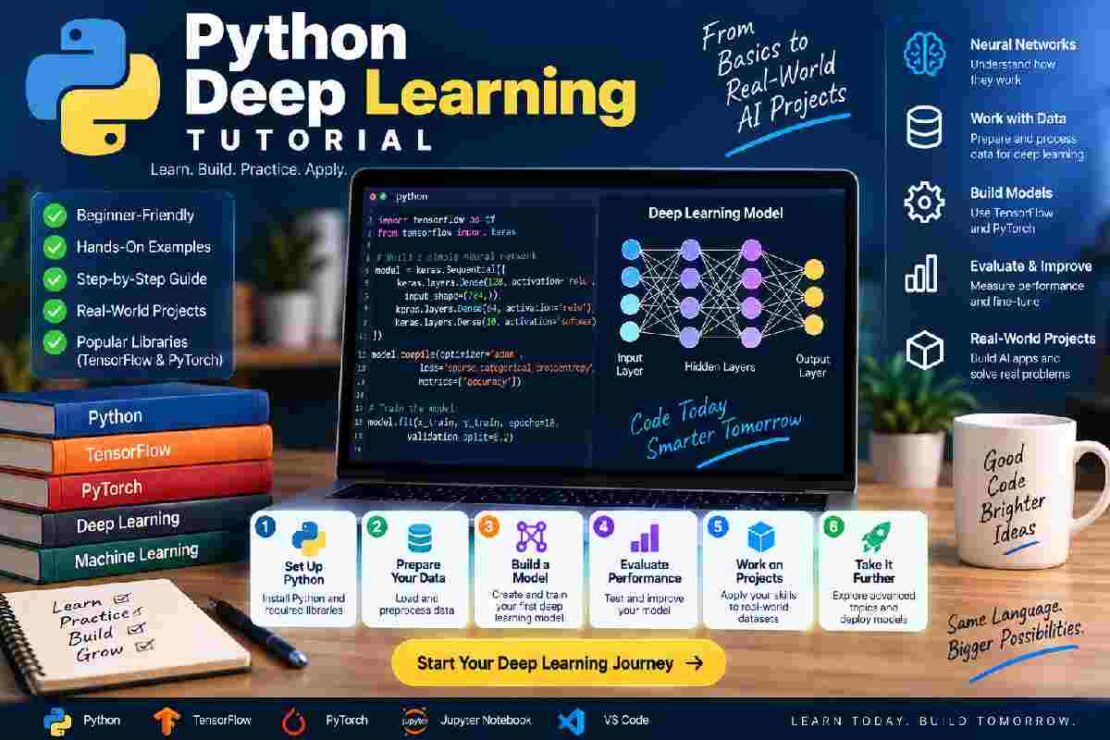
A Simple Learning Path
A practical Python deep learning tutorial should follow a logical progression.
Start with neural networks and basic classification. Once that makes sense, move into convolutional neural networks (CNNs) for images. After that, explore sequence models, transformers, natural-language processing, and generative AI.
The current Deep Learning with Python material follows a similar hands-on progression, covering classification, computer vision, text classification, transformers, text generation, image generation, and real-world best practices.
For practice, Google Colab is convenient because you can run Jupyter notebooks in the browser without setting up a complete local environment. The companion notebooks for Deep Learning with Python also support Colab-based learning.
Common Beginner Mistakes
One mistake I see often is trying to learn every deep learning framework at once. You don’t need to do that.
Pick one framework, build a few small projects, and understand why your model behaves the way it does. Copying code from tutorials can get you started, but changing the dataset, adjusting the model, and investigating errors is where the real learning happens.
Also, don’t skip Python fundamentals. If basic Python code feels confusing, neural-network code will become frustrating very quickly.
Final Thoughts
A Python deep learning tutorial should be more than a collection of code snippets. The goal is to understand what the code is doing and why.
Start small, practice with real datasets, and gradually move from simple neural networks to CNNs, transformers, and generative AI. With consistent practice, deep learning becomes much less intimidating—and Python gives you a practical way to experiment along the way.