Last Updated: September 16, 2026
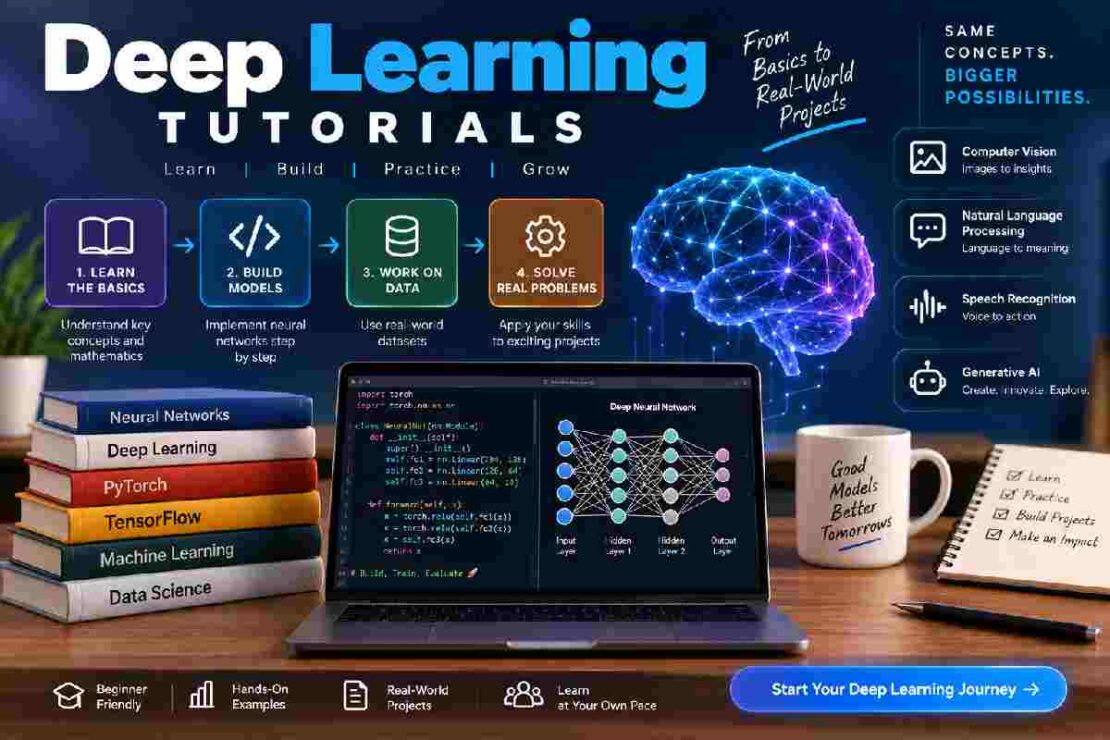
Are you searching for deep learning tutorials?
If that is the case, then you can easily come up with hundreds of courses, videos, documentation pages, notebooks, bootcamps, etc that tell you how to train neural nets, large language models, and anything in between. The bad part is that there is no dearth of learning resources.
But here is the good part – you do not know where to begin, what to learn next, what technology/framework to pick, and most importantly how you can convert any of these tutorials into practical solutions. And here comes this comprehensive guide.
It doesn’t matter if you are new to deep learning, a Python programmer, a machine learning student, or someone planning to work on modern AI: you can use this deep learning tutorials guide to learn everything from what deep learning is, what to learn before, what concepts are most important, the difference between PyTorch vs. Tensor Flow, which tutorials to follow at each stage, and how to go from neural networks to CNNs, RNNs, Transformers, and modern AI models. 2026 learning tip: Don’t just follow the tutorial to get the model working fast. A good tutorial will also show you the data, architecture, loss, training procedure, evaluation, limitations, and what to do when the model doesn’t work.
What Is Deep Learning?

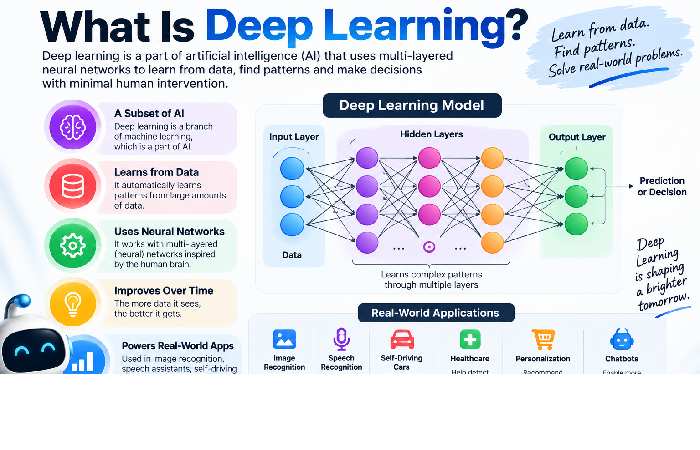
Machine Learning – Deep learning is a subset of Machine Learning that uses neural networks with many layers that learn features and patterns within data. Unlike traditional machine learning where we rely on carefully hand-designed features, deep learning can learn useful data representations on their own from the large volumes of data. For example, for an image classifier, visual features such as edges, shapes, textures, etc. learn to exist within its layers.
Deep learning is now used in areas including:
- Image recognition
- Speech recognition
- Natural language processing
- Recommendation systems
- Fraud detection
- Medical imaging
- Autonomous systems
- Generative AI
- Large language models
- Computer vision
- Time-series prediction
Modern tutorial resources increasingly extend beyond traditional neural networks into Transformers, LLMs, transfer learning, and practical deployment. Current 2026 tutorial collections from DataCamp and other learning platforms reflect this broader scope.
Why Learn Deep Learning in 2026?
Deep learning remains one of the pillars of present-day AI. And if you acquire that knowledge in 2026, it won’t be the same experience that you had a decade or two ago. You don’t need to painstakingly roll out every model yourself from scratch for months just to see if you get any wins. Pre-built models, improved tools, cloud notebooks, open datasets, more practical tutorials–it’s never been easier to run your experiments.
And that can be a bad thing. Because it’s easier to mess around without any actual expertise.
That is why a good learning plan should combine:
- Fundamentals
- Mathematics
- Programming
- Hands-on projects
- Framework knowledge
- Model evaluation
- Modern architectures
- Deployment and production concepts
The goal is not simply to complete tutorials. The goal is to become capable of answering questions such as:
- Why did the model fail?
- Is the dataset suitable?
- Is the model overfitting?
- Should I use a CNN, RNN, or Transformer?
- Do I need transfer learning?
- Which metric should I use?
- How should I improve the model?
- Can the model be deployed efficiently?
Deep Learning Tutorials: What Should You Learn First?
You are new to deep learning. Do not dive head first into LLM tutorials when you start deep learning. What is probably a more sensible journey: Python NumPy Machine Learning Theory Neural Nets Deep Learning CNN Sequence Models Transformers Specialized Apps Deployment The journey is probably comparable to many great learning materials but institutions vary about the order in which they introduce the different topics: courses for beginners, for example, introduce neural nets & backpropagation before CNNs, sequence models & Transformers.
Prerequisites for Deep Learning Tutorials
You do not need to be a mathematics expert to begin.
However, some foundations make deep learning significantly easier.
1. Python
Python is one of the most common programming languages used in machine learning and deep learning.
You should be comfortable with:
- Variables
- Functions
- Loops
- Lists and dictionaries
- Classes
- Modules
- File handling
- Basic debugging
You should also become familiar with common libraries such as NumPy and, depending on your workflow, pandas and matplotlib.
2. NumPy
Deep learning involves enormous amounts of numerical computation.
NumPy helps you understand:
- Arrays
- Dimensions
- Matrix operations
- Broadcasting
- Vectorization
- Basic linear algebra operations
Understanding arrays will also make tensors easier to understand later.
3. Basic Mathematics
You do not need advanced mathematics at the beginning, but you should gradually learn:
- Linear algebra
- Probability
- Statistics
- Derivatives
- Gradients
- Optimization
Important concepts include vectors, matrices, dot products, derivatives, partial derivatives, and gradient descent.
4. Machine Learning Fundamentals
Before studying deep learning, understand:
- Training data
- Validation data
- Test data
- Features
- Labels
- Loss functions
- Classification
- Regression
- Overfitting
- Underfitting
- Model evaluation
These concepts appear repeatedly throughout deep learning.
Best Deep Learning Tutorials by Learning Stage
There is no single tutorial that is perfect for everyone.
Your best choice depends on your experience and your goal.
| Learning stage | What to learn | Useful tutorial format |
|---|---|---|
| Complete beginner | Neural-network intuition | Visual/video tutorials |
| Python learner | Tensors and basic models | Code-along tutorials |
| ML learner | Backpropagation and optimization | Structured courses |
| Intermediate | CNNs and sequence models | Project-based tutorials |
| Advanced | Transformers and LLMs | Research + implementation tutorials |
| Developer | Deployment and production | Framework/cloud tutorials |
| Career-focused learner | Projects + portfolio | Courses with assignments |
The important point is to avoid choosing a tutorial simply because it is popular.
Choose one that matches your current level.
Deep Learning Tutorials Comparison: Major Learning Options
The following comparison focuses on the characteristics of major tutorial approaches available in 2026 rather than declaring one resource universally “best.”
| Resource/type | Beginner friendly | Hands-on | Theory | Projects | Cost model |
|---|---|---|---|---|---|
| University tutorials | Medium | High | High | Medium-High | Often free |
| fast.ai-style courses | High for developers | Very High | Medium | Very High | Free |
| DeepLearning.AI courses | High | High | High | High | Free/paid options |
| DataCamp tutorials | High | High | Medium | High | Subscription |
| Kaggle tutorials/notebooks | High | Very High | Medium | Very High | Free |
| Framework documentation | Medium | Very High | Medium | High | Free |
| YouTube courses | Very High | Varies | Varies | Varies | Usually free |
| Paid marketplaces | High | High | Varies | High | Usually paid |
Kaggle’s deep learning resource collections, for example, include practical courses and curated learning material, while MIT’s deep learning repository combines lectures with notebooks and practical assignments.
Deep Learning Tutorials for Beginners
Getting Started With Reels (Part 1): How to use Reels for beginners How a neural net works #1: the job of the neuron A neuron receives input, scales it by a weight, then the scaled data are summed and the weighted sum is used as an input for an activation function. It is like this: output = activation(weighted sum(inputs)+bias) But don’t memorize it for now. Learn.
Input Calculation Activation Output
By stacking a series of neurons into layers, we get layers, and when we stack layers, we get a neural net.
Step 2: Understand Neural Network Layers
A basic neural network contains:
- Input layer
- One or more hidden layers
- Output layer
The input layer receives information.
Hidden layers transform that information.
The output layer produces a prediction.
Example 3 For a handwritten-digit classifier: the output has ten values (for digits from 0 to 9). Step 3: Learn Activation Functions Neural networks are capable of modeling complex nonlinear functions. Nonlinear functions typically use:
- ReLU
- Sigmoid
- Tanh
- Softmax
ReLU
ReLU is widely used in neural networks because it is simple and computationally efficient.
It returns zero for negative values and retains positive values.
Sigmoid
Sigmoid produces an output between 0 and 1 and is commonly associated with binary classification outputs.
Softmax
A. Softmax. Softmax transforms the calculated values into a probability set, and thus it is used for multiclass classification. Step 4: Understand Forward propagation The data will flow through the network from input to output during the process of forward propagation.
For example:
Input data Layer 1 Layer 2 Output It generates a prediction.
Next, the prediction will be compared to the expected answer.
That difference is represented by a loss function.
Step 5: Learn Loss Functions
A model needs a way to measure how wrong its prediction is.
That is the purpose of a loss function.
Common examples include:
- Mean squared error
- Binary cross-entropy
- Categorical cross-entropy
The training process attempts to reduce the loss.
Step 6: Understand Backpropagation
Backpropagation calculates how changes in model parameters affect the loss.
The resulting gradients help the optimizer update the model’s weights.
A simplified training loop looks like:
Input → Prediction → Loss → Gradients → Weight update → Repeat
This process happens repeatedly over batches and epochs.
Step 7: Learn Gradient Descent
Gradient descent is an optimization technique used to reduce model loss.
Imagine standing on a hill and trying to reach a low point.
The gradient gives information about the direction of steepest increase.
To reduce the loss, optimization moves in the opposite direction.
Important concepts include:
- Learning rate
- Batch size
- Epoch
- Optimizer
- Momentum
- Adaptive optimization
TensorFlow vs PyTorch for Deep Learning Tutorials
One of the most common questions from beginners is whether they should learn TensorFlow or PyTorch.
Both are important deep learning ecosystems, but their tutorials and workflows can feel different.
| Feature | PyTorch | TensorFlow/Keras |
|---|---|---|
| Beginner learning | Strong | Strong |
| Python-style workflow | Strong | Strong |
| Research use | Strong | Strong |
| Production ecosystem | Strong | Strong |
| High-level API | Available | Keras |
| Debugging experience | Often intuitive | Depends on workflow |
| Tutorials | Extensive | Extensive |
| Computer vision | Strong | Strong |
| NLP/Transformers | Strong | Strong |
| Community resources | Extensive | Extensive |
The choice does not need to become permanent.
It’s about learning the concepts, not just memorising the API from a single framework. The student who understands tensors, gradients, losses, optimization, data pipelines, evaluation and model architectures can always take those skills to another framework.
PyTorch Deep Learning Tutorials
PyTorch is widely used for hands-on deep learning development and research.
A typical PyTorch learning sequence includes:
- Tensors
- Datasets and DataLoaders
- Neural-network modules
- Forward passes
- Loss functions
- Optimizers
- Training loops
- Validation
- Saving and loading models
- Transfer learning
- Deployment
A useful beginner project is an image classifier.
Start with a dataset like MNIST or CIFAR and evolve from simple to convolutional layers gradually. For production users – Microsoft guides you through training, tuning, and publishing a PyTorch model using Azure Machine Learning.
TensorFlow and Keras Deep Learning Tutorials
TensorFlow remains another major ecosystem for deep learning.
Keras provides a higher-level interface that can make model development easier for beginners.
A typical beginner project can follow this structure:
Load dataset
     ↓
Preprocess data
     ↓
Build model
     ↓
Compile model
     ↓
Train model
     ↓
Evaluate model
     ↓
Make predictions
This approach is useful for learning the complete machine-learning workflow instead of focusing only on individual layers.
Convolutional Neural Network Tutorials
CNNs are particularly important for computer vision.
A CNN can learn spatial patterns in images.
Typical components include:
- Convolution layers
- Activation functions
- Pooling
- Batch normalization
- Fully connected layers
- Dropout
A beginner image-classification project is one of the most useful ways to learn CNNs.
You can progress from:
MNIST → CIFAR-10 → Custom image dataset → Transfer learning
Transfer Learning Tutorials
Transfer learning is one of the most practical topics to learn after understanding basic neural networks and CNNs.
Instead of training a huge model from scratch, you can start with a pre-trained model and adapt it to a related task.
The advantages can include:
- Less training data
- Lower computational requirements
- Faster experimentation
- Better starting performance
Current cloud documentation also emphasizes transfer learning as a way to reduce the training process compared with building a model completely from scratch.
Common models used in transfer-learning tutorials include:
- ResNet
- EfficientNet
- MobileNet
- Vision Transformers
RNN and LSTM Tutorials
Recurrent neural networks were designed for sequential information.
They have historically been used for:
- Text
- Speech
- Time series
- Sequential prediction
LSTMs were designed to solve some of the problems in learning long-term dependencies in simple RNNs. Even though Transformers are taking over a large portion of today’s language applications, it still makes sense for your students to learn about RNNs and LSTMs to understand how sequence modeling transitioned over time. The best current collections of tutorials tend to include LSTMs along with the newer models.
Transformer Tutorials
Transformers have become one of the most important architectures in modern AI.
They use attention mechanisms to model relationships between elements in a sequence.
Transformers are central to technologies involving:
- Large language models
- Machine translation
- Text generation
- Question answering
- Document processing
- Multimodal AI
- Some modern computer-vision systems
A sensible learning sequence is:
Neural networks → sequence models → attention → Transformers → pretrained models → fine-tuning
Do not skip the fundamentals simply because Transformers are more exciting.
Deep Learning Tutorials for LLMs
If your goal is modern generative AI, you should eventually learn:
- Tokenization
- Embeddings
- Attention
- Transformer blocks
- Positional information
- Pretraining
- Fine-tuning
- Evaluation
- Inference
- Quantization
- Retrieval-augmented generation
- Model deployment
However, not every LLM learner needs to train a giant model from scratch.
For most beginners, understanding how the architecture works and learning how to use pretrained models is a more practical starting point.
Practical Deep Learning Projects
Watching tutorials is not enough.
You need projects.
Here is a progression you can follow.
Beginner Projects
1. Handwritten Digit Classifier
Learn:
- Neural networks
- Classification
- Loss
- Accuracy
- Training loops
2. Fashion Image Classifier
Learn:
- Image preprocessing
- CNNs
- Model evaluation
3. Binary Image Classifier
Build a model that distinguishes between two categories.
Learn:
- Data augmentation
- Validation
- Overfitting
Intermediate Projects
4. Transfer Learning Image Classifier
Use a pretrained model and fine-tune it on a custom dataset.
5. Sentiment Analysis
Build a text-classification model.
Learn:
- Tokenization
- Embeddings
- Sequence processing
- Evaluation
6. Time-Series Forecasting
Use historical data to predict future values.
Learn:
- Sequential data
- Windowing
- Regression metrics
- Validation strategy
Advanced Projects
7. Transformer Text Classifier
Use a pretrained Transformer model and fine-tune it.
8. Image Captioning
Combine computer vision and language modeling.
9. Retrieval-Augmented AI Application
Build a system that retrieves information from documents before generating an answer.
10. Deploy a Deep Learning Model
Take a trained model and expose it through an API or application.
This final step is important because a model that works inside a notebook is not automatically a production-ready system.
Deep Learning Tutorial Learning Path
Here is a practical roadmap for 2026.
Python
  ↓
NumPy + Data Handling
  ↓
Machine Learning Basics
  ↓
Neural Networks
  ↓
Backpropagation + Optimization
  ↓
PyTorch or TensorFlow/Keras
  ↓
CNNs
  ↓
Transfer Learning
  ↓
Sequence Models
  ↓
Attention + Transformers
  ↓
LLMs / Generative AI
  ↓
Deployment + MLOps
Suggested timeline
| Stage | Approximate focus |
|---|---|
| Python foundations | 1–3 weeks |
| ML fundamentals | 2–4 weeks |
| Neural networks | 2–4 weeks |
| CNNs and practical DL | 2–4 weeks |
| Advanced architectures | 3–6 weeks |
| Transformers/LLMs | 3–6+ weeks |
| Projects | Continuous |
These are learning-planning estimates, not requirements. Your pace will depend on your programming and mathematics background.
How to Choose the Right Deep Learning Tutorial
Before starting a course, ask these questions.
Does it include practical coding?
A tutorial that contains only slides may help with theory, but coding is necessary for building practical skills.
Does it explain why?
A strong tutorial should explain why a particular architecture, optimizer, loss function, or preprocessing technique is being used.
Is the material maintained?
Deep learning changes quickly.
Older tutorials can still be valuable for foundational concepts, but framework syntax, APIs, tooling, and modern AI techniques may change.
Does it include projects?
Projects force you to solve problems that tutorials often hide.
Does it teach evaluation?
Accuracy alone is not enough for every problem.
You should learn metrics appropriate to the task.
Does it explain failure cases?
Real machine learning involves failed experiments.
A useful course should discuss overfitting, bad data, class imbalance, poor generalization, and other problems.
Free vs Paid Deep Learning Tutorials
Free resources have become remarkably comprehensive.
Kaggle, MIT, framework documentation, university resources, YouTube, and open-source projects provide substantial material without requiring a paid subscription.
Paid courses can still be useful when you need:
- Structured progression
- Assignments
- Grading
- Certificates
- Community support
- Instructor guidance
- A predefined curriculum
The question is not simply whether a resource is free.
The better question is:
What learning problem does this resource solve for you?
Deep Learning Tutorials: What Competitor Content Often Misses
A review of current tutorial content shows several recurring approaches.
Some resources focus heavily on structured courses. Others provide huge collections of links. Some focus on framework-specific coding, while university resources emphasize concepts and assignments.
For a learner, these approaches can complement one another.
A practical strategy is:
One structured course + one framework + one project + official documentation + research/advanced material
This is usually more useful than completing five introductory courses that teach the same basic neural-network concepts.
Common Deep Learning Tutorial Mistakes
Mistake 1: Starting With LLMs
LLMs are exciting, but starting there can leave major gaps in your understanding.
Learn neural networks and optimization first.
Mistake 2: Watching Without Coding
Passive learning creates the illusion of progress.
Write the code yourself.
Mistake 3: Copying Notebooks
Copying a working notebook does not mean you understand it.
After completing a tutorial, modify something.
Change:
- The dataset
- The architecture
- The optimizer
- The learning rate
- The evaluation metric
Then observe what happens.
Mistake 4: Ignoring Data
Model architecture gets most of the attention, but data quality can have a huge effect on results.
Learn:
- Cleaning
- Label quality
- Splitting
- Normalization
- Augmentation
- Class imbalance
Mistake 5: Chasing Every New Model
Deep learning produces new papers and models constantly.
You do not need to learn everything.
Build strong fundamentals first.
Deep Learning Troubleshooting Guide
Why is my model not learning?
Check:
- Input preprocessing
- Labels
- Learning rate
- Loss function
- Output activation
- Model architecture
- Data dimensions
A simple debugging strategy is to test whether the model can overfit a very small dataset.
If it cannot learn a tiny dataset, investigate the training pipeline before increasing model complexity.
Why is validation accuracy much lower than training accuracy?
This can indicate overfitting.
Possible approaches include:
- More training data
- Data augmentation
- Regularization
- Dropout
- Early stopping
- Reducing model complexity
- Transfer learning
Do not automatically add more layers.
Why is training extremely slow?
Possible causes include:
- Large datasets
- Large models
- CPU-only training
- Inefficient data loading
- Small batch sizes
- Excessive preprocessing
- Limited hardware
Profile the workflow before changing everything.
How to Build a Deep Learning Portfolio
If your goal is employment or freelance work, completing certificates alone may not demonstrate practical ability.
Build projects that show your complete process.
For each project, document:
- Problem
- Dataset
- Data preparation
- Baseline
- Model choice
- Training process
- Evaluation
- Errors
- Improvements
- Final results
- Deployment, if applicable
A GitHub repository can include:
- README
- Source code
- Requirements
- Training instructions
- Evaluation results
- Screenshots
- Model limitations
This makes the project easier for another developer to understand.
Deep Learning Tutorials and E-E-A-T
For technical content, credibility matters.
A high-quality deep learning article should not simply list courses.
It should demonstrate understanding of:
- Current frameworks
- Model architectures
- Learning prerequisites
- Practical workflows
- Limitations
- Evaluation
- Responsible use
Claims about current tools and courses should be checked against their official documentation or current course pages.
For example, current Microsoft documentation describes PyTorch training, hyperparameter tuning, and deployment workflows, while current MATLAB resources provide practical deep-learning examples involving transfer learning, classification, sequence models, and deployment.
Frequently Asked Questions
What are deep learning tutorials?
Deep learning tutorials are educational resources that teach concepts and practical techniques for building neural-network-based machine learning systems. They can include videos, written guides, notebooks, courses, exercises, and projects.
Can I learn deep learning as a beginner?
Yes. Start with Python, basic mathematics, machine-learning fundamentals, and simple neural networks before moving to CNNs, Transformers, and advanced models.
Do I need Python for deep learning?
Python is not theoretically required, but it is one of the most practical languages to learn for modern deep learning because of its extensive ecosystem.
Should I learn TensorFlow or PyTorch first?
Either can work. Choose one and become comfortable building, training, evaluating, and debugging models. The underlying concepts transfer between frameworks.
Is deep learning difficult?
It can be challenging because it combines programming, mathematics, statistics, data preparation, optimization, and experimentation. A structured learning path makes it much more manageable.
Can I learn deep learning without advanced mathematics?
Yes, especially at the beginning. However, understanding linear algebra, calculus, probability, and optimization becomes increasingly valuable as you move into advanced topics.
Are free deep learning tutorials enough?
They can be. There are extensive free resources from universities, open-source communities, Kaggle, framework providers, and educational platforms.
How long does it take to learn deep learning?
There is no universal timeline. A learner with strong Python and machine-learning knowledge can progress faster than someone starting from zero.
Final Deep Learning Tutorials Roadmap
The most effective way to learn deep learning is not to collect as many tutorials as possible.
It is to build a sequence.
Start with Python.
Learn NumPy and basic data handling.
Understand machine-learning fundamentals.
Then learn how neural networks work, including forward propagation, loss, backpropagation, and optimization.
Move into a framework such as PyTorch or TensorFlow/Keras.
Build practical projects.
After that, study CNNs, transfer learning, sequence models, and Transformers.
Finally, move toward LLMs, deployment, MLOps, and specialized applications.
The current deep-learning education landscape provides resources for almost every stage. Beginner courses focus on fundamentals, practical platforms provide hands-on notebooks and projects, and university or research-oriented resources can take you deeper into the mathematics and architecture behind modern systems.
The biggest mistake is trying to find one tutorial that teaches everything.
Instead, build your own learning stack:
Learn → Code → Experiment → Break the model → Debug → Build a project → Read deeper → Repeat.
That process will take you much further than simply finishing another course.