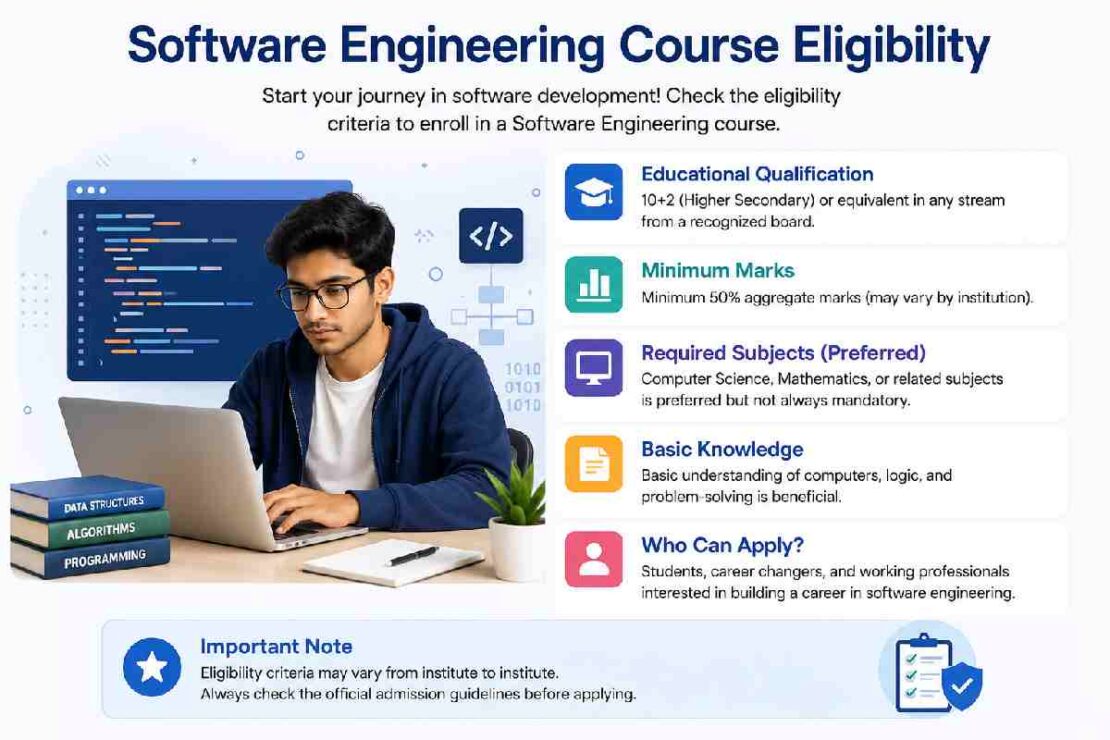
As far as software engineering course eligibility is concerned, don’t worry, there’s only one way. The course’s eligibility will differ for each course (degree, BTech/BE, BCA, diploma, certificate,online course, postgraduate course, etc.) and institution is free to fix admission criteria according to it. For Indian students, students can directly pursue the course after getting their degree of class 12 th with necessary science subjects by admission on the college’s admission/ entrance procedure or through its counseling. But it varies from institution to institution therefore, always check the latest notification of admissions prior to applying.
What Is the Basic Eligibility for a Software Engineering Course?

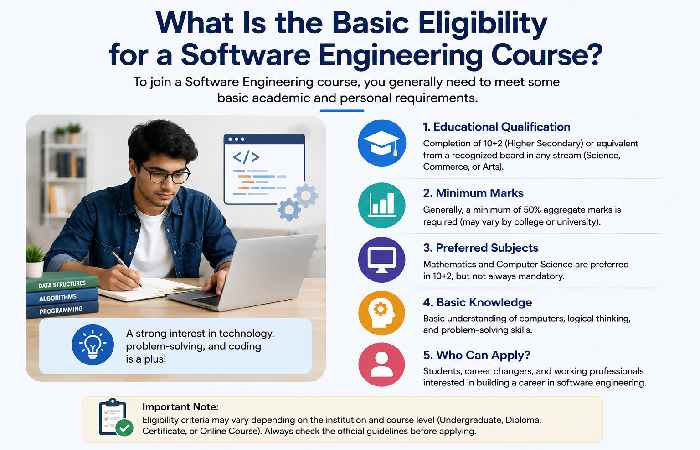
The general criteria to be eligible for a B. Tech/B.E in Software Engineering/Computer Science program:
1. Pass Class 12 or equivalent with requisite subjects of study.
2. Mathematics and Physics are the prescribed subjects that you must have studied.
3. Obtain the minimum percentage specified by the institute.
4. Meet the requirement of entrance exam, if any.
5. Other rules imposed by the university or state.
The percentage would differ for every institution.
AICTE’s Approval Process Handbook lists out criteria of admission to undergraduate engineering program on the basis of 10+2 qualifications & prescribed subjects whereas some institutions set their own admission criteria subject to the eligibility framework already in place.
Software Engineering Eligibility After 12th
Your Class 12 subjects can significantly affect which engineering programs you can apply for.
Typical BTech route
| Requirement | Typical expectation |
|---|---|
| Education | Class 12 / 10+2 |
| Mathematics | Usually required for engineering |
| Physics | Usually required |
| Chemistry/other subject | Depends on admission rules |
| Minimum marks | Varies by institution |
| Entrance exam | Depends on college/state |
| Duration | Usually 4 years |
For NITs, IIITs and other participating CFTIs, NTA specifies Physics and Mathematics as compulsory subjects for B.E./B.Tech., along with one of Chemistry, Biotechnology, Biology or a technical/vocational subject. NTA also notes that admission policies can differ for state-level institutions.
That distinction is important: “eligible for a BTech” and “eligible for a particular college” are not always the same thing.
Do You Need PCM to Become a Software Engineer?
If you’re asking about a BTech/BE engineering admission, Mathematics and Physics are commonly required.
But if you’re asking whether PCM is required to eventually work as a software engineer, the answer is different.
There are alternative educational paths, including:
- BCA
- BSc Computer Science
- Diploma programs
- Online software development programs
- Professional certificates
- Self-directed programming education
- Postgraduate conversion programs
For example, Careers360 lists BCA as an alternative software-development route after 12th and notes different eligibility requirements from BTech programs.
Eligibility by Course Type
One of the easiest ways to understand the requirements is to compare the major pathways.
| Course | Typical entry point | Mathematics requirement | Entrance exam | Duration |
|---|---|---|---|---|
| BTech/BE Software Engineering | After 12th | Usually required | Often | 4 years |
| BTech CSE | After 12th | Usually required | Often | 4 years |
| BCA | After 12th | Depends on college | Sometimes | 3 years |
| Diploma | After 10th/12th | Depends on program | Varies | 1–3 years |
| Certificate | Varies | Usually flexible | Usually no | Weeks–months |
| Online professional course | Varies | Usually flexible | Usually no | Weeks–months |
| MTech/MS | After bachelor’s | Usually technical background | Depends | 1–2+ years |
Important: This table is a general guide, not an admission guarantee. Always check the specific institution’s current eligibility notice.
What Are the Software Engineering Admission Requirements?
Admission usually involves more than simply meeting the educational qualification.
Depending on the course, you may need:
- Academic qualification
- Required subjects
- Minimum marks
- Entrance examination
- Counselling or application process
- Document verification
- Course-specific requirements
For major engineering admissions, JEE Main remains an important pathway. The official NTA site currently publishes the 2026 JEE Main information bulletin and examination documentation.
For JoSAA 2026, the centralized allocation system covers IITs, NITs, IIITs and other participating government-funded technical institutes.
What Are the Requirements for JEE-Based Engineering Admission?
These are, for students aiming for NITs, IIITs, & other participating CFTIs, the conditions prescribed for the required 10+2 subject combination and performance requirements. According to NTA’s guidance for engineering-exam, general criteria require students to have secured at least 75% in Class 12 or to have achieved at least the top 20 percentile within their respective Boards if an institution is admitting via JEE Main.65% has been prescribed for SC/ST category students.
However, since institutions’ admissions criteria tend to vary and can change, candidates are advised to consult the most recent official admission brochure for the current year rather than relying on an older eligibility article.
Can Students From Any Stream Become Software Engineers?
This depends on what you mean by “software engineer.”
Science/PCM students
Students with Mathematics and Physics generally have the widest access to conventional engineering programs.
Commerce students
Commerce students may have access to BCA, selected computer applications programs, certificates and other technology pathways depending on the institution.
Arts students
Arts students can also enter software development through eligible BCA/BSc programs, online courses, bootcamps and self-learning, although individual admission requirements vary.
Diploma holders
Diploma holders may have additional pathways, including lateral-entry opportunities at institutions that offer them.
The key lesson is simple: don’t assume that not having a traditional PCM background automatically ends your software career. Instead, identify the specific course you want and check its eligibility rules.
Is Mathematics Necessary for Software Engineering?
Mathematics is important for many formal engineering programs, particularly BTech admission.
But the amount of mathematics you use professionally depends on your role.
A web developer, for example, may spend most of the day working with programming languages, APIs and databases. A machine-learning engineer or graphics programmer may use considerably more mathematical concepts.
Either way, developing logical and quantitative thinking is valuable for software development.
Do You Need Programming Experience Before a Software Engineering Degree?
Usually, no.
A beginner-friendly degree or course should teach programming fundamentals from the ground up.
You may still benefit from learning:
- Basic Python or JavaScript
- Variables and functions
- Simple problem solving
- Computer fundamentals
- Basic mathematics
- Logical reasoning
Great Learning’s current software-engineering guidance, for example, identifies programming knowledge and familiarity with technical tools as prerequisites for some advanced programs rather than treating them as universal requirements for every software course.
What Skills Should You Develop Before Admission?
Eligibility gets you through the door. Skills help you succeed once you’re there.
A useful preparation plan is:
Programming → Problem Solving → Git → Data Structures → SQL → Projects
You don’t need to master all of these before starting a degree.
Even a small project such as a calculator, portfolio website, expense tracker or to-do application can give you useful hands-on experience.
2026 Eligibility Snapshot
The biggest difference isn’t between “eligible” and “not eligible.” It’s between different types of programs.
Traditional engineering route
12th → PCM → Entrance exam → BTech/BE → Software career
Computer applications route
12th → Eligible BCA/BSc program → Programming + projects → Software development
Professional route
Degree/12th → Certificate/online course → Projects → Skills → Entry-level opportunity
Advanced route
Bachelor’s → MTech/MS/PG program → Advanced software specialization
This makes software engineering more accessible than the phrase “engineering degree” might initially suggest.
Common Eligibility Problems and How to Solve Them
“I didn’t study Computer Science in Class 12.”
That doesn’t automatically disqualify you. Many programs focus on required subjects such as Mathematics and Physics rather than requiring Computer Science specifically. Check the institution’s admission rules.
“I didn’t get the required percentage.”
Look for colleges or alternative programs with different eligibility thresholds. Don’t assume every institution has the same cutoff.
“I didn’t take PCM.”
A traditional BTech route may be restricted, but BCA, selected BSc programs, diplomas and online learning can provide alternative routes depending on their admission criteria.
“I don’t want to take an entrance exam.”
Look for institutions and programs that offer merit-based or direct admission, where permitted. Admission policies vary considerably.
“I’m already working.”
You may not need to start with another four-year degree. An online software development program, certificate or structured self-learning path may be more practical, depending on your career objective.
Frequently Asked Questions
Software Engineer: Eligibility After 12th: BTech/BE courses generally require class 12 pass with science stream as minimum requirement, having mathematics and physics as mandatory subject. Minimum percentage required varies from college to college. The eligibility conditions of a college and its entrance examination also need to be fulfilled.
Can I become software engineer after 12th?
Yes, the candidate can pursue BTech in software engineering, BBE in software engineering, BCA in computer application, BSc in computer application, DIP in computer application or other engineering or diploma courses of any recognized University/ Institute after class 12th. Can I learn software engineering after class 12th if I am from commerce stream? A candidate from the commerce stream is eligible to get into BCA Computer Application in computers course or Diploma and Certificate course in Computer Application.
Can an Arts student do a BTech in software engineering?
Arts Students to pursue BTech in software Engineering through a variety of modes.
Some institutes also take admission in computer application courses from Arts streams.
Is an entrance exam mandatory for software engineering?
While some private and public institutions might conduct their own entrance examinations for admission in software engineering, other institutions might grant admissions on the basis of the candidates’ merit in class 12th or their scores in the respective national or state-level common admission tests.
Is it possible for someone to become a software engineer without a degree? As an individual with no formal computer science or software engineering education, you still can find a career in the tech industry; in fact, many highly skilled, knowledgeable software engineers with high salaries do not hold a bachelor’s or master’s degree.
Final Takeaway
The exact eligibility criteria will be program specific.
If BTech is chosen after 12th, then Physics and Mathematics is of key importance, while entrance exams or institutional criteria can play a part. However if the straight traditional engineering path isn’t followed then BCA, BSc, dipoma, online and vocational courses can offer alternative solutions to acquire software development skills.
Always take general eligibility write-ups as initial guidelines and not as definite admission criteria and refer to the relevant institution or exam authorities for the year 2026 and beyond.