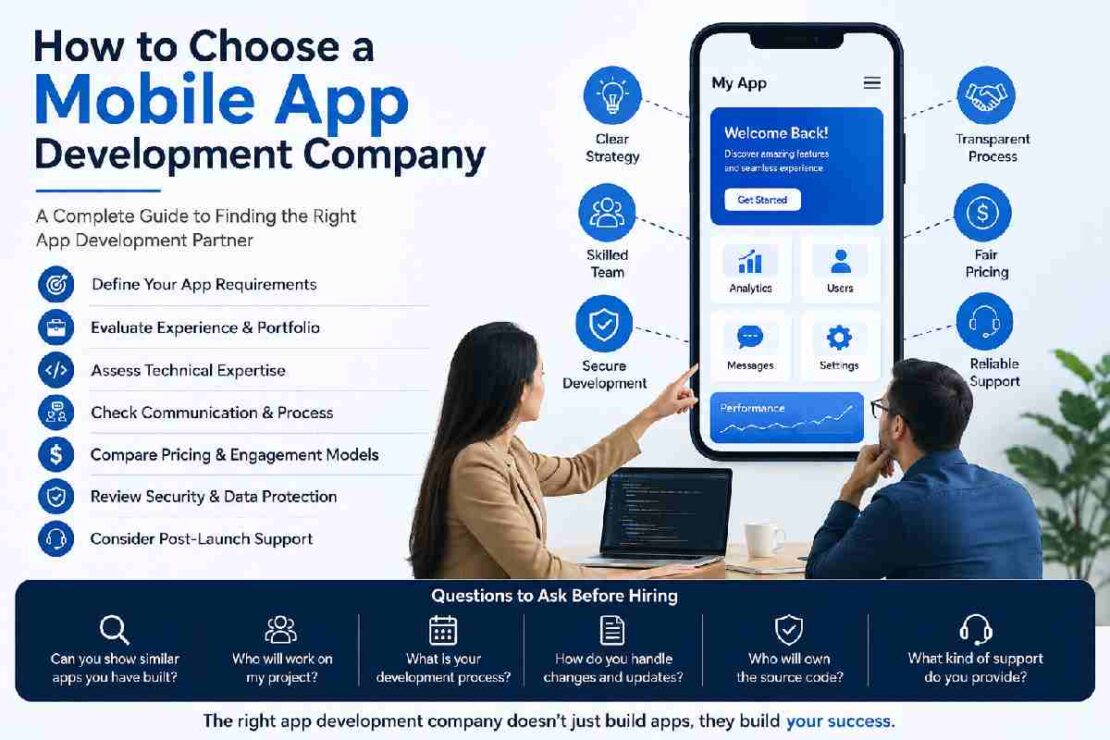
Understanding the Process for Choosing a mobile app development company can protect you months down the line – whether that’s delays, surprise costs, or an costly remake. Not only code writing skills needed from your development partner-they ought to also consider your individual business goals and objectives, recommend the best technological stack for its’ and be transparent and protected in terms of communication along with your intellectual assets. With the growing competition in the app dev’ space, you should look further then cost when choosing vendors-which hundreds of agencies, software’ studios, freelancers, and outsourcing companies fight for the app dev’ projects now on the industry.
A superior approach should entail to review every one within the development groups about the identical parameters.
The post under highlights and outlines within 2026 framework a methodology you can embrace earlier you finally commit to having signed onto a construction agreement.
1. Define Your App Requirements First

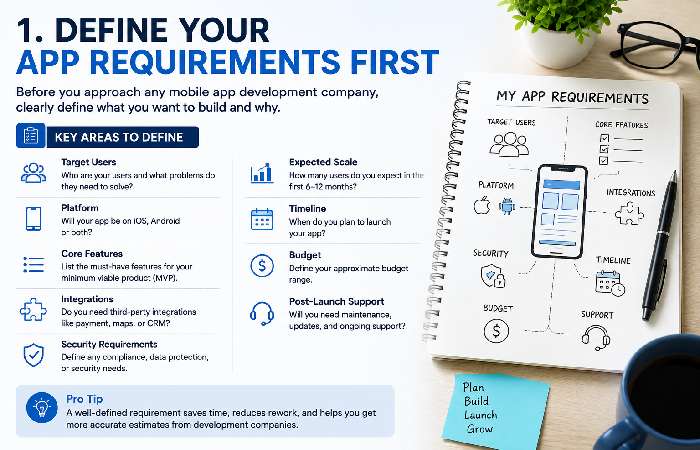
Before contacting development companies, document what you actually need.
At minimum, define:
- Target users
- iOS, Android, or both
- Core features
- Expected number of users
- Integrations
- Security requirements
- Launch deadline
- Approximate budget
- Post-launch support requirements
“There is no need for a technical specification. A clear problem, audience, and required feature is suffice for the first round discussion with any vendor. A capable development partner will also question things that lack clarity, instead of saying it’ll do. “
2. Check Relevant Experience, Not Just Years in Business
A company saying it has 10 years of experience does not automatically mean it is suitable for your project.
Look for experience with apps similar to yours in terms of:
- Industry
- User complexity
- Technology
- Integrations
- Security requirements
- Scale
- Business model
For example, an agency experienced in simple content apps may not be the best choice for a fintech application requiring payments, identity verification, and strict security controls.
Mobile App Development Portfolio Evaluation
Do not simply look at screenshots on a company’s website.
Download the apps they claim to have developed when possible. Check their App Store or Google Play listings, reviews, update frequency, interface quality, onboarding, performance, and overall user experience.
Ask the company:
- What was your role in this project?
- Did you build the entire application?
- Can I speak with a previous client?
- What challenges did you solve?
- Is the application still maintained by your team?
This provides stronger evidence than a portfolio full of attractive mockups.
3. Evaluate Their Technical Approach
The right technology depends on your product.
A company should be able to explain why it recommends native development, cross-platform development, or another approach.
| Approach | Best suited for | Main advantage |
|---|---|---|
| Native iOS/Android | High-performance or platform-specific apps | Maximum platform control |
| Flutter | Many cross-platform products | Shared development approach |
| React Native | Cross-platform applications | Reusable JavaScript/React ecosystem |
| Hybrid/Web-based | Simpler applications | Potentially faster development |
Avoid selecting a technology just because it’s a buzz. The Dev Shop must tell you the performance, dev-speed, maintenance, scalability, testing, and also hiring tradeoff. But even so more critically back again at 2026!
From Aug 31, 2026, The new Android App Bundle size limits policy of Google Play the actual new apps and updates released should targets Android 16 (API Level 36) or higher.
Having this at the back of the heads it is critical the dev shop gives you the roadmap how it’s app is up dated regarding platform versions and.
4. Understand the Development Process
A professional company should be able to explain what happens after you sign the contract.
A typical process includes:
DiscoveryUX/UIDevelopmentTestingDeploymentMonitoringMaintenanceDon’t hesitate to ask:How often will you get builds and progress reports? Agile development can come in handy as teams work in sprints to build the functionality, gaining insight back before they finish the whole application. Big red flag is if they don’t know the answers to questions concerning who is responsible for the requirements, testing, approvals or change control.
5. Compare Mobile App Development Pricing Models
Never compare two quotes based only on the final number.
Clutch’s July 2026 pricing data shows that many app development companies listed on its platform charge approximately $25–$49 per hour, while reviewed project costs commonly fall between $10,000 and $49,999. Its location data also shows significant differences between markets, including India at under $25/hour and Canada at $50–$99/hour.
| Pricing model | Advantages | Potential problem |
|---|---|---|
| Fixed price | Predictable budget | Changes can become expensive |
| Time & materials | Flexible scope | Final cost can change |
| Dedicated team | Greater control | Requires ongoing management |
| Milestone-based | Payments tied to progress | Scope must be clearly defined |
The cheapest quote is rarely enough information to make a decision.
Compare what each quote includes: discovery, UI/UX, development, QA, deployment, project management, infrastructure, warranty, and ongoing maintenance.
6. In-House Team vs Development Agency
There is no universal winner.
| Factor | In-house team | Development agency |
|---|---|---|
| Hiring speed | Slower | Usually faster |
| Internal control | High | Medium |
| Access to specialists | Requires hiring | Usually broader |
| Initial overhead | Higher | Lower |
| Long-term ownership | Strong | Contract dependent |
| Flexibility | Depends on team size | Often high |
An in-house team may make sense when mobile development is a permanent core capability of your business.
An agency can be more practical when you need specialist expertise quickly or want to validate an MVP before building a permanent internal team.
7. Offshore vs Local App Development Company
Offshore development can reduce labor costs, but location should never be your only selection criterion.
Clutch’s 2026 data illustrates the cost variation between development markets. However, the real comparison should also include communication, timezone overlap, project management, technical quality, security, and accountability.
A strong offshore partner with excellent communication may outperform a poorly managed local vendor.
8. Ask These Questions Before Hiring App Developers
Before signing, ask:
- Who will actually work on my project?
- Can I interview the lead developer?
- What similar apps have you launched?
- What technology do you recommend and why?
- How do you handle security testing?
- How frequently will I receive builds?
- Who owns the source code?
- Where will the code repository be hosted?
- What happens if the project is delayed?
- What is included in post-launch support?
- How are additional features priced?
- Can you provide client references?
The answers are often more valuable than the sales presentation.
9. Use This Mobile App Development Company Checklist
Score every shortlisted company from 1–5.
| Evaluation factor | Score |
|---|---|
| Relevant portfolio | /5 |
| Technical expertise | /5 |
| UX/UI capability | /5 |
| Communication | /5 |
| Development process | /5 |
| Security practices | /5 |
| Pricing transparency | /5 |
| Client references | /5 |
| Post-launch support | /5 |
| Source-code ownership | /5 |
A company with the lowest price but weak technical expertise should not automatically beat a slightly more expensive company with stronger evidence.
10. Watch for These Hiring Mistakes
Common mistakes include:
- Choosing purely on price
- Accepting an impressive portfolio without verification
- Ignoring the actual development team
- Not defining ownership of source code
- Failing to discuss maintenance
- Accepting vague estimates
- Skipping security discussions
- Not establishing communication expectations
- Making major scope changes without documentation
Another mistake is assuming the project ends when the app reaches the App Store or Google Play. Mobile products require ongoing updates, bug fixes, analytics, security improvements, and compatibility work.
A Simple Way to Choose the Winner
After interviewing three to five companies, compare them using the same requirements.
A useful decision formula is:
Technical fit + relevant experience + communication + delivery process + security + commercial transparency + support
Price should be one factor—not the entire decision.
Typically the right mobile apps developer is not one offering the fastest turn around times and cheapest quotation. It is a partner that shows related expertise, clearly outlines technical reasons behind their process, provides clarity from a commercial standpoint and remains accountable after your project launch.
FAQ
What is the typical price of hiring a mobile app development company? The price typically depends on some factor, but mostly can go from $ 25-49/ hour as stated Clutch data from july 2026, and can go as $ 10k to $49K for reviewed cases. Should I build an in-house app dev team or hire agency services?
As per requirement, if require high skilled team for temporary duration then go for an agency.
But when we have the mobile app developmnet for the forever in biz then we will need an in-house app team.
How many mobile app development companies I need to analyze?
It should have minimum 3 to 5 best vendors if we want to analyze well to proceed for. What are the warning signs when hiring a mobile app development company?
I want someone who promise an out-of-date technology , with vague promises, a poor technical explanation of work process , I cannot show me my projects that are relevant or I am not going to own any part of the project, or that they will have any claim over any source code etc, but basically with an unknown quantity.
What Should the Mobile App Development Company Contract Clearly State?
It should include scope of the work and milestones, payments terms, ownership terms of all intellectual property associated with the project (the app itself, artwork), access to all source code and development tools, clear explanation of responsibilities, Acceptance criteria/process for final Product, Process for handling of changes/amendments (Change requests) throughout the development Cycle, Terms of confidentially, warantees, on post launch or maintenance process.
Conclusion
Our Summary The best advice on this could easily be that, even if there can not be any company offering best price of app. It is very important that right company could well connect to your business, have appropriate know-how as well as offer useful experience, help regarding the cost and pricing, and after sales and also other services to offer you with the optimum solution possible.