
Last Updated: July 30, 2026
Introduction
If you intend to develop a business application, one of the questions that you will first ask is how much does web application development cost. It is impossible to give a precise price, as each application is different. For instance, a simple internal dashboard may be worth several thousand dollars, while an enterprise SaaS service with AI, real-time communication, and cloud technology may cost hundreds of thousands of dollars.
In 2026, the cost of development has reached a new level, given the progress of AI-assisted coding, cloud-native application design, security standards, and the demands of the user. Companies are now paying not only for code but also for scalability, security, performance, user experience, and ongoing maintenance.
Here you will find out all the details involved in the cost of web app development: pricing averages, impact of the scope of work on cost, various engagement models and unexpected expenses, costs of the maintenance, ways to save money without reducing quality.
Average Web Application Development Cost in 2026
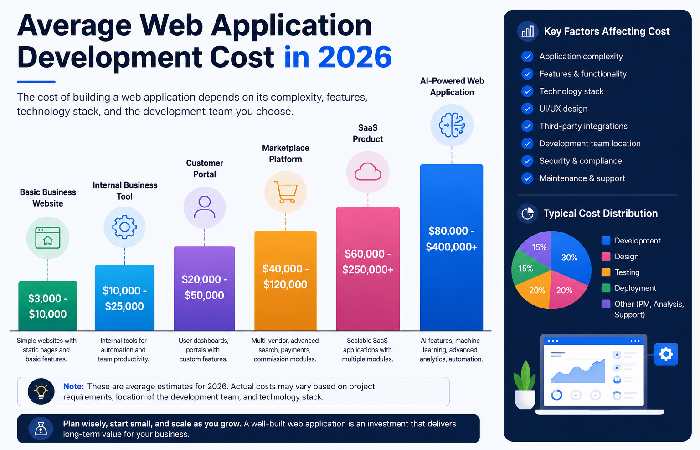
Depending on the features, and how much you’d like it customized, the final cost of any application differs greatly on the functionality, aesthetics, third-party integration required, and the development team working: Application Type Estimated Cost Simple Business Website: $3k – $10k Internal business tool: $10k – $25k Customer portals: $20k – $50k Market place platforms: $40k – $120k SaaS products: $60k – $250k+ Ai powered web applications: $80k – $400k+ These cost estimates are an approximation for design, development, testing, launch and on-boarding of your application. An additional investment would be required for after-launch updates and maintenance. Pro tip: Remember to set apart at least 15-25% of the development budget for the maintenance of the website, server space and subsequent development of features.
What Determines Web Application Development Cost?
No two applications are identical. Several variables influence the final budget.
1. Project Complexity
Complexity is the single biggest pricing factor.
| Complexity | Typical Features | Estimated Cost |
|---|---|---|
| Basic | Login, Contact Forms, Dashboard | $5k–20k |
| Medium | Payments, APIs, Notifications | $20k–70k |
| Advanced | AI, Video, Chat, Analytics | $70k–250k+ |
2. UI/UX Design
Modern businesses expect intuitive interfaces that improve customer engagement.
Design work typically includes:
- User Research
- Wireframes
- Interactive Prototypes
- Brand Design
- Responsive Layouts
- Accessibility Testing
Professional UI/UX design often represents 10–20% of the total project budget.
3. Features & Functionality
Every additional feature increases development time.
Examples include:
- Secure Authentication
- Social Login
- Payment Gateways
- Live Chat
- Search Filters
- Admin Dashboard
- Reports
- Analytics
- AI Chatbots
- Video Calls
- Notifications
- CRM Integration
The more custom functionality you require, the larger the investment.
Cost by Project Size
One of the easiest ways to estimate a budget is by project scope.
| Project Size | Timeline | Estimated Cost |
|---|---|---|
| Small | 1–2 Months | $5k–20k |
| Medium | 3–6 Months | $20k–80k |
| Large | 6–12 Months | $80k–250k |
| Enterprise | 12+ Months | $250k–1M+ |
Enterprise software often includes compliance requirements, multi-region infrastructure, AI services, extensive integrations, and advanced security.
MVP Development Cost
Launching a Minimum Viable Product (MVP) allows startups to validate ideas without overspending.
Typical MVP includes:
- User Registration
- Dashboard
- Basic Database
- Core Features
- Payment Integration
- Admin Panel
Average MVP Cost:
| MVP Type | Budget |
|---|---|
| Basic MVP | $15k–30k |
| Startup MVP | $30k–60k |
| AI MVP | $50k–100k |
Focus on an MVP initially to minimize the financial risks. A successful MVP allows you to get real feedback from the potential clients. In case, your service works, you can add much more functions to the service.
Freelancer vs Agency Pricing
Many businesses struggle with the decision between hiring freelancers and working with an agency.
| Factor | Freelancer | Agency |
|---|---|---|
| Cost | Lower | Higher |
| Speed | Depends on individual | Dedicated team |
| Design | Limited | Professional |
| QA Testing | Usually minimal | Dedicated QA |
| Security | Depends on experience | Standard practice |
| Scalability | Difficult | Easy |
| Long-term Support | Risk of availability | Ongoing contracts |
Freelancers are suitable for small internal tools or prototypes. Agencies are generally better for commercial products that require reliable delivery, quality assurance, and ongoing support.
Development Team Structure
A professional web application project often involves:
| Role | Responsibility |
|---|---|
| Project Manager | Planning & Delivery |
| UI/UX Designer | User Experience |
| Frontend Developer | Interface |
| Backend Developer | Server Logic |
| QA Engineer | Testing |
| DevOps Engineer | Deployment |
| Security Engineer | Application Security |
Larger projects may also include AI engineers, cloud architects, and product owners.
Technology Stack and Its Impact on Cost
Development time and costs can significantly change depending on the technology used. Here are a few examples of well-regarded:
Frontend frameworks: React, Angular and Vue.js.
Backend frameworks/languages: Node.js, Django, Laravel, ASP.NET and Spring Boot.
Cloud hosts: AWS, Microsoft Azure and Google Cloud.
The rise in use of AI to assist development work, automated testing and microservice deployments are key trends in modern development as they increase developer efficiency but adds on costs in building, provisioning and maintaining infrastructure.
Native vs Progressive Web Apps
| Type | Best For | Relative Cost |
|---|---|---|
| Web App | Businesses | Lower |
| Progressive Web App | Retail & Content | Medium |
| Native Mobile App | Performance | Highest |
| Cross-platform App | Startups | Medium |
Choosing the right platform depends on your audience, performance needs, and budget.
Maintenance Cost
The launch of a web app is just the beginning. As time progresses, you’ll need to continually update and monitor your application to ensure it is safe, can render on modern web browsers and devices, and can adapt to increases in traffic from an growing user base. As a rough guideline, the general estimation for annual web app maintenance cost comes to between 15 and 25 percent of the original development investment. A breakdown of Web App Maintenance Cost: Task Estimated Cost Annually Bug Fixes $1,000-$10,000 security Updates $2,000-$8,000 feature Enhancements $5,000-$50,000+ server Updates $1,000-$6,000 Cloud Hosting $500-$30,000+ Database Maintenance $1,000-$5,000 If we take a look at a web app of $50,000 as an example, the yearly maintenance costs would fall between $7,500 – $12,500.
Hidden Development Costs Most Businesses Forget
Many first-time buyers focus only on coding costs. However, several additional expenses can significantly impact the overall budget.
| Hidden Cost | Why It Matters |
|---|---|
| Domain Name | Annual renewal fees |
| SSL Certificates | Secure HTTPS connections |
| Cloud Hosting | Monthly infrastructure costs |
| Third-party APIs | Maps, SMS, payment gateways, AI APIs |
| Email Services | Transactional email delivery |
| Push Notifications | User engagement tools |
| CDN | Faster global performance |
| Security Audits | Vulnerability assessments |
| Compliance | GDPR, HIPAA, PCI-DSS |
| App Monitoring | Performance tracking |
| Backup Solutions | Disaster recovery |
| Software Licenses | Premium tools and libraries |
Ignoring these costs often results in budget overruns after launch.
Web Application Cost by Industry
Industry Estimated Cost Health care $60,000 – $300,000+ FinTech $80,000 – $500,000+ E-commerce $20,000 – $150,000 Education $25,000 – $120,000 Real estate $20,000 – $100,000 Logistics $40,000 – $250,000 Social networks $70,000 – $400,000 SaaS $60,000 – $300,000+
AI Features and Their Impact on Development Costs
AI has found its place in most of today’s web applications, and some of the top of the line AI features being used are-
AI chatbots
Recommendation engines
Image recognition
Voice search
Predictive analytics
Document summarization
Automated customer support
Smart search
| AI Feature | Estimated Additional Cost |
|---|---|
| AI Chatbot | $5,000–$30,000 |
| Recommendation Engine | $8,000–$40,000 |
| OCR Document Processing | $10,000–$50,000 |
| Voice Assistant | $15,000–$60,000 |
| Predictive Analytics Dashboard | $20,000–$100,000 |
Cloud Infrastructure Costs
Cloud services make applications scalable but add recurring operational expenses.
| Service | Monthly Cost (Approx.) |
|---|---|
| Shared Hosting | $10–$50 |
| VPS | $30–$200 |
| AWS | $100–$5,000+ |
| Microsoft Azure | $100–$5,000+ |
| Google Cloud | $100–$5,000+ |
| CDN | $20–$500 |
| Database Hosting | $30–$2,000+ |
Costs increase as user traffic, storage, and compute requirements grow.
Cost Estimation Calculator
Use the following table as a simple planning tool.
Estimated Total: ~$61,000
This estimate is illustrative. Actual costs depend on complexity, team rates, and project scope.
How to Reduce Web Application Development Costs
How to lower your product costs without sacrificing quality : -Start with an MVP- Identify ‘must have’ features only- Take advantage of popular open-source frameworks- Reuse UI components- Automate testing when practical- Integrate from the start- Cut down on features built for niche uses- Keep good documentation- Adopt scalable architecture- Invest in testing so costly errors don’t need fixes later
Freelancer vs Agency: Which Should You Choose?
Choose a freelancer if:
- You have a small budget.
- The project is simple.
- You need a prototype.
- Long-term support isn’t critical.
Choose an agency if:
SaaS Development Needs If you’re building the backend for SaaS you’re likely seeking The need for security and compliance. A dedicated team. The ability for your application to scale with time. Software that must remain functional as it’s for customers or for critical systems.
Common Mistakes That Increase Development Costs
Avoid these costly mistakes:
- Starting without clear requirements.
- Frequently changing the project scope.
- Ignoring user experience.
- Skipping testing.
- Delaying security planning.
- Choosing technology based only on trends.
- Underestimating maintenance.
- Not planning for future scalability.
Troubleshooting: Why Is My Project Cost Higher Than Expected?
| Problem | Possible Cause | Solution |
|---|---|---|
| Budget keeps increasing | Scope creep | Finalize requirements before development |
| Delayed launch | Poor planning | Use agile milestones and regular reviews |
| Slow application | Inefficient architecture | Optimize code and infrastructure |
| High cloud bills | Unused resources | Monitor usage and enable auto-scaling |
| Security vulnerabilities | Outdated dependencies | Perform regular updates and audits |
| Difficult maintenance | Poor documentation | Maintain technical documentation |
How Business Size Affects Web Application Development Cost
Business Type and Size How big your company is will largely influence what you can and can’t afford on a web application project. A startup working on its MVP is not going to have the same functional needs as an enterprise business supporting thousands of users and several highly complicated work-flows. More importantly the business type will also affect priorities; often small businesses will be looking for an application that is affordable and quick to get to market, while large enterprises will place much higher value on scalability, security and a long term maintenance.
Choosing the Right Technology Stack
Use and Management A web techstack has a significant influence on your time-to-market, maintainability, performance and up-gradability to ensure that your new ventures succeed in the long term. Using well-established and largely adopted technologies are highly efficient for lower long-term expenditures; since developers are easy to find. Most of the new tech stackweb apps are designed of front end stack of development, back end stack of web applications, stack of data and cloud computing and APIs. It depends upon organization that which of the following 5 types should they go for. requirements rather than following trends.
| Layer | Popular Technologies |
|---|---|
| Frontend | React, Vue.js, Angular |
| Backend | Node.js, Django, Laravel, ASP.NET |
| Database | PostgreSQL, MySQL, MongoDB |
| Cloud | AWS, Azure, Google Cloud |
| DevOps | Docker, Kubernetes, GitHub Actions |
A well-planned technology stack can improve performance, simplify maintenance, and lower operational costs over time.
Security Features That Impact Development Costs
Security shouldn’t be an optional extra. For one thing, data breaches, ransom attacks and compliance fines will cost much more to recover from than building the relevant security into an application in the first place. There are many security measures to implement in applications; some critical security best practices for applications include: • Multi-factor authentication (MFA) • Role-based access control • End-to-end encryption • secure api authentication • vulnerability testing • automated backups • Web application firewall • DDoS mitigation • Logging For applications dealing with customer data, financial and medical data, the standards of security tend to be more rigorous and although can push up the cost of building application solutions they minimize costs and risks in the longer term.
Third-Party API Integrations and Their Costs
We’re increasingly using third-party APIs in almost every web app for all manner of features. We avoid reinventing the wheel but may still incur regular costs or consumption pricing for those same 3rd party APIs. Examples include… Google Maps Stripe/PayPal payment gateways (as soon as it goes live) Email marketing provider CRM providerSMS provider (e.g.
Twilio) Analytics tools (GA etc) Authentication provider (e.g.
Firebase Auth)AI providers (e.g. OpenAI) As we choose the APIs that support the feature, consider… Cost – can you budget for the API?
Usage limits – what are the restrictions?
Documentation – how clear is it?
Long term viability – can this API provider afford to be around for a while?
Picking a service for the wrong pricing model might get costly over time.
Why Scalability Should Be Planned From Day One
Start with a Plan to Avoid theredo, Rehash, Reimagine Nightmarish Many teams rush through the initial app development and only consider scaling once their application has picked up some steam. For most, this will end in a costly app rebuild. But in order to deploy a scalable application, your plan needs to be considered from day one, in the initial stages of app design and development.
Scalability is all about ensuring the application can accommodate the growing load, manage expanded data storage, handle the addition of future features, and maintain its peak performance without succumbing to an inevitable slow down of its operational efficiency when facing these pressures.
Utilizing a scalable architecture approach in your initial app design strategy helps reduce the future expenditure that is usually required of re-engineering the app at some later stage and minimises system downtime whilst dealing with massive increase in app usage. Essential Scalability Techniques: Cloud Native Deployment Load Balacing optimisation and scaling Cache utilisation and strategy Microservices(at this particular level when it would be reasonable for its implementation) Automated load balancing Auto Scaling infrastructure CDN caching It’s almost always cheaper to start with a sustainable approach to Scalabilitythan spend later in the development pipeline.
How Long Does It Take to Build a Web Application?
Development depends on factors like team size, type and complexity of features and an overall idea. While we can have some applications ready in few weeks; we can expect some months or even more than an year in case of big enterprise applications:
Project Type Estimated Timeline Landing Page 2-4 Weeks Small Business App 1-3 Months Customer Portal 3-5 Months SaaS Platform 6-9 Months Enterprise Solution 9-18 Months Make sure the project’s scope and timeline incorporates; Planning,UI/UX Design, Development,Testing,deployment and after sales Support and service. Dont be impatient, since hurry has its costs!
Future Trends in Web Application Development (2026 and Beyond)
Here are the top web development trends that should be part of your IT strategy: Web app trends include new AI technologies, automation, and cloud-native applications. Many developers seek technologies and frameworks for a long-term reduction in operating expenses and improving a seamless user experience. Web developmenttrends include- AI-driven copilot and chatbot- Zero trustarchitecture on enhanced web apps, low-coding &no-coding development, Progressive WebApps, serverless computing, edge computingand so on. Businesses need to embrace those advancements strategically as a part of their IT plans.
Frequently Asked Questions
1. What is the Average Cost of Web App Development in 2026?
Web development projects mostly fall within the $10k-$250k and above range, based on features, size and complexity of the application.
2. How Long Does It Take to Build a Web Application?
A typical app development cycle varies between 1 to 3 months for basic apps and can stretch anywhere from 6 to 12 months or more for an enterprise application.
3. Is It Cheaper to Hire Freelancers?
Freelancers are usually considered more cost-effective for smaller projects, while agencies can offer a complete set of skills, processes and long-term support needed to deliver large applications.
4. What’s the estimated Maintenance Cost?
A rule of thumb suggests budgeting 15-25% of the initial development costs annually.
5. What Is the Average Cost of MVP Development?
Developing an MVP will typically range from $15k to $60k. However, MVP applications integrated with machine learning technologies are more expensive.
Conclusion
Cost Web application: what is this price? The cost to develop a web application in the field of enterprise software is the one item that defines software development the most. Simple apps could be a few thousand dollars, a much larger scale version may include AI, cloud-native and security features to exceed six figures. What matters is to think beyond just price, instead analyze the total expense of ownership; design; Development; Infrastructure; support & maintenance; … Building the application with scalable architecture, strong security and user friendliness at the beginning means your expenses in the future should ideally lower.